Looking back, it’s easy to condemn the U.S. invasion of Iraq—and the broader War On Terror—as a legally flimsy and unspeakably brutal effort to extend American hegemony in the region. When New Yorker staff writer Dexter Filkins penned a piece titled “Atonement” back in 2012, however, it had been less than a year since U.S. troops withdrew, and that after eight years of occupation. The feature charts the intersection of three parties as they process a tragedy during the early days of the conflict in 2003. Among them are the surviving members of a family that was unjustly slain in Baghdad, the marine who is haunted by his role in their killing, and then-war correspondent Filkins. As the writer reconnects with sources, he also sheds light on institutional failures regarding vague “rules of engagement” when it comes to interacting with civilians in combat zones, as well as a lack of mental health resources for veterans when they’re back on U.S. soil.
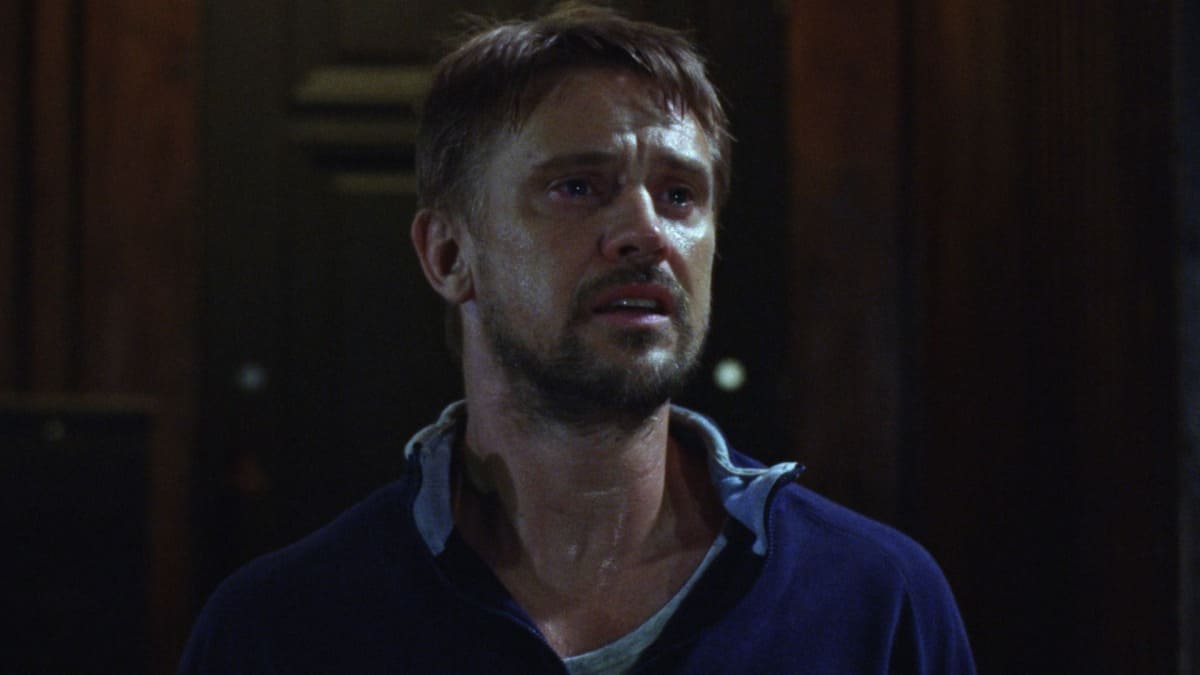
Atonement, Reed Van Dyk’s adaptation of Filkins’ article, is less interested in what the writer exposes about these large-scale pitfalls than it is in presenting a conventional philosophical survey on who, exactly, merits absolution. This most directly applies to Lou D’Alessandro (Boyd Holbrook, embodying real-life vet Lu Lobello), a marine who was discharged as Other Than Honorable when he tested positive for drugs after his tour in Iraq. “When I got back, I couldn’t get the care I needed from the VA,” he says during an enrollment interview for law school. “So a lot of guys will go to the black market to get meds to deal with the physical pain. You’re just trying to get through a day.” But drug use isn’t really his cross to bear; really, it’s the debilitating PTSD episodes that cause him to violently lash out. On a daily basis, he thinks back to his role in the killing of innocent Iraqis as he and his squadron rained bullets onto downtown Baghdad, supposedly firing at enemy forces.
Atonement initially follows the Armenian-Christian Khachaturian family as they scramble to evacuate their relative’s house after a nearby bombing nearly kills them. They pile into three cars and race toward home. As they turn into an intersection, snipers begin shooting without hesitation. Family patriarch James and his two adult sons, Nicola and Edmond, are instantly riddled with bullets; D’Alessandro is one of several pulling the trigger. The women and children, strewn between passenger and back seats, are doused in blood. The onslaught only ceases when matriarch Mariam (Hiam Abbass) strips her wailing grandchild of his red-streaked onesie and uses it as a white flag. The marines immediately rush in to aid the survivors, but there is no saving anyone from the devastating consequences—murderers and mourners alike.
This is where frontline correspondent Michael Reid (Kenneth Branagh, Filkins’ avatar) first begins his reporting. After arriving at a hospital teeming with injured patients and lacking in basic supplies—both owed to the advancing occupation—he sees Miriam’s 23-year-old daughter Nora (Gheed), badly injured from a shoulder-shattering bullet. As she wails in physical and emotional anguish, she is comforted by her mother and sister-in-law (Yara Bakri). Despite their dour state, the women agree to be interviewed by Reid for a New York Times story that details their family members’ deaths. From the hospital, he then seeks comment from the marines involved in the incident. He speaks with D’Alessandro, who is less than remorseful. “Not sure why anyone would drive through that intersection if they didn’t mean us harm,” he scoffs. “They’d have to have some fucking death wish.” (In Filkins’ real article, Lobello is not interviewed.)
For the remainder of the film, Atonement charts D’Alessandro’s attempt, with the aid of Reid, to make contact with Miriam and Nora Khachaturian, who, a decade after the original massacre, he discovers to be living just a few hours away from his home in San Diego. The audience learns about his mental health struggles, feels his intense loneliness, and understands his deep-seated desire to be absolved of his crime. At one point, he meets a colleague (and casual lover) in a hotel room. When he discusses his plan to write “a forgiveness story” about Lou’s eventual meeting with the family, she winces: “Sorry, but it is selfish. This woman and her daughter are supposed to just open up their home, open up their old wounds so he can feel better?”
Only after the meeting is already organized do we see Miriam’s perspective. She lays in bed in the wee morning hours, paralyzed from persistent insomnia. She eats breakfast with Nora, her husband Asaad (Majd Eid), and their two children. Her face is wrought with worry. She then silently cleans the apartment and prepares for the encounter. But Atonement doesn’t really glean a real sense of interiority from her (a shame for a typically strong performer like Abbass). This lack of depth doesn’t feel like a pointed commentary about D’Alessandro or Reid’s absolute interests to cease the self-hatred, to write a popular piece. Indeed, elements of the New Yorker story that highlight the women’s experiences after the attack—how their Christian faith has somewhat coerced them to forgive in spite of their trauma; their latent anxiety that this soldier was returning to kill them—are scrapped from Atonement, leaving these characters hollow.
As is the name of the game for big-screen adaptations of real-world stories, many elements are subject to change: names, quotes, locations. But eliminating the more probing questions in Filkins’ original piece (including the fact that many in Lobello’s regiment ended up committing suicide or murder) makes for a subpar study of the effects of violence, particularly when fervent nationalism requires the complete dehumanization of an “enemy” population. (The ongoing, U.S.-backed genocide in Palestine makes this point all the more relevant.) Even more potent is Filkins’ nagging concern that Lobello didn’t feel genuinely responsible for what happened. But the one thing that Atonement appropriately strikes from the record is Filkins’ saccharine ending, one content with peddling a rote “forgiveness story,” instead ending with a scene of these disparate people collectively searching through the grass for a nondescript object. Only after they all do their part to locate it can they put this interaction in the rearview, perhaps content to live their lives without the burden of securing further closure.
Director: Reed Van Dyk
Writer: Reed Van Dyk
Starring: Boyd Holbrook, Kenneth Branagh, Gheed, Hiam Abbass
Release Date: October 2, 2026


 Keep scrolling for more great stories.