The best strategy games, whether turn-based or real-time, make the player feel the weight of their choices, with defeat or victory tracing back to clear branching points that changed the tide. Did you deal with that Chryssalid cocoon when you had the chance? Did you make the right sacrifice against the Vek? At least based on the demo we played, Australia Did It, an upcoming tactics game from Aesthetician Labs and designer Rami Ismail (of Vlambeer fame), taps into this sense of consequence, giving the player constant decisions as they cultivate a small but elite squad to defend a train from big bugs.
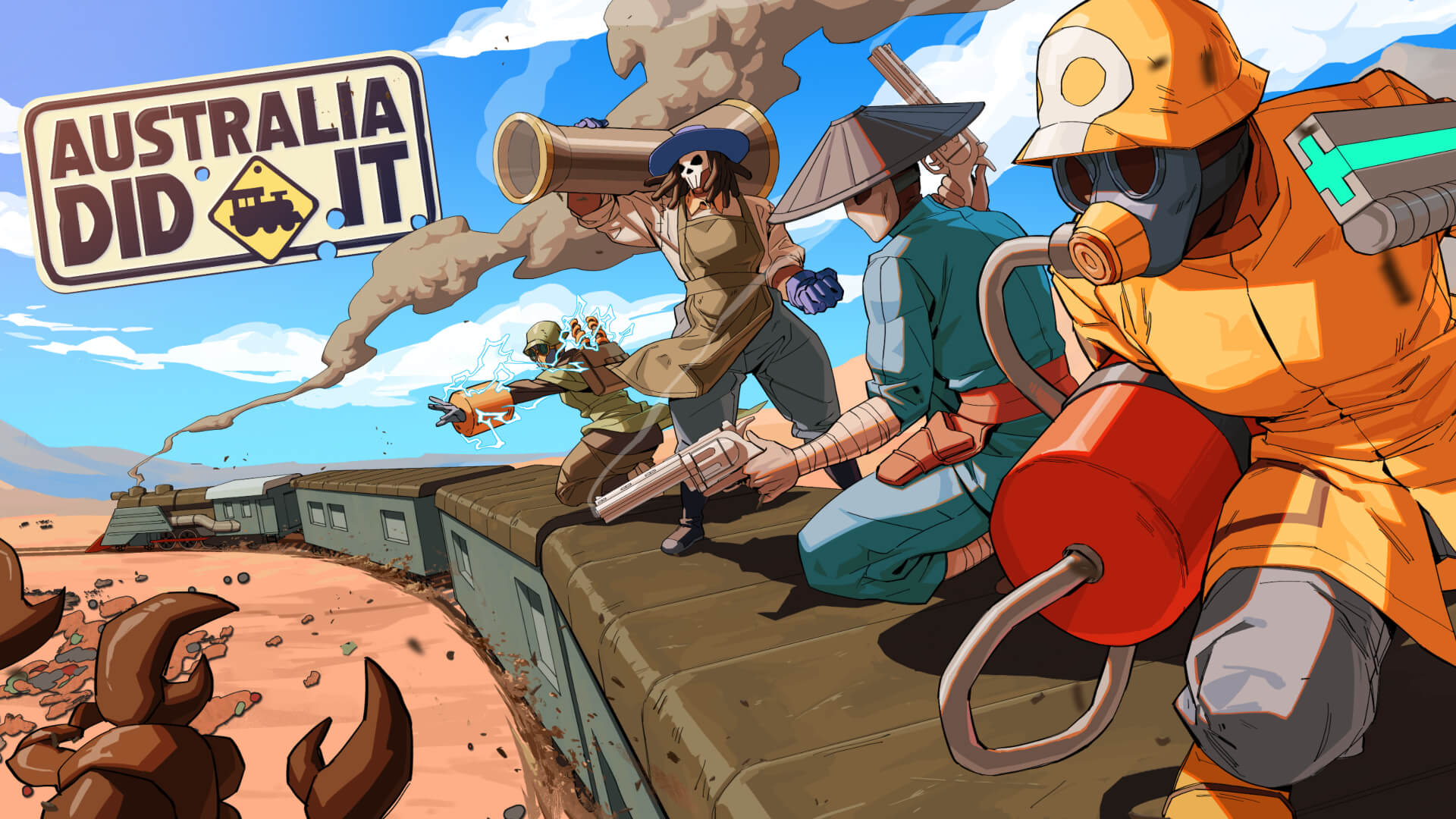
While the term “roguelike” is familiar at this point, the rest of this game’s self-description isn’t. As the tagline says, it delivers “turn-based tower defense meets reverse bullet hell,” which is a mouthful but a good frame of reference. Here, the player has to protect a railbound supply convoy as it travels across a wasteland that used to be the Atlantic Ocean. Unfortunately, there are giant insects, killer robots, and hostile soldiers along the way—you know, video game stuff.
This trek is divided into two modes. The first is the turn-based part, where you maneuver units on a grid while defending a train station. The second stage, the reverse bullet hell component, happens once your locomotive is on the move; in these sections, you loosely control your soldiers in real-time as they fill the screen with bullets, explosives, and blasts of electricity to protect the cargo. If the station is overrun or your train breaks down, it’s game over and back to the beginning.
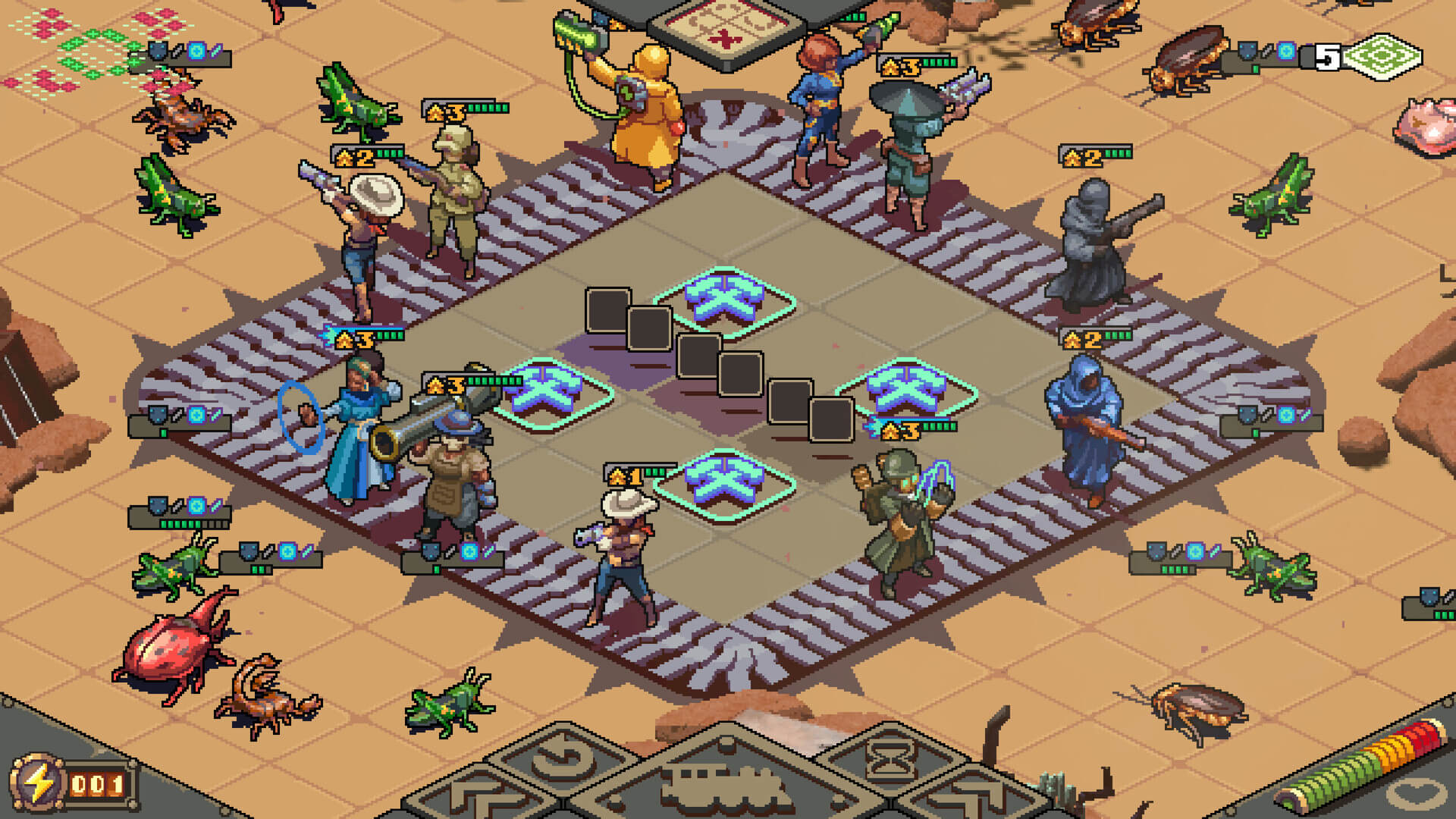
As for the turn-based component, there’s a lot of Into The Breach here, both visually, with sharp isometric pixel art, and in the chess-like elegance of its gameplay. To be specific, mathematical clarity and determinism are central: Enemy actions and spawns are telegraphed in advance, and the game uses small numbers for damage and health points to make it easy to calculate outcomes by hand. It all gives the player the information they need to get through in one piece (theoretically, anyway).
The influence of Into The Breach is very much there, but thankfully for the sake of originality, Australia Did It isn’t beholden to all of its specifics. The biggest difference maker is that you can merge your mercenaries to “Evolve” them, something that will probably kick off some “Gotta Catch ‘Em All” related impulses—there’s even a compendium that keeps track of which guys you’ve created so far. There are three base classes: the Gunslinger, who uses revolvers to deal ranged damage; the Nomad, who pushes back enemies; and the Radshot, a totally-not-Vault-Dweller who fires irradiated blasts that hurt foes over time. An initial fusion between two units will power up the base one with the sacrificed fighter’s abilities. For instance, when a Nomad is merged into a Gunslinger, the Gunslinger’s slugs gain an effect that kicks enemies back a tile.
Your underlings can only be merged if their levels match (which represents the number of times they’ve been combined so far), but where it becomes really interesting is that the odd-numbered merges (level three, five, etc.) will result in entirely new unit types. For instance, a level two Gunslinger combines with a level two Nomad to make a level three Rocketeer, a powerful ally whose projectiles deal splash damage. From these pairings, you can create lightning-wielding shocktroopers, healer telepaths, and guitarists who use oversized amps as weapons; according to the Steam page, there are 1,500+ combinations with unique stats across 30+ unique class types. That’s a lot of dudes, and it’s rewarding to experiment with new strategic possibilities, tapping into a brand of combinatorial tinkering that will strike a chord with those who’ve spent hours huddled over a Game Boy while synthesizing the best creatures in Dragon Quest Monsters.
It’s important to build up a range of units, because each defense mission will throw a quickly scaling lineup of nasty bad guys your way, each with particular weaknesses. After fighting giant cockroaches and locusts, the demo’s first clear power jump came from a bulky, slow-moving beetle that could practically take out the station in a single hit if not dealt with properly. While each home base comes with a handy conveyor belt that lets you quickly rotate units around the battlefield, forward-thinking positioning alone won’t save the day, and scaling up the correct mercs for the job is key. There’s even a compelling dash of risk-reward where you can defend a train station for longer to gain resources that will help improve your squad, at risk of overextending and coming to an early demise. It adds up to one interesting decision after another.
There’s more here, though, and while these tactical skirmishes make up the bulk of a run’s playtime, it seems like things will generally be won or lost in the reverse bullet hell segments, where you train moves from one station to the next while being assaulted by lots of mutated monsters. Ismail described these sequences as a bit of a “skill check,” filtering out if your troops are strong enough to plausibly make a deep run. In practice, these parts are a bit like a moving tower defense section, with your units automatically firing at attackers that approach your train. There is some amount of direct control: You can temporarily concentrate fire on manual targets, switch out the mercs currently on defense duty to deal with particular threats, and use powerful abilities to get out of a tight spot, like an invincible speed boost. However, by design, the player is given dramatically less agency than in the tactics portions.
Although these sections come with the fun of watching your little guys automatically blast through swarms, it seems a bit too likely that a lengthy, time-intensive run will end in seconds during these less interactive portions. Especially compared to the readable tactics sections, these chaotic train segments make it much harder to tell where you’ve made a mistake. The demo wasn’t particularly brutal, but this was likely because it only includes the first section of a full run—it was tough to avoid taking at least a bit of damage, and these dings and scrapes don’t go away once you’ve made it to a station. Basically, the reverse bullet hell sections have the potential to be frustrating because they take away the sense of control and considered decision-making found elsewhere, forcing you to watch as your carefully built-up troops are demolished.
Luckily, the other, more time-consuming part of the experience, the tactics, seems very good—perhaps great, even. The base rules are easy to understand but flexible, and the unit merging gives the kind of room for experimentation that can make a run-based game varied and dynamic. Even if the real-time defense segments are less convincing upfront, there’s a very real chance its logic will click with time, setting up situations where runs full of fatal build mistakes are mercy-killed early on, while the success of deeper attempts relies more on tactical choices. If that all comes together, Australia Did It could be riding the rails to success.


 Keep scrolling for more great stories.