Despite Avatar: The Last Airbender being a deeply beloved animated series that has been around for two decades, it never received a particularly memorable game adaptation, mostly because the show premiered in an era when tie-in video games were Bad (generally speaking). In the mid to late 2000s, Aang appeared in quite a few lukewarm action titles, with one as recent as 2023. As for Korra, she starred in a similarly disappointing outing from PlatinumGames, as well as in a forgotten tactics RPG for the 3DS. However, none of these were given the time or resources to have a real chance, likely envisioned by their publishers as a way to make a quick buck off parents whose kids were still hoping their airbending powers would awaken any day now.
Until recently, Avatar Legends: The Fighting Game threatened to meet an even worse fate than mediocrity: cancellation. It was put on ice by publisher Maximum Games until the newly formed Gameplay Group International (which is staffed by many ex-Maximum Games employees, some of whom worked on Killer Instinct [2013]), swooped in to save it. And it’s a good thing they did because, having played in the game’s Closed Alpha test over the weekend, this bending-based fighting game very much has the juice. It’s such an accurate homage to the series that it won’t be long before it puts you in the shoes of Admiral Zhao, cursing Aang as he hits you with a filthy cross-up before pulling off an alarmingly long air-bending powered combo in the corner.
This is a fast, unique, and seemingly deep installment in the genre made by veterans in the space who know what fighting game community (FGC) sickos want. Whether a more general audience will also be taken by its free-form fisticuffs remains to be seen—this will likely be determined by the strength of its single-player offerings, which haven’t been shown yet—but judged purely on the merits of this alpha, Avatar Legends will likely have genre devotees eager to master all four elements.
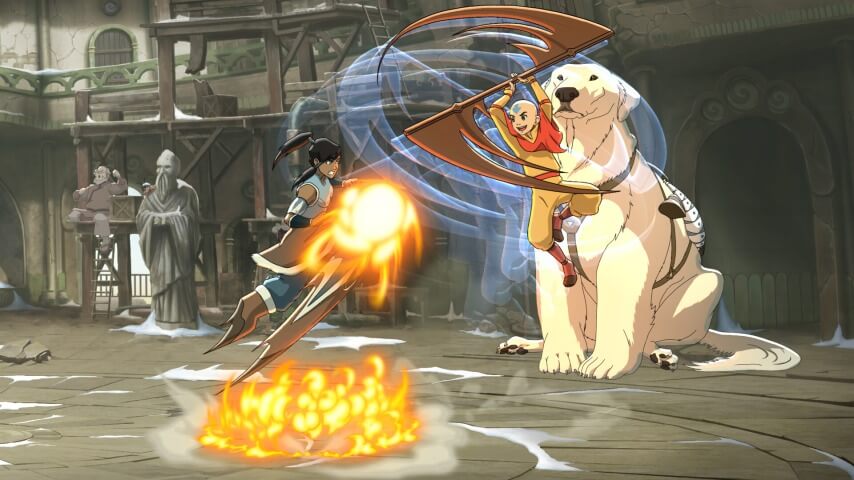
As for where the game fits in the grand scheme of the space, this is a one vs. one fighter (no tagging in allies) that uses a four-button layout (there are buttons for light, medium, and heavy attacks, as well as one for its unique Flow mechanic) and has a heavy emphasis on movement. Special attacks like throwing fireballs or doing a dragon punch-style uppercut are tied to traditional motion inputs, albeit easy ones like half-circles (performing a half-circle motion with a joystick or d-pad) or down-down motions. An auto-combo activates a simple attack sequence when mashing the light button, making things a bit simpler for beginners. Additionally, each character can enter the Flow state to automatically dodge attacks, and when this input is combined with a direction, they’ll perform a variety of bending-based moves that zip them around the stage. Katara bends an ice path that turns her into a speeding otter penguin, Aang uses air scooters and his glider to approach from above, and so on.
While incredibly powerful, overusing these movement abilities can burn through resources and put you in a disadvantaged state where you can’t use a good chunk of your bending. The game’s resource systems work a bit like Street Fighter 6—there’s one meter (this one contains a resource called Chi) tied to Flow actions, as well as another meter (this is represented by a series of orbs called Chakra) tied to damaging super attacks and certain enhanced special moves. Your Chakra increases as you land attacks or trigger special conditions called Critical Strikes (ie, one of Korra’s is to land her uppercut while charging forward, encouraging you to embrace your inner meathead). Meanwhile, your Chi meter begins full and charges automatically as time passes, but if you use it all up, you’ll become “Unbalanced” and unable to use any skills tied to it.
If it wasn’t clear from the previous description of Aang’s airbending acrobatics and so on, you will very much want to avoid becoming Unbalanced because the Avatar Legends’ defining features are the Flow-based movement abilities. Since you can chain multiple of these techniques together in a row, players have already started applying clever means of combining them; there were Zuko players who weaved in and out of Korra’s uppercut range with their many air hops to bait out anti-airs and punish whiffs with a messed-up divekick that led into full combos. A positively evil Aang player stalked online lobbies, unleashing the character’s fittingly zippy air movement to apply tricky high-low mix-ups. Katara practitioners approached with smooth short-hop crossups, and Korra mains love running at their foes in a straight line like a Chipp out of hell. This is a “high-power level” kind of fighting game, meaning each fighter is capable of doing diabolical things to their opponent with enough training.
These bending-based mobility options give the game a massive skill ceiling that calls to mind the movement techniques in platform fighting games like Super Smash Bros. Melee (but much easier to pull off). And since each character has entirely different means of using bending to navigate the stage, the cast play quite distinctly—while plenty of fighting games have a few combatants that “break the rules” of movement with options that differ from the rest of the cast, like double jumps or air dashes, here it feels like there are barely any rules at all. Adding to the complexity is the fact that each character can pick a supporter out of three options—like everyone’s favorite sky bison, Appa, for Aang—which can bolster their aerial speed, improve projectiles, or grant other passive boons.
As these homage support characters would suggest, a great deal of attention was put into not just making this a fun fighting game, but a fun Avatar-related one specifically. Move sets reference techniques and fighting styles from the show, like how Katara does her behind-the-back freezing move for her throw, and the frothing-at-the-mouth guy from Kiyoshi’s village makes a cameo during a win screen. The characters’ playstyles are generally quite accurate, too; Aang is elusive and speedy, while Korra runs at you like a charging freight train. Bending has been featured in plenty of the previously mentioned tie-in games, but it’s never felt so freeform and expressive, as if you’re selecting from a wide toolbox of iconic moves to custom craft an action scene with your opponent.
That said, even with these nuances, it was fairly easy to pick up and play each member of the cast because Legends doesn’t require high-level execution to get in and start hucking fireballs. All characters can perform basic combos by performing light, medium, and heavy attacks in sequence, and the standard routes are simple and short, with only corner combos truly breaking fingers. Basically, there’s a low skill floor to get in and start bending, but plenty of complexity for those who want it. It is quite fitting that this martial arts show, which features so much training to master challenging techniques, would receive a game that encourages the same kind of dedication, even if the only thing on the line is a match against your arch nemesis, OzaiFan4Lyfe, and not an actual bout with the Fire Lord.
While there were some minor issues worth quibbling over, like how the idle animations could use a bit more pizzazz to fully sell the otherwise well-rendered 2D art style, or how it would be nice if there were some slightly better options to knock foes out of the sky in addition to Korra’s uppercut, things ran surprisingly smoothly for an alpha; most online matches played out without any hiccups (provided the other player wasn’t on airplane wi-fi or located on the opposite side of the planet). There’s apparently even going to be cross-play between PC and consoles, which is pivotal for a potentially smaller fighting game like this.
Admittedly, there are still many unknowns here, like whether the other eight characters will feel this distinct, how the single-player material will land, or, perhaps most importantly, what kind of audience it will attract. While the game is very much geared at capturing the attention of both newcomers, with its cast of beloved characters and a relatively straightforward control scheme, as well as hardcore freakazoids, with its complex movement options, actually getting both parties interested is a tall order that only a handful of titles have successfully pulled off. Will some of these more casual players stick around to become bending experts, or will they disappear as quickly as a one-off side-character? Hopefully, they do stick around, because if Avatar Legends: The Fighting Game can find an audience when it comes out next summer, it has the potential to live up to this seminal series; that’s no small feat indeed.


 Keep scrolling for more great stories.