Crosstalk: Can Marathon survive where so many other live-service games failed?

Bungie's new on-line shooter splashes down into an incredibly turbulent market for this kind of game.

Crosstalk: Can Marathon survive where so many other live-service games failed?

Welcome to Crosstalk, wherein A.V. Club staffers discuss their varied (or unvaried, as the case may be) perspectives on a pop-culture topic. This time, Garrett Martin and Elijah Gonzalez log into the first big online shooter of 2026 that hasn’t already been shut down, Bungie’s Marathon. Has the Halo and Destiny studio hit the trifecta of sci-fi shooters, or will this reboot of Bungie’s ’90s series disappear like so many other live-service shooters?

Garrett Martin: Here comes Bungie, stomping straight into one of the most exhausting debates in games today. Marathon is the latest big budget live-service online shooter, launching a week before the last “latest live-service online shooter,” Wildlight Entertainment’s Highguard, shuts down for good after less than two months. Countless YouTubers and shit-posters seem desperate to make any new shooter like this into an immediate failure, crowning almost as many “next Concords” as rock critics have “next Dylans.” If anybody can still make this work in 2026, though, you’d think it’d be Bungie—the studio that gave us the live-service success Destiny and a little game called Halo. One obvious step it’s taken to prevent a catastrophe is that Marathon isn’t free to play; you’ve got to drop $40 to get in the door. There’s a lot to talk about with Marathon—its striking (and apparently controversial) aesthetic, if a multi-million dollar game released by Sony can criticize capitalism in a way that doesn’t ring hollow, how it pulls off its attempt to make an “extraction shooter” for a more “casual” audience—but we might as well start with the biggest cloud in Marathon’s sky. Is there room for another successful live-service shooter, or is the market fully saturated? And if there is, do you think Marathon has what it takes?

Elijah Gonzalez: I think that there will pretty much always be space for multiplayer shooters that do something new. Or to be more specific, games that sort of do something new, like how Fortnite added digital LEGOs into the mix but still let you shoot guys in the head with your friends. Sometimes a fresh(ish) take can pull people away from their current game and encourage them to pick up a different one that also blasts their brain with dark patterns (more on that later). Will Marathon do that? I think the answer is yes, but maybe not enough to appease Bungie’s overlords at Sony. The weird thing about this game is that while people assumed it’d be a less hardcore extraction shooter (like Arc Raiders), because that’s probably what makes more “financial sense,” they still made something for little freaks. Ammo runs out quickly, there are killer space government robots everywhere, and at least with the shitty starting loadout, your character is less Master Chief and more like one of those UNSC grunts who get blown away by the dozens.

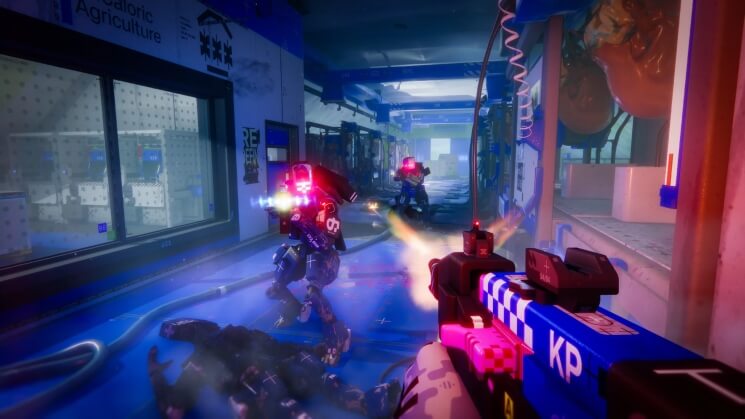
As for the game’s niche compared to its competition, it’s really Bungie’s buttery smooth gunslinging. There’s a nerdy technical reason that partially explains why it feels better than most other extraction shooters ([pushes up glasses] if you’re curious, its servers run at 60hz), but the gist is that it really seems geared around fighting it out with other players, which tends to be the most unforgiving part of these games. The other big differentiator is that Marathon really cares about creating a sleek sci-fi space through its architecture and talky segments featuring cyberpunk nightmare corporations, cartoon anarchists, and religion-fueled murder maniacs. What are your thoughts on the game’s world and look so far? 

Garrett Martin: Before I get to your question: You mention the smooth shooting. That [along with the ample presence of easily beaten bots] is why somebody who’s as bad at shooters as I am can still have fun and feel like I’m accomplishing something before my inevitable death [or, when I’m lucky, my last-second extraction after crawling to the exfil point before bleeding out]. Marathon is not an easy by any means, especially if you’re playing solo (as I tend to) or with a bad squad (which I tend to turn them into whenever I join one [sorry, anybody who’s played with me]), but it does find ways to give even total incompetents like me a semblance of success. 

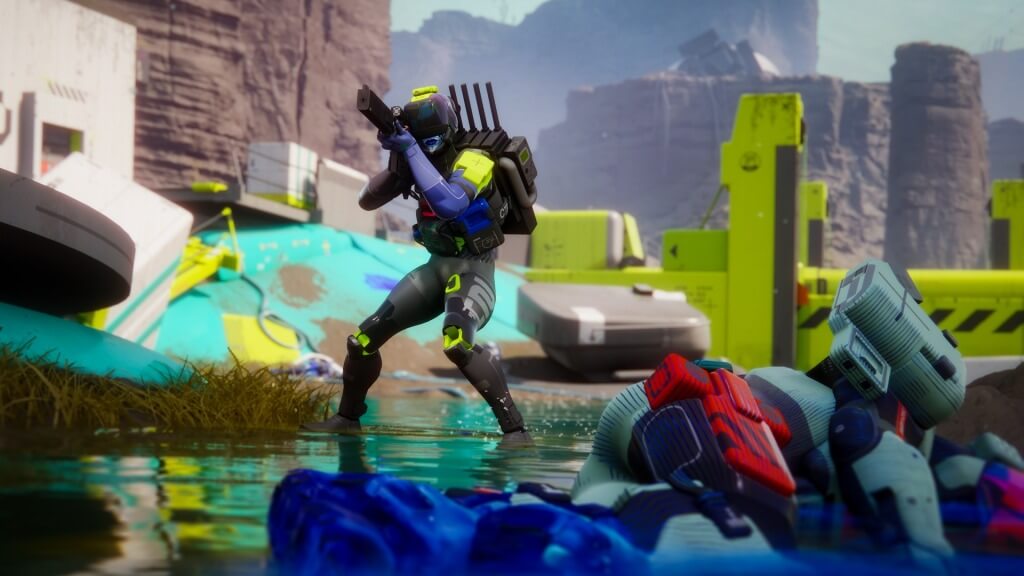
Okay. When’s the last time a shooter looked as distinctive, as great as this one—and also tied its visual design tightly to its larger themes? I’m not talking about the blades of grass or how realistic the water looks, but the general aesthetic—the eye-blindingly bright colors, how most (perhaps all?) of the in-game text is diegetic, the almost prohibitively convoluted way the interface mimics user-unfriendly office software… Even if it did play exactly like other popular shooters, Marathon would immediately stand out compared to the sci-fi sleekness of Destiny, the cartoonishness of Fortnite, or the gray-brown sludge of… pretty much every other shooter, right? I’m not sure if it was an intentional choice to make a game that’s not especially “intuitive” (a word we game writers have murdered through overuse) but the complicated menus, indifference to providing clear direction, and overall information overload capture the corporate onboarding process better than any other game I’ve ever played about shooting people. The neon shock of it all jibes with the broader cyberpunk thing it’s going for, but otherwise it avoids the most obvious cliches from that genre, which is greatly appreciated; since Blade Runner people too often get hung up on how cyberpunk is supposed to look and not what it’s trying to say. Marathon doesn’t make that mistake.   

Although it might be subtle in how it displays information, its commentary isn’t really subtle at all. What do you make of the game’s “critique” of corporations—is there anything to it, does it just feel like pandering, and is it even possible for a game like this, made by companies like Bungie and Sony, to criticize capitalism in any meaningful way?

Marathon Bungie

Elijah Gonzalez: As for how the anti-corporate commentary lands, it has a pretty sharp angle for a dystopian hell future: What if your mind and memories were proprietary information on a company server? Like you mentioned, one of the mega-conglomerates jockeying for position on this dead colony literally owns the operating system that manages the Runner’s consciousness. Because of that, every bit of information given to us by the talking-head tutorial character, Oni, is biased. The game doesn’t draw attention to this upfront, and while it becomes less subtle as other avatars for the competing interest groups barge in with their over-the-top (and very good) propagandistic cinematics, this situation sucks in an all-encompassing way: Your soul is trapped in the vacuum of space, and the only groups you can interact with are self-serving corpos and other Runners who’ve been mostly turned against each other to serve these special interests. That’s a pretty solid metaphor. If I’ve got a nitpick, it’s that the one anti-corporate faction are these strawman anarchists that feel like a corporate stooges’ depiction of resistance. The first mission you take from them literally involves smashing a bunch of windows, which is like Rupert Murdoch’s version of what “Antifa” is up to.

As for whether games bankrolled by real-world megacorps can meaningfully criticize capitalism, that probably warrants its own full discussion, but I’m of two minds. If the Disneys and Apples of the world aren’t afraid of financing these things, then it’s because they think having more anti-corporate concepts out there doesn’t hurt them. In some ways, that’s true, because watching a TV show or playing a game isn’t activism. At the same time, though, ideas do matter, and you have to learn from somewhere, even if it’s a sci-fi video game about blasting robots with a high-powered assault rifle. The developers writing Marathon aren’t the same people at Sony who are financing these projects, and maybe they’re trying to get some neat concepts across while in the belly of the beast.

There is a problem, though. You don’t have to look outside the work to find a hard-to-ignore contradiction: Despite the anti-capitalist overtones, this game has scummy microtransactions. While the worst of it has been patched out (due to backlash), when the game launched, it did a classic dirtbag live-service tactic where the amount of in-game currency you get for 10 bucks was just under how much it cost to buy a skin, so you’d have to spend an extra $5 (the cheapest option) if you wanted one. Also, the paid battle pass (which is $10) is one of the worst I’ve seen in a live-service game, with only one character skin, no in-game currency, and single-use stickers/charms. For context, in other games, battle passes usually have like four to six skins and let you earn in-game currency, making it so you can eventually get a premium pass without having to pay. Again, I get that the people pushing for these kinds of monetization choices probably aren’t the same ones writing the game, but it becomes much harder to ignore these kinds of inconsistencies when they’re sitting there together on the main menu. Everything else about Marathon has grown on me, but the in-game store has that live-service funk to it.

I’m curious though, I’ve heard tales about people who have a supernatural ability to ignore cosmetics in live-service games (thankfully, there isn’t much “pay-to-win” going on here; the things you buy are mostly visual). Do you care at all about skins, or do you mostly ignore that junk? And do you have any other closing thoughts about the game we didn’t get to?

Garrett Martin: I have never bought a skin in my life. Never paid a cent for “cosmetics.” I get why people are into customizing and personalizing things, and I understand wanting your character to look cool, especially in a game where it’ll be seen by other real-life players, but paying actual money for it is one of many things I don’t understand about games today. One thing I appreciated about Highguard is that its microtransactions were exclusively cosmetic, and that game was actually free to play; if Marathon ever gates functional content behind a paywall, despite charging $40 for the base game, that’d definitely sour me on it. That doesn’t seem to be the case, at least not at the moment, and hopefully they resist that urge.

This is getting long, but before we split, are you playing this in squads or solo? I’ve stuck largely to solo runs (I don’t want to rely on others almost as much as I don’t want others to have to rely on me), and it has such a material impact on how the game feels. Many have noted that soloing Marathon is closer to something like Alien Isolation than a shooter—that the best play whenever you encounter anybody, even bots, is to run like hell instead of engaging. I won’t lie—I haven’t made as much progress through solo runs as I would like, as the contract requirements get pretty tough pretty quickly—but I genuinely prefer the dread that any interaction brings in a solo run to the pressure and anxiety of playing with a team. Where do you fall on that? And how do you want to wrap this chat up?

Elijah Gonzalez: I’ve mostly been playing alone, and like you said, at that point it basically becomes a horror game: You’re about as likely to “win” a solo run as the Nostromo crew was at besting the xenomorph. But after hours of solo runs, I finally roped in a friend. It’s been fun! Grouping up is a big shift, mostly because there is an intimidating amount to learn, but the game really rewards everything you put in. The maps are complicated, with all these alcoves and air ducts that give different approach angles, and knowing when to pop your characters’ ability can decide if a firefight goes your way or not (shout out to my man, the Assassin, and his probably-overtuned invisibility powers).

Where I think the game has really kept me coming back is how both modes—playing solo or squadding up—have shades of the other. It makes for a weird hodgepodge, this narrative-focused competitive horror shooter thing. I’m into each of those component parts independently, but they really shouldn’t work together. Somehow they do, and I’m dangerously at risk of putting this in my unsustainable live-service rotation. Marathon might have what it takes to stick around for the long run.

 
Join the discussion...
Keep scrolling for more great stories.