A-

Paul Thomas Anderson makes you feel like you were there with Cameron Winter At Carnegie Hall

The filmmaker gives you a mesmerizing front-row seat to the Geese frontman's solo show.

Paul Thomas Anderson makes you feel like you were there with Cameron Winter At Carnegie Hall

If you’re on the fence about a musician everyone else loves, the best thing you can do for yourself is to see them in concert. There’s no guarantee that the live show will change your mind, but it does ensure that you’ll experience the artist in the most ideal setting, fully immersed in the music and surrounded by an adoring audience in tune with every word. Even if you remain unconvinced, perhaps at last you’ll understand the appeal. And who knows: Maybe begrudging respect might transform into admiration over the course of one magical night. 

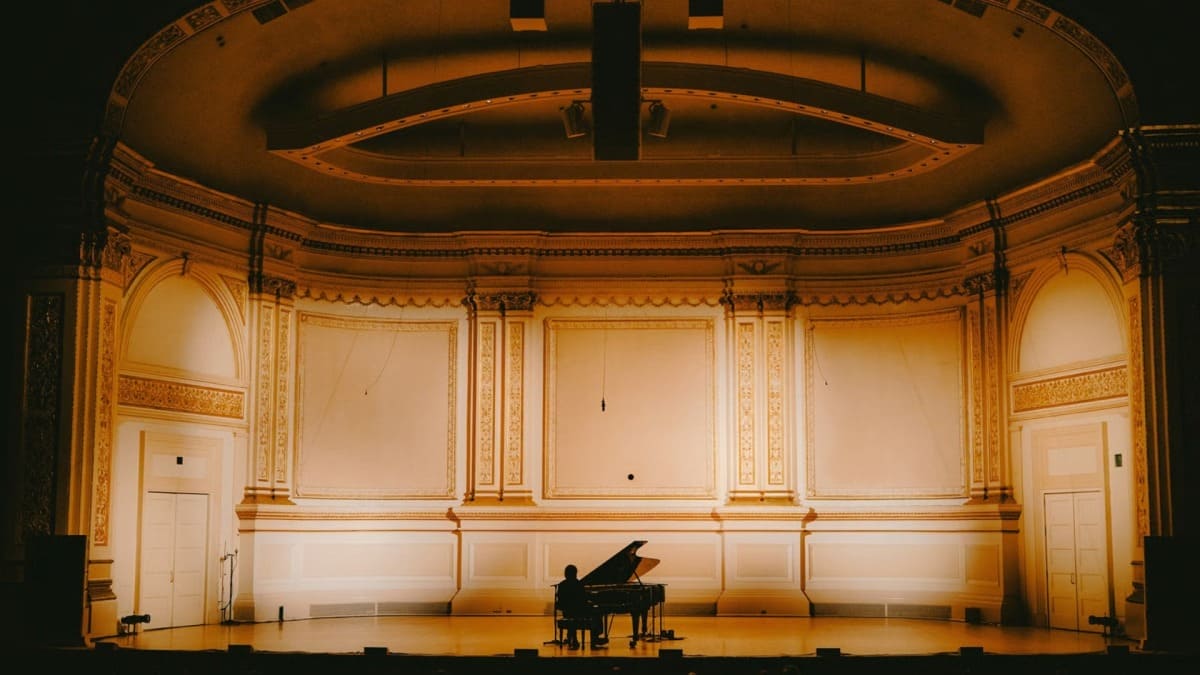
Plenty of people will be excited about Cameron Winter At Carnegie Hall, the concert film from the frontman for Geese, one of American indie rock’s most celebrated rising bands. But even skeptics—including those of us who consider Winter’s voice an unwieldy mixture of eccentric and distracting—may find themselves transfixed by a movie that offers a riveting new perspective on a songwriter who knows how to command a stage, despite the fact that, for most of Carnegie Hall, he’s playing a piano with his back to the crowd. Geese naysayers who have long resisted the hype might be tempted to credit the film’s greatness to Paul Thomas Anderson, who directed Carnegie Hall in the midst of Oscar campaigning for One Battle After Another. But even so, Anderson’s principal achievement is recognizing how to turn an intimate show into something unexpectedly transcendent. That means putting the focus on Winter’s exceptional talent.

The film captures Winter’s December 11, 2025 performance at the fabled New York venue, and Anderson wastes little time getting on with the show. A smattering of shots of fans excitedly entering Carnegie Hall start the movie, and soon Winter is walking toward his Steinway & Sons as the lights dim. The bulk of Cameron Winter At Carnegie Hall‘s songs are taken from his 2024 solo album Heavy Metal, where the tunes were stripped down, accented by acoustic guitars, spare drums, keyboards, and a little bit of French horn. But on this tour, Winter emphasized the “solo” in “solo album”—it’s just him and a piano. 

The desired effect is familiar to anyone who has been alive since MTV’s Unplugged series popularized the notion of the world’s biggest artists paring back their instrumentation in order to showcase their “true” artistry. Sure, the trend quickly became a gimmick, but with Carnegie Hall, Winter doesn’t simply bury the Heavy Metal versions but cements the case that Geese diehards have been making for a while about his wizardly stage presence. Rarely interacting with the audience, quietly and quickly moving from song to song, he embodies the compositions’ pain, vulnerability, and mystery so completely that, like Anderson’s camera, you can’t take your eyes off of him. Staring into the middle distance, intoning the lyrics with stunning intensity, Winter barely moves, and yet the performance is volcanic.

Anderson is no newbie to music movies. Whether shooting videos for Haim and Radiohead, masterminding Thom Yorke’s short film Anima, or directing the 2015 documentary Junun, he approaches the job with an appealing modesty, allowing the musicians to shine. In this way, he pays homage to one of his heroes, Jonathan Demme, whose Stop Making Sense set the standard for how to convey the electricity and immediacy of live performance. 

Filming in 35mm, Anderson takes on a daunting task considering that, unlike most concert movies that feature full bands, Winter’s setup doesn’t allow for dynamic cutaways or myriad visual treats. Much of Carnegie Hall consists of shots of Winter singing and tickling the keys, and it’s to Anderson’s credit that he resists cutting around a lot to create an artificial sense of energy. As was true with Demme, he understands the power of a sustained take, his camera holding on an arresting moment so that we observe Winter giving himself over to the material, falling into a trance with his eyes open. 

The lack of jittery edits also allows us to concentrate on the lyrics, which add to the spell. From the relatively jaunty “Love Takes Miles” to the wistful “Cancer Of The Skull,” the words express just enough to push across the tracks’ themes, but concreteness remains bewitchingly out of reach. “I came up here to sleep in your infamous kitchen” is but one of many lines that, like Anderson’s camera on occasion, slips out of focus, then suddenly snaps back into dazzling sharpness.

But Carnegie Hall‘s unfussy elegance most accentuates Winter’s operatic voice. With Geese and on his solo work, it can come across as needlessly showy—nothing more than a self-indulgent mannerism undercutting his material’s sincerity. But such quibbles vanish as Winter abandons the flourishes for something far more galvanizing and emotional. Drawing comparisons to Rufus Wainwright’s soaring tenor—albeit with extra bite—or a young Bob Dylan pouring his heart out through his larynx, Winter simply opens his mouth and a flood of longing crashes through the screen. Anderson infrequently incorporates moving cameras to give Carnegie Hall a bit of propulsion, but more often he knows that Winter is all he needs. Now 24, not a quicksilver prodigy nor a tortured genius, he is both revealed and still fascinatingly opaque.

Running only 75 minutes, Carnegie Hall overwhelms you then fades away. But fragments remain. The way the mournful “$0” lightly mirrors the melody of “Christmas Time Is Here.” The incredible shot Anderson snags of Winter’s silhouette projected high on the wall, an instant bit of mythmaking you just want to stare at forever. There’s an accompanying album, Live At Carnegie Hall, which came out last month. You may be surprised to discover that the record doesn’t quite replicate the experience of the movie, and it’s not just the immense pleasure of seeing Winter articulate these songs on stage that’s missing. It’s the cozy, bewitching atmosphere Anderson conjures up out of thin air. With live records, the standard complaint is that, really, you had to be there to understand what made the show so special. With Cameron Winter At Carnegie Hall, you feel like you were.

Director: Paul Thomas Anderson
Release Date: November 20, 2026 

 
Join the discussion...
Keep scrolling for more great stories.