
Johnny Depp's comeback doesn't solve his key problem: His acting
The actor’s resurgence isn’t just a case of un-cancellation, but rather a refusal to admit that audiences grew weary of his shtick.
Photo: Paramount Pictures
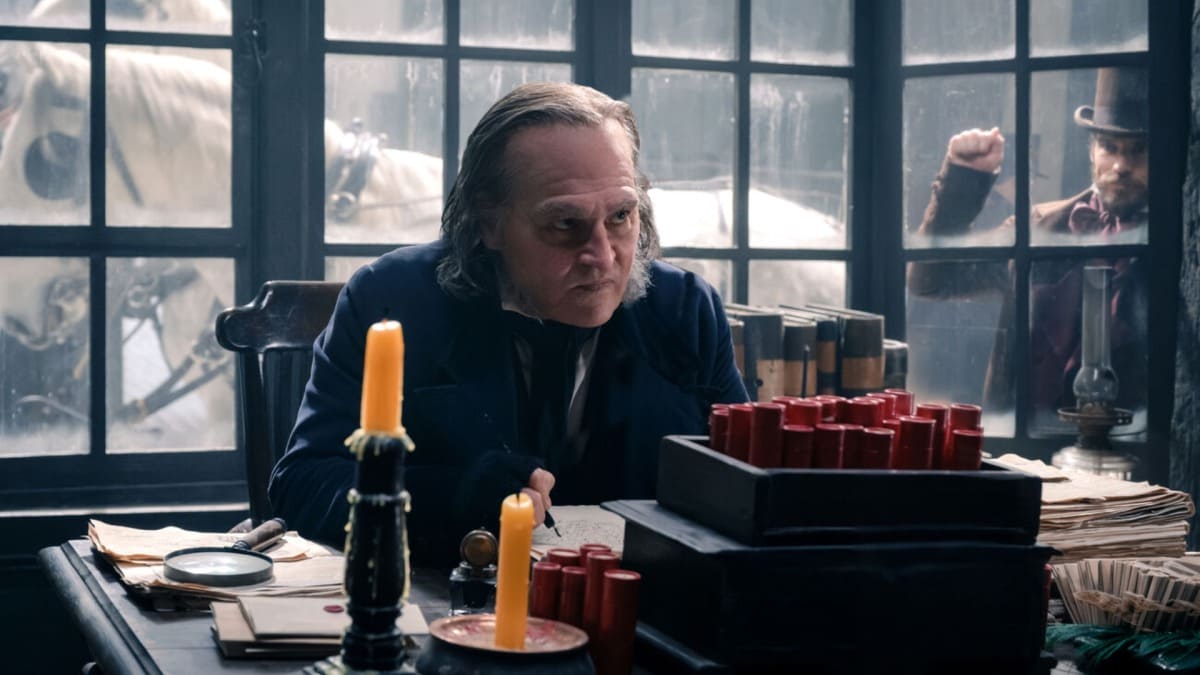
You can almost see Johnny Depp salivating at the concept of a huge comeback with Ebenezer. There’s an easy narrative for Depp and his fans that goes like this: One of the biggest movie stars in the world was unfairly canceled following abuse allegations from his ex-wife, Amber Heard. He sued her in the U.S., won damages, and now that his good name has been restored (as long as you ignore how the U.K. ruled when Depp pursued legal action), he’s ready to return as the beloved “Master Of Mischief” cited in the trailer for Ebenezer, which notes his past roles as Jack Sparrow, Edward Scissorhands, and The Mad Hatter. Before you know it, he’ll be back to opening billion-dollar movies.
But to reach this conclusion, you have to assume that Depp’s popularity never died off, and was merely interrupted by an out-of-control and utterly unfair #MeToo movement (again, you’d have to ignore any other allegations of violent behavior). All of this breezes past Depp’s dismal 2010s, where—despite previously reaching superstardom thanks to the success of the Pirates Of The Caribbean movies and Tim Burton’s adaptation of Alice In Wonderland—he had become box-office poison. If the 2000s were the zenith of a career that felt like it had finally come to fruition by embracing the kind of weirdos Depp knew how to play, the 2010s were about coming back down to earth, unable to satisfy audiences who felt like they had seen everything the actor had to offer.
The drop-off began around 2012. While his stardom was able to pump a fourth Pirates movie past the $1 billion mark and he was able to give a fun voice performance in 2011’s Rango, reteaming with Tim Burton for Dark Shadows was not the summer hit Warner Bros. was hoping for. The adaptation of a cult 1960s gothic soap opera limped to a modest $245 million worldwide gross off a pricey $150 million budget. An even bigger flop arrived the following year with The Lone Ranger, a misguided attempt to recapture the magic between Depp and original Pirates director Gore Verbinski. The film was plagued with production problems, while audiences weren’t thrilled at seeing “pretendian” Depp play Tonto. He also wears a dead crow as a hat.
The 2010s kept repeating a similar story: Depp could no longer connect with audiences. If he tried playing a normal guy, like Will Caster in Transcendence, it was deathly dull, with Depp doing little more than sitting in front of a black screen to show that he was now an AI singularity. More often, he attempted endless affectations; the outlier during this era was when Depp played for awards by “disappearing” into the role of Whitey Bulger in Black Mass. If audiences were still with Depp, then they would have shown up for the shenanigans of Mortdecai, or at least turned out to see him reprise the role of Mad Hatter in Alice Through The Looking Glass. But the Alice sequel grossed less than a third of what the original made.
 Keep scrolling for more great stories.