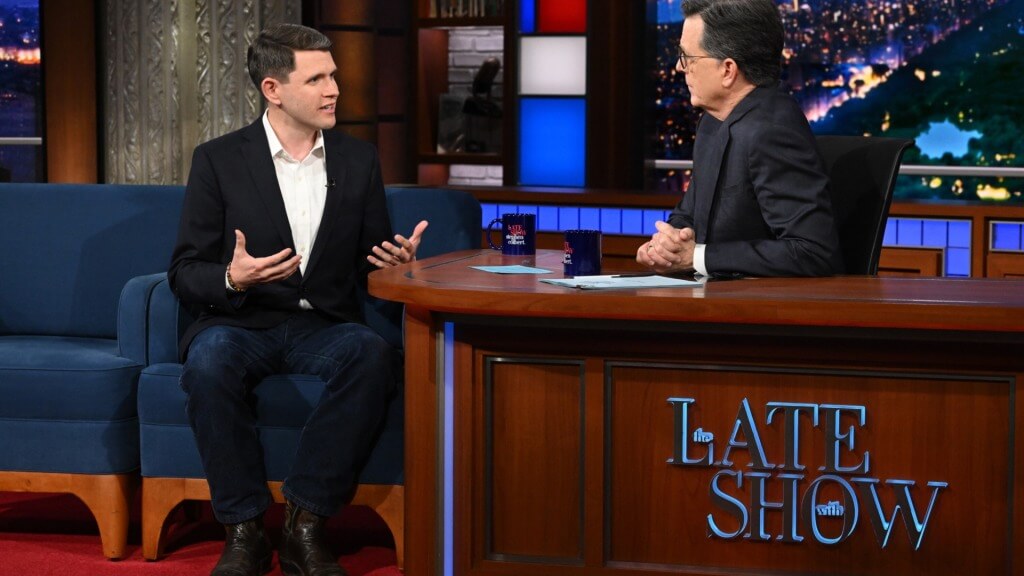
The gulf between Stephen Colbert and CBS continued to widen last night, as Colbert claimed on The Late Show that the network’s lawyers told him he could not broadcast an interview with Texas State Rep. James Talarico because of the FCC’s equal-time rule, which typically exempts talk shows. “I was told, in some uncertain terms, that not only could I not have him on, I couldn’t mention me not having him on,” Colbert said. In a statement, the network denies the allegations, saying it was merely offering Colbert some helpful legal advice.
“The Late Show was not prohibited by CBS from broadcasting the interview with Rep. James Talarico,” a statement from CBS said. “The show was provided legal guidance that the broadcast could trigger the FCC equal-time rule for two other candidates, including Rep. Jasmine Crockett, and presented options for how the equal time for other candidates could be fulfilled. The Late Show decided to present the interview through its YouTube channel with on-air promotion on the broadcast rather than potentially providing the equal-time options.”
Talk shows have been exempt from the FCC’s equal time rule since 2006, when Jay Leno hosted California Governor Arnold Schwarzenegger on The Tonight Show. That seemingly came to an end in January, when FCC Chair Brendan Carr reiterated his commitment to going after talk shows that criticize Trump because there aren’t enough cranks on TV ranting about vaccines, trans people, and immigration. At the time, Carr said lawmakers “were worried that TV programmers would broadly take advantage of trying to claim they were bona fide news when they weren’t. But if you’re fake news, you’re not going to qualify for the bona fide news exemption.” Carr has not yet officially invalidated the exception. Still, nevertheless, Colbert claims CBS is “unilaterally enforcing it as if he had.”
The only Democratic FCC commissioner, Anna Gomez, agreed, calling it “another troubling example of corporate capitulation in the face of this Administration’s broader campaign to censor and control speech.”
“The FCC has no lawful authority to pressure broadcasters for political purposes or to create a climate that chills free expression,” Gomez continued in a statement. “CBS is fully protected under the First Amendment to determine what interviews it airs, which makes its decision to yield to political pressure all the more disappointing.”
Paramount Skydance has torpedoed its credibility in recent months, first by publicly firing Colbert and then by hiring every billionaire’s favorite blogger, Bari Weiss, as the head of CBS News, while also paying Trump $16 million to settle a weak lawsuit against 60 Minutes amid the Paramount-Skydance merger. The FCC has also tanked its authority as an unbiased institution in the last year, with Carr attempting to silence television’s loudest Trump critics by using the various mechanisms at his disposal, including strong-arming local carriers who need FCC approval for another monopolistic merger. We expect these types of flame-ups to continue until Colbert is booted from the airwaves this May.


 Keep scrolling for more great stories.