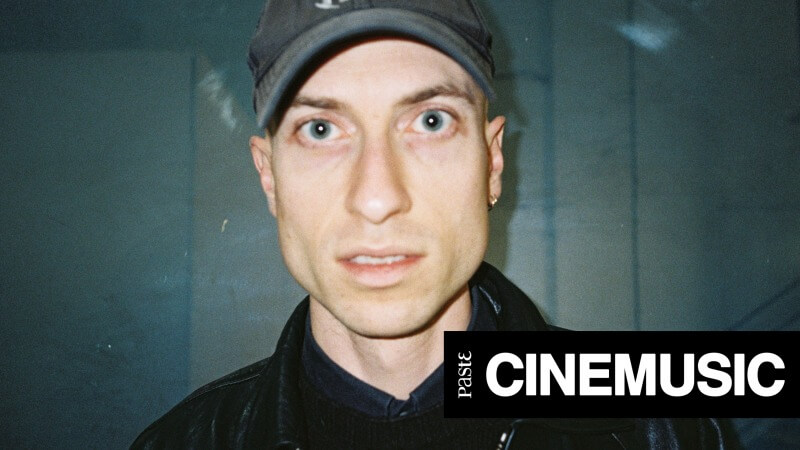
Sam Rosenberg’s monthly columnCineMusichighlights newly released film scores and soundtracks and the composers/curators behind them. In this first installment, Sam speaks with Daniel Blumberg about his rousing score for Mona Fastvold’s historical/musical drama The Testament of Ann Lee.
It’s been a few weeks since I saw Mona Fastvold’s The Testament of Ann Lee for the second time and I still haven’t gotten its score and soundtrack out of my head. Arriving in theaters this week, the film is an expressionistic biopic about the titular leader of the Shakers, a 19th century religious movement whose form of worship consisted of rhythmic, ecstatic dancing. Daniel Blumberg, who got started in bands like Cajun Dance Party and Yuck before winning the Academy Award for Best Original Score earlier this year for The Brutalist, composed the music for Ann Lee while also adapting a few Shaker spirituals and writing and performing an original song, “Clothed by the Sun,” with star Amanda Seyfried. Additionally, he makes a brief cameo in the film as a deacon to a fear-mongering preacher-turned-Shaker convert played by Tim Blake Nelson.
Similar to his thrilling work on The Brutalist, Blumberg’s score for The Testament of Ann Lee is visceral and rousing, filled with ominous piano plinks, riveting string arrangements, and even some electric guitar shreds. Its rich, stirring instrumentation also embodies the ambition and disillusionment of its protagonist, who, like Laszlo Tøth, sought to exorcise their trauma through a creative endeavor amid an intense cultural turning point. But unlike The Brutalist, Ann Lee is an all-out musical drama, with its characters often breaking out into rapturous song and choreography in the hopes of getting closer to a higher spiritual power that could liberate them from their pain.
Over Zoom, Blumberg discussed more about his recording and research process, working extensively on set, and using handbells to support one the film’s most climactic scenes. This interview has been edited for clarity.
*****
Paste Magazine: Just to start off, congratulations on the film. I’ve seen it twice now and I really enjoyed it, especially the music. I’m curious to know what the research process was that went into adapting the music from the Shaker movement. Were there specific songs that you found that you felt fit the story, or did Mona and Brady [Corbet] note them in the script and ask you to adapt them?
Daniel Blumberg: There were placeholders in the script for when they wanted songs to happen, but we approached it quite openly. Mona said it’s possible for it to be all original songs—whatever feels right—so we just met up in New York as soon as The Brutalist was done to start putting this together, meeting up every day and going through thousands of hymns and spirituals. Our starting point was just looking at those. They’re really informal melodies that you can access quite easily. We just started looking at words. Some of the songs just have syllables as the lyrics, so “va vi vam.” I was just immersing myself in the history of the Shaker music and then we started experimenting.
There were some bits that sounded relevant to moments in the narrative. The reason why Mona asked me to score her last film [The World to Come], which was my first film score, was because she had listened to all my song records. I’m a songwriter and I make song records, so she was very encouraging for me to approach it like that. I was just finding the balance between doing something that felt really within [the Shaker] tradition, but also knowing that you’re not making a documentary. You’re making a fable about Ann Lee, so it was just drawing on the traditions. They didn’t have instruments and we decided to use more instruments as we went on. A lot of it’s based around this idea that there was this documentation of them being quite free at the beginning with their songs and singing. I relayed that to these improvising singers that I go and see in London, particularly Bill Minton and Maggie Nichols.
You’ve worked with both Mona and Brady before. Are your collaborations with each of them different or is there overlap in how they work with you, especially since they already work so close together as creative and romantic partners?
They’re very different people, so they’re definitely different to work with. Obviously, it’s within the family, but I have slightly different ways of working with both of them. It both comes from the same place, which is trust and the fact that we both think we can make something good together and that we’ll push each other. It’s quite a simple thing, but it’s quite actually a big starting point for a collaboration because, essentially, I’m helping Mona or Brady make their piece of work. I love films more than I love film scores. I never really listened to film scores. I got into film through directors, so I love working with directors. I wanna see this script become a film and it feels like an honor to be part of the process.
Before working on the score, were you familiar with Ann Lee and her teachings? If not, did you try to insulate yourself from knowing more about her so you wouldn’t feel too influenced? Or did you find it more beneficial to absorb who she was in order to have a stronger grasp on how to compose the score?
I just immersed myself as much as possible in the Shakers. For example, I pored over all of the books about their music and also lots of their drawings. They did beautiful drawings. I really love those. I do drawings as well. I really like some of their books that I found on their furniture. You never really know what the way in will be for the film, but I didn’t prescribe a “I don’t wanna know too much about them” or anything like that, because there was just a lot of work to do. I was doing it with Mona as well, so we went to the Hancock settlement and I was talking to the music people there. Seeing their construction firsthand, you get a feeling just from being around there that you are literally in the same place where Ann Lee was. You get different ingredients to harness your instincts.
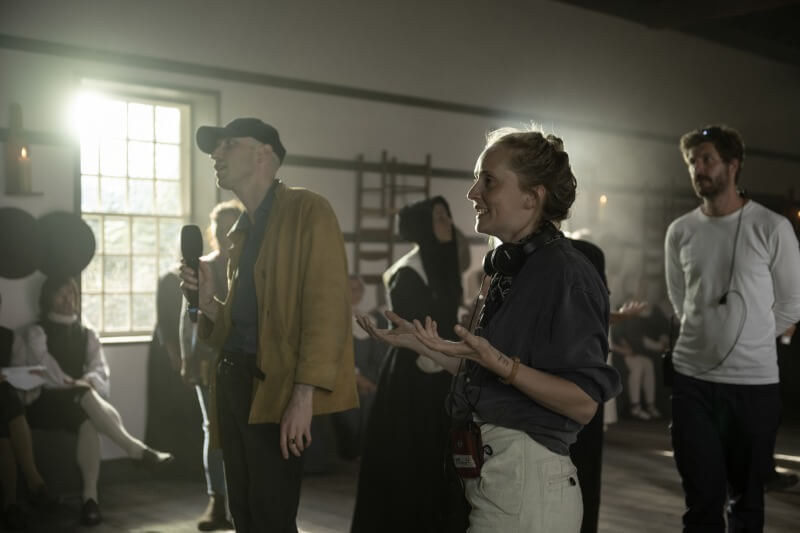
The fact is, when I’m recording in the studio with musicians, [I ask]: What’s the part of me that knows that it’s a good take, or that it’s sounding correct for that scene or for the world? Being on set really helps. I was on set for the whole of this film. I was having meetings with all the heads of department in pre-production and they’re talking about a visual language or a different side of things, but all of those are giving me clues as to what world we’re making together for this film.
Then, obviously, eventually, you start seeing the pictures—the celluloid and the performances—and all of the ingredients start to just influence the decisions you make musically. I worked early on The Brutalist, but with this, I was part of every bit of it, in terms of the edit and then sound mix. By the end, you know—together—what you feel is the right move.
At the start, we were trying to decide what songs to put in. I wrote John’s running song because [Mona] wanted to change the pace in that moment in the film. Some words were inspired by the description of them finding a settlement. There just comes a point where you think that that will work—but, yeah, I didn’t put a cap on how much information I knew or not.
It’s so funny you brought up the running song because that’s one of my favorites from the movie. It’s so goofy and fun, which is such a stark contrast to the rest of the soundtrack and score.
At that point in the script, we wanted a lighter, quite funny moment. I wrote this piece on the keyboard that was quite a late edition. I don’t really read and write music on manuscript. I dunno what I pressed on the piano, but they were very strange chords. They wanted a choir to sing it—the “doo beep boo da doop!” My cousin’s in this amateur choir that meets every Tuesday afternoon and she showed me a video of them singing and I thought, “Oh, maybe they’d be good for this film.” So I worked with the conductor of this amateur choir and this guy wrote out all of my strange keyboard parts into manuscript that they all sung. It sounded bonkers. We recorded with a lot of different mic setups so that we could put the sounds all around the woods when we got into the sound mix. There’s people singing around the whole cinema. The spatialization of that song was really fun to do with the sound mixer Steve Single. That was really intricate, that mix. That was definitely the funnest song.
In addition to that song, another song I love is “Hunger & Thirst,” mainly because Amanda Seyfried sings the title over and over in a way that’s almost hypnotic. Was this a Shaker spiritual that you kept mostly intact? How much of that and the other spirituals did you reinterpret?
That was quite a breakthrough for us. I remember I sent it to Mona. We would normally work during the day and then I would spend the evening and night doing demos. The melodies are so simple. There’s literally a Shaker hymn called “Hunger & Thirst.” There’s versions of that song everywhere on the Internet, like loads of people singing that. I kept the lyrics, but I put a mid eight in it and put more minor chords underneath it. Mona was really excited about that. When I woke up in the afternoon, I had all these texts on my phone. She’d listened to it when she woke up and she was saying, “This is exactly what we need to do.”
She liked that it was totally a Shaker song, but also sounded like one of my songs from one of my records. Then, I wrote it with Amanda in mind and had to change the key for her. She sings in a different key. It was cool because that was one that was really elevated in terms of using more reverb than other places in the film. This is where she transcends the Earth and she soars up. She connects to heaven. We just went wild. Steve Nobles played church bells on that. Really beautiful sounds with these church bells we got hold of. He was scraping the edges of these really resonant church bells and had a choir pad, just chords from that amateur choir. It also sounded like a musical to me. It was like a pop song.
One of the things that was interesting as well was “Beautiful Treasures,” which is [Amanda’s] first big solo song. That’s in the reel before, so it’s not that far away from “Hunger & Thirst” and the difference between our approaches to those two songs was a big conversation. For example, there are a lot of live vocals in “Beautiful Treasures” because we wanted it to really be in the room, so I used a lot of vocals from her dance and breaths on set. The violins were really dry. The sound of her moving her hand across the floor—it was really in the room. We had to be really careful with the mood of that song because it’s so sad with the stillbirths. It’s heavy material. Those two big songs coming quite close together—we had very different approaches to each of them in terms of production and singing on set.
Also, “Hunger & Thirst” was a oner, so she performed that in one go, which was amazing. And when I say she performed it, the cinematographer Will Rexer shot that in one take on 35mm. We recorded [Amanda’s] vocals on Sunday, and then on Tuesday, we were shooting it. That was one of the moments where I was really impressed. I really enjoyed working with Amanda. We very instantly clicked. With “Hunger & Thirst,” she was mouthing to playback while she was dancing and I had to sit and watch her lips when she was performing, just to make sure they wouldn’t have any issues in the edit because you can’t really mess with the song too much. Her vocals are just banged on. She’d learn her performance at night after shooting for the whole day. “Beautiful Treasures” had a lot of live vocals and I was trying to retain that live energy. I was choosing which bits would be live and which bits would be playback, just depending on what the actual intention of the song was in the film.
There’s another song that stands out, which is the one with the electric guitar that plays during the solar eclipse scene. Even though it’s a more contemporary touch, it feels fitting in reflecting the epicness of the moment. I’m curious what went into incorporating that part into the score.
The idea of the electric guitar was in the script. When [Mona and Brady] write their scripts, they always write the musical cues. Sometimes, they might say “orchestral swell” and I don’t really use orchestras, so it’s like a note saying that it’s gonna be a big thing happening, or something. I remember the first time I read the script and it said “electric guitar screech.” But in the end, the electric guitar only came in at that point. I tried electric guitar on various points throughout the process and it felt really exciting when it comes in, when [Lewis Pullman’s character] is basically encouraging people to join their movement. I found that song, “Bow Down O Zion,” and I made this epic outro where he starts the song off by encouraging these people. And then they all join in at the end and they’re like, “We are with you,” and the electric guitar comes in. I just made the lyrics saying about the mother’s devotion to set us all free.
The singer from Low, Alan Sparhawk, is doing backing vocals, which is nice. I stayed with Alan and Mimi [Parker]. We’ve done a lot of touring together and recording at their house. I thought of them a lot during this process, ‘cause they’re religious and always singing in their household and on tour. It’s a very genuine part of their lives. It was really beautiful that Alan came and sang on that. I thought it was nice that he sang on that song specifically ‘cause of the fuzzed out guitars, which are quite associated with Low and my music. I actually used Mark Hollis’ amplifier for that eclipse, which is quite an interesting, weird thing that happened. I have his Champ and Mark Hollis is a musician I really love. I have his Fender Champ and the first time I used the amp was [during] the eclipse.
I noticed you had a little cameo in the movie as Tim Blake Nelson’s deacon. I’m curious to know what it was like being on set and performing with the other actors.
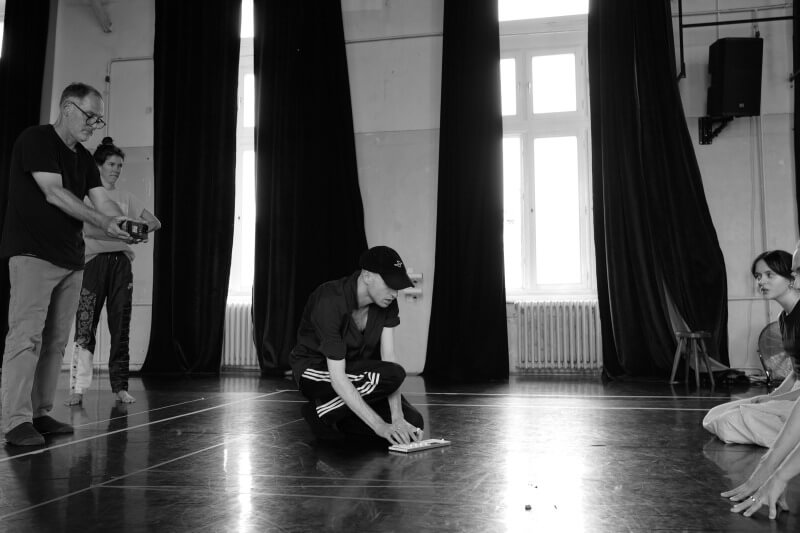
I was on set the whole time because I had to make sure microphones were in the right place and playback was happening in the right way. I had an engineer with me, Danny, and we had our Pro Tools session. Just technically, there was a lot of stuff to make sure would work so that when they received all the footage, it would be in sync and Sofía [Subercaseaux] would be able to edit without having to problem solve and all that stuff. I was recording all the actors during that process, so they would come and record their vocals at my Airbnb when they had time off shooting. Everyone was very close. Amanda would come and record at my Airbnb. After shooting for ten hours, 12 hours, she’d come and we’d have some wine and record.
One thing that I really liked was there were some singers we knew would be part of the score. Maggie Nichols, who’s this seminal improvising singer, does an amazing performance right at the start of the film, just before you see their first prayer together, the big dance sequence. Then, Josephine Foster, who’s an incredible folk artist. I did the credit song for The World to Come with Josephine. We always wanted her to be in the film. For me, it was a really nice link between what you’re seeing on the screen and these beautiful voices in the score. Obviously, it’s the same case with the actors, but there’s also a lot of vocal sounds and Maggie did a whole improvisation to the whole film that we were mixing in throughout the sound mix and re-voicing some of the Hungarian extras with these singers. There’s no one who sings like Josephine. It was really great to have her in the film. I got to put her voice in the funeral sequence as well, so it was really nice to have a link between the sounds and the score.
In the same way that when you see Ann ringing the bell at the end in the Shaker village, there’s a really nice link between all the handbells that are in the next scene with all the fire. There’s 50 or 60 handbells being rung and that kind of dissonant sound is when it’s all burning down. Just loads of handbells. I had about 50 handbells in my flat in London that I rented out. They were so beautiful and I used them for the whole film. Because the actors were singing in different keys that worked with their vocal range, I had to rent all of the handbells in five different octaves. When they were just laid out on my floor, I thought, “What would it sound like to hear all of them rung at the same time?”
So my friend Kenichi came over and we just spent about two hours just ringing all of the bells one by one. It sounds crazy. You have the idea and it doesn’t sound like a good idea, but that really worked. It sounds louder than it is because there’s all these dissonant notes. When there’s two notes on the chromatic scale, it creates this atonal dissonance, so it all sounds quite abrasive. It has a really strong sound that it’s almost like putting my fingers in my ears, just on the cusp of that. It’s a very extreme moment. The fact that that can exist, that extremity, and then the extremity of Amanda Seyfried singing “Beautiful Treasures” and “Hunger & Thirst,” those two things existing in one picture, was something that we were literally trying to achieve for those extremes to make sense. That was something from the start, we were trying to find ways of pushing that.
What was your favorite or the most meaningful song to compose?
I love all the songs we ended up using. I love “Down to the Deep” and the way that that chorus hits. They all have their own space in the film. It was quite a diverse set of songs. I guess the newest one for me was the song at the end. I was quite skeptical of putting a song at the end, but I’m quite happy with how that turned out. That’s quite nice, ‘cause we’ve been singing and we’ve been doing some gigs as well together, me and Amanda, and that’s a nice one to play.
Sam Rosenberg is a filmmaker and freelance entertainment writer from Los Angeles with bylines in The Daily Beast, Consequence, AltPress and Metacritic. You can find him on Twitter @samiamrosenberg.


 Keep scrolling for more great stories.