Couture, the title of French filmmaker Alice Winocour’s most recent effort, literally translates to “stitches.” This is appropriate for a film that entrenches itself in the small details of Paris’ fashion industry, particularly as it pertains to a reliance on women’s labor. Just as a seamstress would assemble a haute garment, Winocour attempts to weave together the realities of three women—a film director, a makeup artist, and a model—to illustrate the disparate adversities they face as they attempt to hone their craft while nurturing their social, familial, and romantic lives. Their stories are often fascinating, melancholy, and even at times relatable. But the threads that bind their storylines are done with an amateur’s haphazard hand, particularly when one character clearly takes narrative precedence over the others.
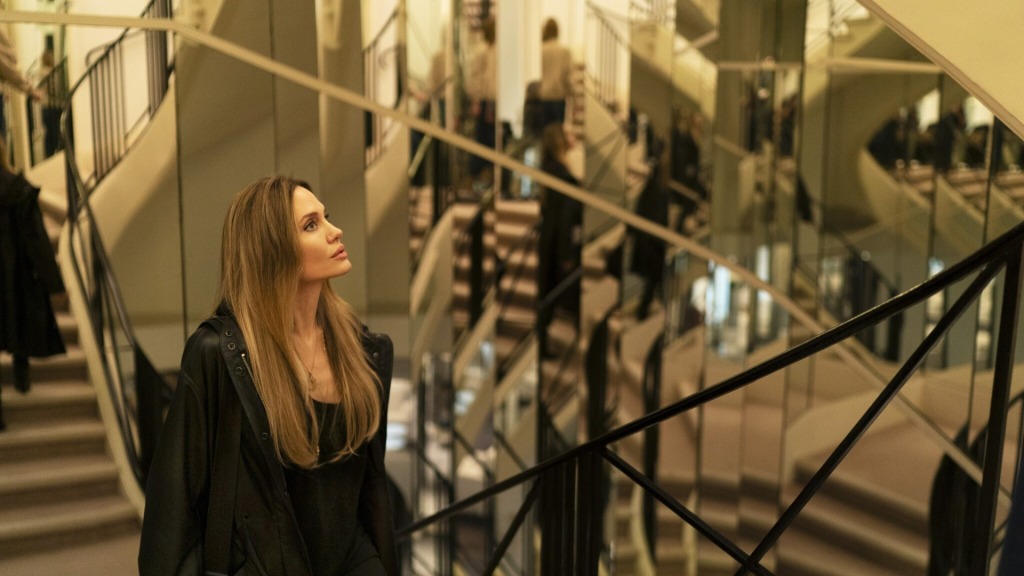
First, Couture meets Maxine Walker (Angelina Jolie), a filmmaker whose low-budget horror films have caught the eye of a prestigious brand that wants her to direct a short film that will open their Paris Fashion Week show. Of course, she is dressed in all black when she arrives at the label’s office, fresh from CDG airport. Her schlubby-chic fit doesn’t impress anyone on staff, who react with muted embarrassment when she opts to film a promotional interview in the same outfit. She manages to save face, however, when she is able to hold a conversation in French. “My mom was French,” she explains with a smirk. While Jolie’s real-life mother, Marcheline Bertrand, had French (Canadian) roots, the actress insisted on studying the language ahead of starring in Couture. Yet the rest of Maxine’s storyline hews more closely to Jolie’s lived experience: Divorce proceedings put pressure on her duties as a mother, and a health scare has her considering a double mastectomy. Just like that, Maxine must make a decision between tending to her health or to her career. The decision might seem easy on paper, but it’s not every day that an indie filmmaker gets to play such an extravagant game of dress-up.
As transfixing as Jolie is newcomer Anyier Anei, a lithe and striking South Sudanese model who is likely playing a loose version of herself. Winocour dissuaded Anei from taking acting lessons, which allowed her to give a markedly vulnerable performance as Ada, a twentysomething who arrives in the city after being scouted in her home country. She is placed in an apartment already filled with other models, forcing her to sleep on the floor. But the situation she finds herself in now—untouched by war, far away from her strict family’s judgemental eye, making real money for the first time in her life—makes the mean girls tolerable. Despite her nascent career, Ada is chosen to star in the same show that Maxine’s short film will open. She is instructed to practice her wobbly runway walk incessantly, but in this case practice results not in perfection, but pain that threatens to sabotage the show.
Finally, there’s Angèle (Ella Rumph, the hazing older sister in Raw), whose gig as a makeup artist doesn’t quite satisfy her creative itch. Her real passion lies in writing a metafictional memoir about her experience in the fashion industry that’s rife with titillating angst. Despite the film literally being set in France, Angèle is told that her edgy manuscript has no hope of being published. (This sentiment also feels odd hot off the heels of The Devil Wears Prada 2.) It’s less clear what Winocour is hoping to communicate through Angèle, whose presence feels more ancillary than not. If Couture were a blouse, Maxine would be a bias-cut bust, Ada a pair of ornate but not totally essential silk sleeves, and Angèle the back-up button sewn into the care label. For a character crafting a would-be exposé, there isn’t much drama that unfolds around her. In fact, the industry itself is presented in a puzzlingly banal light. Just when you think Winocour might be ready to unveil some sort of horrifying truth—pertaining to sexual misconduct, workplace abuse, or immigration issues—nothing actually happens.
While the fashion house that employs these women is never named outright, it’s been reported that Winocour is the first director allowed to shoot in Chanel’s Paris showroom and atelier. It’s understandable for Winocour to seek out a brand founded by an iconic woman designer, but perhaps this arrangement could only come about if the filmmaker vowed to veer away from the industry’s unsavory side—eating disorders, addiction, pay discrepancies, nepotism—ultimately yielding a story that is all style and no substance. (In truth, it’s not as if Coco Chanel herself has retained the most palatable posthumous legacy, what with the Nazi collusion and all.)
Couture‘s lack of sensationalism could have been its strength, but instead it all feels lackluster. Even the built-in beauty of Paris and the styles housed within it are never given proper adulation: The city itself is cast in dreary grays or by dull streetlights, and the actual art of crafting couture garments is all but absent, save for one scene when a seamstress pricks her finger while constructing her first solo garment. Had Angèle’s character been a seamstress, perhaps, the connective tissue of Couture would have been slightly more reinforced.
Then again, Jolie could have easily starred in the film alone, as the stakes of her storyline supersede any aspirations on the catwalk or publishing circuit. When she’s attending a mastectomy consultation, a surgeon uses red marker to demonstrate his knife’s projected path; it’s no coincidence that these ticks perfectly resemble hand-stitched seams, and perhaps this is what Maxine’s work crush (Louis Garrel, definitely given more to do than Rumpf) is taken aback by when he notices them on her chest. But despite these moments of cohesion, Couture is a patchwork quilt assembled from mismatched fabric swatches. If the disparate textiles were more intricately patterned and less flat-out drab, Winocour might have had a cleverly low-key interrogation of high-end folly on her hands.
Director: Alice Winocour
Writer: Alice Winocour
Starring: Angelina Jolie, Louis Garrel, Ella Rumpf, Garance Marillier
Release Date: June 26, 2026


 Keep scrolling for more great stories.