[Editor’s note: The following contains spoilers for Toy Story 5.]
When it comes to Pixar characters who are immediately recognizable with just one name, Andy is up there with Dory, Sully, and Merida, which is impressive considering the central kid of the original Toy Story trilogy really doesn’t have that much screentime. In fact, part of the reason Pixar chose toys as the subject matter of its first film is because the studio’s pioneering computer animation wasn’t quite up to the task of rendering emotive human characters yet. That set a precedent the subsequent Toy Story films have largely followed: These are first and foremost films about what kids mean to their toys, not what toys mean to their kids. That all changes with Toy Story 5, the first to treat its kid character as one of its leads.
This coincides with a bit of a gender flip in the franchise too. With Woody (Tom Hanks) living outside the toy room and Buzz Lightyear (Tim Allen) playing second-in-command, it’s Jessie (Joan Cusack) who now serves as the main sheriff in town for Bonnie (Scarlett Spears), the little girl who inherited the toys at the end of Toy Story 3. Back then, the original films took Andy’s suburban boyhood as a sort of generic default background for their tales of cowboys and spacemen. With Toy Story 5, however, the nuances of girlhood are brought front and center.
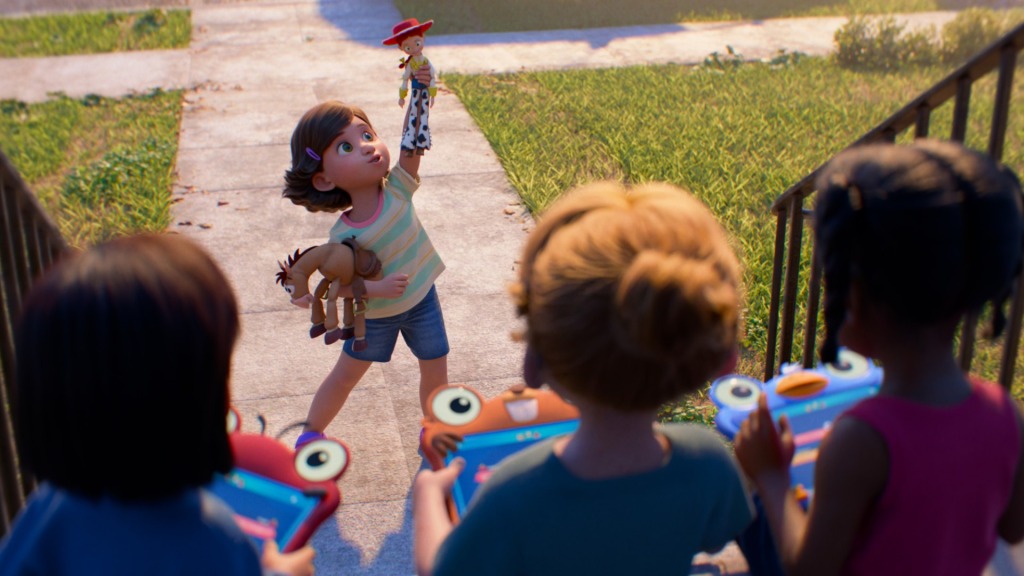
Though the trailers sold the movie around the arrival of technology, the plot is actually much more centered around how hard it is to make friends when you’re an eccentric little girl—someone who’s explosive and creative in the private world of play but impossibly shy when it comes to talking to other kids. After all, Bonnie is the free-spirited weirdo who created Forky to cope with the scariness of kindergarten. Three years later, she’s gifted a Lilypad tablet not because she even really wants one but because her parents are devastated when she asks them, “Why won’t anyone be my friend?” They reluctantly decide that giving her a kid-friendly device might help her bond with her tech-obsessed peers.
From there, Bonnie’s story partially becomes about tech addiction, but even more so about elementary school friend cliques. Bonnie’s mom puts her in a group chat with some fellow eight-year-olds from her dance class, who have their own strict, unspoken hierarchy about what’s cool and what’s not. Toy Story 5 is filled with all these nuanced grace notes about how difficult the social dynamics of girlhood can be, like when Bonnie excitedly brings her dolls to show off at her first sleepover only for one of her new friends to cut her down with a droll, “Oh, you still play with toys?”
Writers Andrew Stanton and Kenna Harris understand there’s an indirectness to how little girls are taught to communicate and sometimes even how they’re taught to feel. There’s a devastating moment where another little girl named Blaze (Mykal-Michelle Harris) gets a dismissive text from a friend bailing on their plans and immediately bursts into tears. Toy Story 5 remembers that the slights and frustrations that can be more maturely contextualized in adulthood are often all-consuming in childhood, where every social interaction feels monumental. It makes the film feel as much like a spiritual prequel to the Inside Out series as a continuation of the Toy Story one.
While Blaze and Bonnie’s parents do their best to be supportive, it’s the toys who exist on the same emotional plane as the kids and therefore understand them best. For her part, Lilypad tries to gamify Bonnie’s friendship dilemma by getting her the maximum number of friends in the shortest amount of time possible. But it’s Jessie who realizes that Bonnie “won’t click with just anyone.” She needs someone just as imaginative as she is—someone who values make-believe fun over preprogrammed games. The trouble is, Bonnie is so traumatized by her terrible sleepover experience and some subsequent group chat teasing that she preemptively buries her whimsical personality before anyone else can cut it down.
If you’ve raised a little girl or been one yourself, it’s almost physically painful to watch Bonnie turn down Blaze’s warm attempts at friendship because she’s scared she’s going to get made fun of again. Surveys have shown that while girls and boys have equal levels of confidence when they’re little, from ages eight to 14, girls’ confidence levels drop by 30 percent. Toy Story 5 captures that milestone in real time—and argues that, if anything, technology is speeding it up. Pixar has perhaps never created a more haunting image than Bonnie flinching away from her Lilypad until her parents reassure her, “It’s okay, we turned off the chat.”
Those very human stakes help give Jessie a unique arc as well. As with Woody in the previous Toy Story films, part of her story is about processing her own baggage around being a toy—in this case, the fact that her original owner Emily outgrew her, as was so memorably depicted in the “When She Loved Me” sequence in Toy Story 2. Now she’s scared that Bonnie is doing the same and lashes out at tech devices like Lilypad for “stealing our time.” Yet where Woody’s emotional journeys were inwardly focused, the fact that Bonnie is an actual character in the story allows Jessie to have a more outwardly focused arc this time around, which helps those familiar Toy Story themes feel fresh again. Jessie realizes it doesn’t really matter what she wants from Bonnie, what matters is what she can give to her—in this case, the chance to discover that Blaze is also “creative and silly in a way other kids don’t really get.”
Much like her toys, Bonnie has been worried she’ll get left behind by the increasingly fast-paced transition from kid to tween—that time of life when playing with horse toys and trying out vanilla body mist are both equally appealing activities. But it turns out all she needs is someone moving at her pace. The movie beautifully captures Bonnie and Blaze’s connection by rendering their imaginative play in the exact same way; not with hunks of plastic waving around the room but 2D-animated sequences where wedding murder-mysteries and elegant soirees full of espionage play out just as fluidly as they do in the girls’ minds.
It’s what makes it so fitting that the film’s big credits song comes not from Randy Newman but from Taylor Swift, documentarian of a certain type of girlhood. Her new song “I Knew It, I Knew You” captures a wistful, nostalgic feeling of old friends coming back together—one that feels as appropriate for Jessie finding closure over Emily as it does Blaze and Bonnie finding each other as kindred spirits. For a long time now, Andy has remained the defining name when it comes to Toy Story kids. With this fifth installment, however, Bonnie (and Blaze) earn a place in the Pixar pantheon.


 Keep scrolling for more great stories.