Cover Me: Wet Leg’s moisturizer artwork is animalistic, grotesque, and totally on brand
Rhian Teasdale talks about the visual language of her band’s sophomore LP, one of the inaugural nominees for Best Album Cover at the 2026 Grammy Awards.
Grant Sharples’ monthly Cover Me column highlights the stories behind great album covers, as told by the artists and bands who made them. In its first installment, Grant speaks with Wet Leg’s Rhian Teasdale about the visual language of moisturizer and being among the inaugural nominees for a Best Album Cover Grammy.
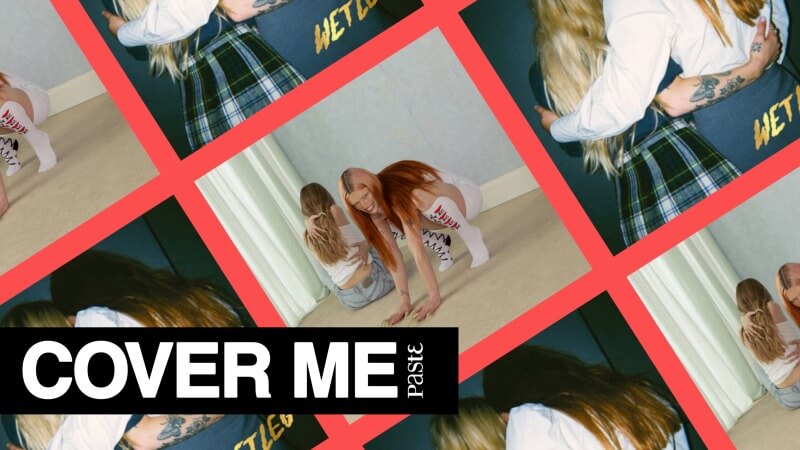
Rhian Teasdale is perched like a goblin with a digitally manipulated rictus grin spread across her countenance. Her comically overgrown nails dig into the carpet, and she rocks knee-high “I ♥️ ME” socks” while her bandmate Hester Chambers turns away from the camera’s gaze, too preoccupied making out with herself to notice. Such is the cover for moisturizer, the UK post-punkers’ excellent sophomore album, a fitting encapsulation that captures the tongue-in-cheek humor and fearless audacity that animates their music.
It’s also one of the inaugural nominees in the Grammys’ new Best Album Cover category (moisturizer is also nominated for Best Alternative Music Album and Best Alternative Music Performance, categories Wet Leg also won in 2023), so it felt like an appropriate candidate for the first edition of this new column, Cover Me (yes, that’s a Bruce Springsteen reference). Every month, I’ll sit down with a band or an artist so they can walk me through the story behind all of their album covers. This installment is a special one-off, given that it’s year-end season and we’re all revisiting our favorite new music of the past 12 or so months. As a fan of Wet Leg’s latest record, I spoke with Teasdale specifically about the visual language of moisturizer and how that iconography bleeds into their live show, personae, and, of course, the songwriting itself.
When Teasdale and I spoke, Wet Leg were billed to perform at the Salt Shed in Chicago that evening. The morning of showtime, Teasdale hopped on Zoom from her hotel room to guide me through the story behind moisturizer’s frankly grotesque album cover and how that imagery engages with the music itself.
Paste Magazine: Walk me through the initial idea behind this cover and what led to it.
Rhian Teasdale: It was really nice going into LP2 and having more time to consider the whole visual world and visual language of the album, like when we did our first album, everything was so unexpected. Everything happened really quickly in such a short amount of time. It was just all so new to us. And of course, we didn’t take ourselves very seriously at all, because we’re just so fresh to everything. So it was really nice with moisturizer to be a bit more considerate and to have a little bit more leverage of like, “Oh, I want to work with this person.”
That’s how we ended up reaching out to Iris Luz, who shot the album cover, and we never would have done that with the first album. I’d never met Iris before, but I really loved her work, and also the whole band, like all of us, were taking a step back from being perceived and being photographed. That’s always been something that we’re a little bit nervous about. Our friend Joanna [Guise], who commissioned the shoot for the album cover and our promo pictures, suggested that we all go away for the weekends out of London and just like, have a play. Like, just see what happens.
And so that’s what we did: the band, Joanna, and Iris. We all went away together, and it was really fun, and it was really silly, and it was not too serious, and we didn’t really know what we were going to shoot or what we were going to get. We were getting used to each other, but over the course of the weekend, that’s when we conceptualized the album cover. A takeaway from the shoot was a picture of me by some stairs in this house, and I’m in that demonic crouching position. And then I was like, “Huh, that really makes me feel something,” because it was quite light. This image was light and glowy, but then also had this unnerving, animalistic, kind of creature energy. I was looking at this image for a while, and I showed it to my partner, and I was like, “How about like this as a starter for the album cover. I think it has the potential, if we reshoot it, like with Hester [Chambers] in it, and with some more bells and whistles. I think this could be the album cover.”
We were in Photoshop, playing around with it, and I was like, “What would it be like if my hands were actually disgusting, like crow’s feet?” I was really serving in this original demo image, and it was too pretty. That’s when we went in and manipulated my face so that I was doing this creepy smile with my mouth, but then my eyes were still very much in this, like, serving kind of mood. Once we did that, we’d created this grotesque monster, and it just really aligned with what I had in mind for the visual language of the album. It had to kind of sit somewhere between, like, super pretty and girly and just menacing and grotesque. It just sat really well with me. It just felt really correct listening to the album and looking at this image, because the album has a lot of love songs. But to me, I think love can be really scary, as well. You know when you’re deeply in love, it just really takes hold of you, and it turns into this animalistic and unnerving state of mind? This creature on the front of the album cover just just felt really right.
It also really aligns with the songwriting, as well. It’s always a little bit tongue-in-cheek. What’s cool is that I didn’t really realize that we were doing this at the time, but the way that Hester has her back turned, and I’m scary at the forefront. It’s a foreshadowing of Hester still very strongly being there and giving you as much as she’s going to give you. And then I’m at the front being a freak, which I think is quite funny.
I’ve seen a lot of people online comparing this cover to Aphex Twin. What were some of the inspiration points for you guys directly? Were there certain things you were pulling from or things you had in mind?
It sounds so basic, but I think a lot of artists and musicians do this. I just went on a big Pinterest binge and collated a lot of images that, for me, evoked the same kind of emotion to what we would eventually create as the album cover. There were some images of jewelry made out of teeth. Teeth jewelry is so pretty, but it’s also grotesque. Just a collection of images that were sugary, sweet, and also disgusting.
An exciting thing about this cover in particular is that it’s one of the first album covers ever to get nominated for the new Grammy category. I assume you’re excited about that?
When the nominations came out, I was so shocked and so stoked because it’s just mad to be nominated in that category, alongside the other nominees who are just like, so legit. I really, really, really love making music, but I really do enjoy making the music videos and making the visuals and getting to collaborate with other people on that. I think it’s so important, especially nowadays, where you’re all on your screen, so you see the visual first and the music second.
So how did you first come across Iris’ work, and what made you want to work with Iris in terms of, like, I know that they can create the cover for this and they can realize what I have in mind?
I first came across their work just scrolling on Instagram, like Instagram is such a great tool for finding people to work with on a visual scale, yeah. And I didn’t know that I wanted her to shoot the album cover. I just knew that I wanted to work with her in some capacity. Originally, we just planned to do some press shots together, because I didn’t know what the album cover would be at this point. And we were moving really fast because we were just so desperate to get rid of the curse of the second album, like, just get it out. We just needed to get it done quickly so people would stop asking us about it. Everything was just moving so quickly at this point. We had the press shoot booked in before we had anything for the album cover, because I didn’t even know that it was necessarily going to be photography-based. We were considering different artists, people who work in drawing and painting mediums. We went away for the weekend, and it just very spontaneously happened.
With any photo shoot you take a lot of photos, were there any other options that were close contenders, that you thought maybe could be the cover?
No, not from the photo shoot. We knew this would be the one.
What gave you that, that certainty, like, “Yeah, this is definitely going to be it?”
I was just excited. I was excited to show my friends, like I was excited to show my school friends. And I think that’s always a really good litmus test of whether something is good or not. I think for me,even with the album as well, like, even with making music, if I’m not excited to show it to my friends from school, or if I’m a little bit on edge, makes me feel shy or a little bit uncomfortable, then it’s probably good to go.
Why do you feel that way, that if something makes you a little uncomfortable, that it’s something you should release?
I think it just means that you’re growing. That’s such a cliche of everyday life, like, “Oh, if you’re pushing yourself, if you’re making yourself feel a little bit uncomfortable, whether that’s making new friends, or going to a restaurant by yourself, it can help you grow as a person.” Like that is such a cliche, isn’t it? You go to therapy, they say, like, “Do this, and you will become a better person.” But I also think that, you know, with art and with making music, it holds some value there, as well.
You mentioned earlier this juxtaposition of light and dark, of funny and serious, containing these two things within the album cover. Why do you feel like you gravitate toward that juxtaposition? Why is that important for you?
I’ve been thinking about this recently, and maybe it’s something to do with gender in general, and being told that you are one thing. You’re kind of like, “This is what it means to be a man; this is what it means to be a woman.” That’s why I find juxtaposition so interesting. It’s an easy trick, as well, to make something interesting in a way. That’s something that we’ve always kind of unintentionally, unknowingly played with in Wet Leg. Even with our first release with “Chaise Longue,” there’s this feminine, kind of cottagecore aesthetic with the post-punk sound. That was just funny to me. That’s probably why I really enjoy that kind of visual language.
It’s like a way to resist a monolithic, rigid interpretation. It’s a way to make sure it’s, like you said, dynamic and interesting.
Monolithic… I wish I could use that word. I am so bad with words. You know, that’s why it’s so good writing songs, because you have, like, all the time in the world to choose your words. And then when people do interviews with me, they’re like, “What are you even saying right now?” Monolithic… [pulls out phone to Google the word] It’s funny because the first thing that comes up is formed of a large block of stone. And, like, yeah, OK, I get it: monolithic stones. OK, I’m gonna say it five times today.
It feels fitting, since you’re on tour: how does this cover and this imagery factor into your live shows and the wardrobes and the stage presence and all that fun stuff?
That’s been another really fun thing to have time to work on and think about with this campaign. Also, a really big shift for me personally is that I’m playing guitar on a lot less songs, so suddenly I’ve got this opportunity to use my whole body to tell the story of this collection of songs and feeling of the album as a whole, which has been challenging, but it’s been a really good challenge. Even with the live show as well, there is a lot of juxtaposition in the movement that I’m doing.
For example, the first song in our set we play “catch these fists.” It’s quite an upbeat kind of song. So you would think the movement for this first song that we play could be, you know, I could run on stage. I could be like, “Come on, let’s go!” and be jumping up and down and stuff. But I think the contrast between that song being so aggressive, but then the contrast of me walking very slowly forward. There’s a verse that’s like, “we’re on our way to the club,” and I’ve really been enjoying treating each verse like a different character. That verse is very girly and cute, and so I mirror that with my body. But then midway through, it switches.
What are some of the challenges as you’re learning to navigate this new stage presence?
Honestly just the mechanical, functional things have been quite a learning curve. And then, emotionally, the guitar is such a shield between me and the audience, and it’s such a safety net. It may not look like it when I’m up there and I’m doing my thing, but yeah, it has been very scary, but I love scaring myself, apparently.
Like what you were saying, if it feels unsafe, or if it feels it makes you feel uncomfortable, then let’s put it out there.
Yeah, because it’s not gonna kill me, and I’m gonna die anyway, so I might as well scare myself. It is a safe environment for me to do that.
I know you want to rest before the show tonight, but just looking back at this album cover, what are you most happy about with it?
I just love it. From what I can see, people are quite torn about it. Some people really hate it and think, “What the hell is this? It’s horrible; it’s stupid.” And some people really love it and are really kind. I’ve seen pictures with people holding their album and assuming the same crouching, demonic position. It’s weirdly relatable to want to do that and want to be this horrible, disgusting creature but also be really cute and pretty at the same time. A lot of people can, without really even probably realizing it, relate to it. Deep down, everyone is a freak.
Grant Sharples is a writer, journalist and critic. His work has also appeared in Interview, Uproxx, Pitchfork, Stereogum, The Ringer, Los Angeles Review of Books, and other publications. He lives in Kansas City.


 Keep scrolling for more great stories.