As a polished cops-versus-bandits melodrama set in Los Angeles, there’s a familiarity to Bart Layton’s Crime 101 that’s impossible to shake. The film seems destined to slide comfortably into streaming libraries beside its primary influences—namely, the works of Michael Mann and William Friedkin, which is not bad company to keep. Yet this proximity inevitably invites comparisons to those directors’ filmographies, and after two-and-a-half hours of watching Chris Hemsworth’s posh, morally gray, crisis-stricken jewel thief grimace his way through sleek L.A., the parallels won’t always be flattering.
Taken on its own merits, Crime 101 is a sturdy offering for those who miss losing an afternoon at the movies with a reasonably engrossing drama made for adults. Adapting Don Winslow’s novella, Layton delivers a mannered, sober crime saga stripped of ostentation and notable for its uncommonly polite genre restraint. It’s less interested in shocking or scandalizing the viewer than hanging out with them for a spell. Considering the cast of heavyweights with whom Hemsworth keeps company—Halle Berry as an insurance agent whose days of wooing the elite are wearing thin, Mark Ruffalo as a rumpled cat-dad detective, Nick Nolte as a fence who conducts business at noodle stands—that’s an invitation worth accepting.
But for all his fascination with criminality and duplicity—themes which defined his nonfiction films The Imposter and American Animals, and proliferate here—Layton flinches at the violent and sexual extremes that define so much of his chosen genre, casting his film as a kinder, gentler variation on mood pieces like Miami Vice or To Live And Die In L.A. This is not to say there isn’t violence or sex in Crime 101; both are present, but they’re calibrated to sustain tension or deepen character, not titillate genre hounds out for a fresh jolt. Layton proves adept at keeping his drama at a simmer—boosted by the thrumming moodiness of Blanck Mass’ score, it’s almost a cinch—yet he rarely lets it boil over. When he does, like in a car chase midway through the film or a somewhat botched heist involving a jumpy, bottle-blond Barry Keoghan, Layton cuts away before leaving too much of a mess behind.
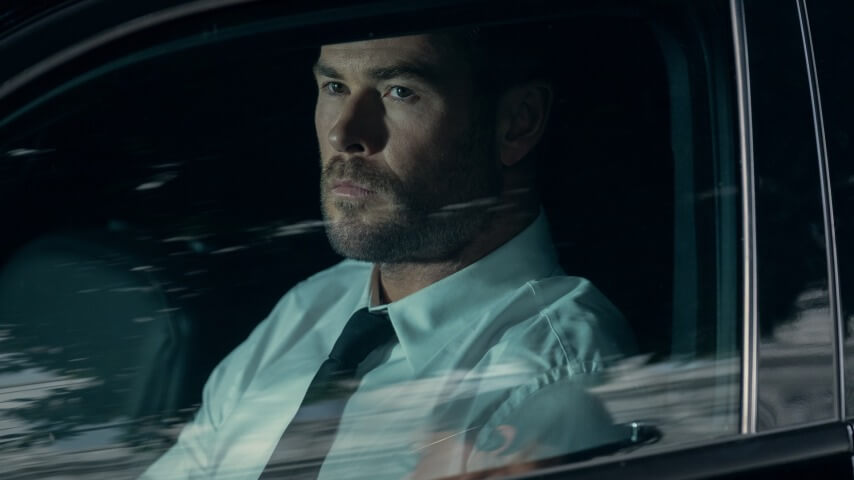
He keeps the film relatively tidy, using Mann’s Heat as his most conspicuous influence while scaling that film’s ensemble down to a functional three-hander. Hemsworth plays Mike, a thief whose modus operandi exploits Highway 101, a stretch of asphalt that provides plump targets and swift getaways. It’s fitting, then, that Mike finds himself searching for an off-ramp from this lone-wolf criminal career, and not a moment too soon; unbeknownst to him, his route has already attracted the attention of Detective Lubesnick (Ruffalo), who needs to collar the serial thief to salvage both his career and what remains of his self-worth, both diminished by advancing middle age and an image-conscious LAPD.
Mike’s longstanding dealings with his fence, Money (Nolte), are already fractured by the film’s opening sequence, a street-level robbery that begins smooth as silk but takes a sudden turn when Mike—distracted by too many variables—misses a hidden gun during the holdup, and the shot goes off too close to its mark. Despite Layton’s overall caution, he finds a propulsion to this sequence that speaks to Mike’s hypercompetence and contrasts nimbly with Money’s blunt-force approach. With this fissure in place, Mike and Det. Lubesnick’s parallel schemes begin to circle around Sharon (Berry), whose disenchantment with her ornamental role at an elite insurance firm (she fails to lure a merrily odious tycoon played by Tate Donovan) compels her to capitalize on her access to the city’s upper crust—before her employers decide she has aged out of usefulness.
Before the plot’s gravitational pull draws them together, the three leads function agreeably within their characters’ fraught private lives. The first hour clearly presents their motives, and, with some effort, the improbable coincidences that otherwise poetically connect their social and professional distances. Secondary characters—like Maya (Monica Barbaro), who falls for Mike despite his spartan, serial-killer digs and economical relationship with the truth, and Ormon (Keoghan), that squirrelly robber who seethes under a motorcycle helmet and shadows Mike in anticipation of his next heist—are more vaguely rendered. While this sketchiness feels deliberate in Ormon’s case (he’s plainly engineered to fit the Waingro wild-card role from Heat), he instead comes off like a refugee from a Temu production of Good Time.
This remoteness actually complements the frustratingly elusive Mike, who smolders just fine when Hemsworth is in Blackhat mode, but appears merely to sulk when Layton’s screenplay attempts to elucidate his inner turmoil. In the latter sequences, we can glimpse the lousier movie Crime 101 could have been had Layton pulled it from the oven too early, and it’s difficult not to grow fidgety when Keoghan, Barbaro, and Hemsworth dominate the frame while richer, more grounded performances (Berry provides an essential wellspring of charisma) hover nearby. When Crime 101 finally pulls into its soft landing, it feels right that Layton leaves behind no lasting scars; with well-crafted characters like Sharon around, we naturally want them to get away clean.
Director: Bart Layton
Writer: Bart Layton
Starring: Chris Hemsworth, Mark Ruffalo, Halle Berry, Barry Keoghan, Monica Barbaro, Nick Nolte, Tate Donovan, Corey Hawkins, Jennifer Jason Leigh
Release Date: February 13, 2026


 Keep scrolling for more great stories.