As it turns out, headshots do not put down the nightmarish wooden dolls of Crisol: Theater Of Idols. It barely slows them down. I discovered this the hard way in the sewers below Tormentosa when I popped one of these astillados (which translate to “splintered” in Spanish) in the skull, only for it to continue stumbling in my direction. A few more shots to the torso seemed to do the trick and I moved on to eliminate another target. After taking them out, I let out a breath of relief and continued on my way until suddenly something struck me from out of nowhere, dealing the last bit of my HP and sending me back to my last checkpoint.
It was the damned legs, of all things. As it turns out, Crisol expects players to be careful and precise with the bullets they expend. They’re your own blood, after all. Every shot counts, and every last drop.
Crisol holds a lot of promise. For one, it clearly borrows from heavy-hitters like Bioshock and Resident Evil. Crisol isn’t a twitch first-person shooter, and as such Gabriel, the game’s protagonist, moves with weight. Though he’s trained in how to use firearms, they still sway in his hands and his aim drifts if held in place too long. He feels like a real person waging a one-man war, rather than a perfect war machine. It feels like Jack emerging into Rapture’s bathosphere for the first time and being thrust into an unexpected battle of survival against a rabid splicer.
The points of comparison don’t stop there, either. Tormentosa is a storm-drenched island run by competing religious cults; based on trailers, it looks to feature locales that seem inspired by Resident Evil 4‘s mountain village and castle segments. Environmental puzzles have you tracking down key items like bolt cutters in order to open up locked gates, and even the way they are conjured from thin air and used in-game is reminiscent of the Resident Evil titles. The occasional poster on the street resembles Bioshock‘s in-game propaganda and the dystopic and run-down ambiance of the city streets feels like a page torn out of Rapture’s book. (That and all the booby traps, of course.) Even the art deco adjacent UI of Crisol feels reminiscent of Irrational’s massively influential FPS.
But Crisol is also far more of a survival horror game than I expected it to be, and that ties into its most interesting and unique mechanic. In Crisol, the weapons you use to put down opponents are fueled by blood. At one point, I picked up a plain old-fashioned bolt-action sniper rifle that was immediately consumed by blood and made into some blasphemous, gothic armament of war. All of Crisol‘s weapons are like this, and rather than take bullets, they take blood directly from your HP.
That means that every reload animation vividly shows the gun draining the player of their life force, and surviving Crisol‘s horrors eventually grows to entail management of your shared health and ammo pool to meet the situation adequately. Shotguns, for example, hold two very powerful shells that one-shot standard enemies, but each takes a pip of your entire health bar. The pistol, by comparison, can hold 10 weaker shots, but each absorbs drastically less health than one shotgun round. In classic survival horror fashion, like Resident Evil, I was almost immediately counting my shots and weighing what I could get away with against my inventory and healing items.
To aid the player, Crisol‘s dilapidated city streets are rich with blood. A conflict has obviously torn the place apart by the time that the player arrives on Tormentosa’s shores, meaning it is rich with dead things for the player to vampirically leech off of. Corpses of fallen men occasionally litter the main pathways, but there are also plenty of mutated animals around too, and both can be consumed by the player to fill their health and tip things back in their favor. I found these to be spaced out pretty well to accommodate a modest challenge. I imagine hardcore players can amp up the difficulty in the settings menu and find even fewer of these for a truly harrowing time.
The player is expected to leverage their gnarly weapons (and I guess torture tools) to do battle against the horrors that seem to have come to life on Tormentosa. According to a producer who was on hand for my demo, many of Crisol‘s enemy variants are born from imagery related to Hispanic culture (the game’s developer, Vermila Studios, is based in Madrid) and seem to especially stem from Spanish-Catholic architecture. And while I have no idea how Crisol will execute upon its obvious religious overtones, it is refreshing to see a game move from the abstract realm of religion and the harmfulness of its institutions into the more concrete by rendering material nightmares from its own iconography.
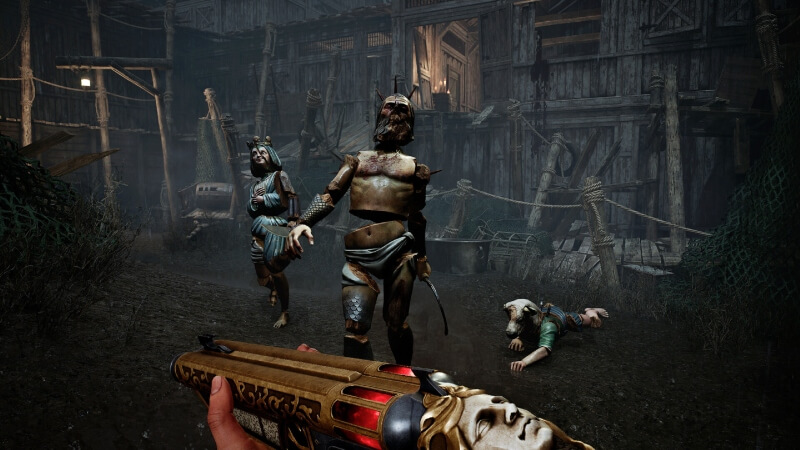
The bulk of the preview saw me engage a bunch of the astillados, which appear to be the game’s primary enemy type, and can be dealt with in varied ways. You can blast through them as I did, but that comes with some of the very caveats I already mentioned. Especially if you’re low on blood, you may want to do a little risk management instead and take out the legs in order to leave slower crawlers. This frees up ammo to go towards greater targets, and buys you time to scan the environs for healing or sources of blood.
The preview also revealed two other enemy types that owe their whole deal to Crisol‘s overtly religious lineage. The first appeared to be cherubic demons made of wax that zipped around the sky pelting me with fire. The other, and far more prominent, enemy was a large unkillable mech called Dolores.
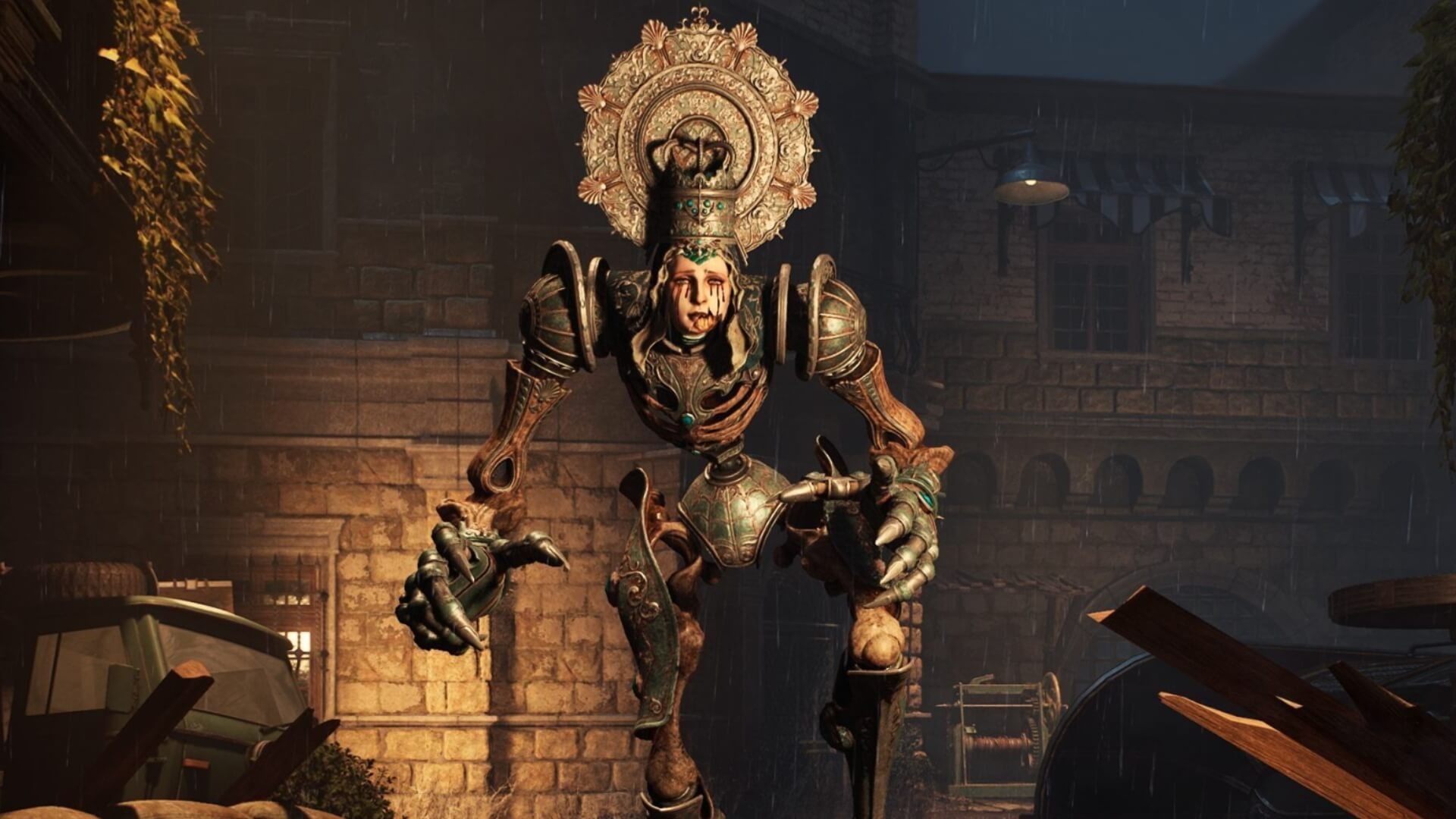
Dolores, perhaps unsurprisingly, functions a lot like Mr. X, Nemesis, or the Xenomorph, who are all roaming enemies from the Resident Evil franchise and Alien: Isolation that follow the player through the majority (or entirety) of the games they haunt. Though her mechanized body allows her to tower over you, her face appears like that of a cracked porcelain doll, with bloody tears running down it, lending her a tragic visage. When she is deployed, she immediately complicates matters by stalking the room calling for you, which sounds creepy enough in English but manages to be even more menacing in Spanish. At one point, she jump-scared me in a room where I had to solve an environmental puzzle resulting in electrified puddles of water; my progress immediately dragged to a screeching halt as I began having to account for her large presence. There were other enemies in the rooms to take care of, including sentries above me, but every fired shot risked alerting her to my presence, and when she first makes an entrance like she does here, it can be disarming.
It seems like Dolores will follow you through a few parts of the game, and I worry that the bit may run dry. While she’s obviously a menace, she’s also not terribly intuitive or smart. She’s fairly restricted in her movement and what she can do to harm you, and I worry that segments revolving around her run the risk of growing stale as you repeatedly bait her to one side of a room so that you can then unlock a door somewhere else and bypass her. In order to maintain her viability as a threat, Crisol will hopefully find greater ways to utilize her as the game goes on.
When Crisol leans into its unique cultural elements, it’s enthralling. When it’s more prosaic and familiar, in settings like factories and plain storefronts, I wished that the developer allowed more of themselves to bleed into the game, similar to how the game’s protagonist bleeds for their cause. I have hope yet that Crisol will grow into a stronger display of Spanish culture—its voice acting and loaded enemy design is already most of the way there—but this glimpse at its early moments leads me to believe it might be a slow ramp up to the full-fledged Spanish nightmare that Crisol could be. It does an admirable job lifting from obvious inspirations, though, and the way that it turns familiar survival horror elements on their head with its blood mechanic leaves me wondering what extreme lengths it might still go to.


 Keep scrolling for more great stories.