In Cult Of Criterion, The A.V. Club highlights a new release from The Criterion Collection each month, examining the films entering an increasingly accessible film canon.
Capturing what it means to be a child doesn’t just mean blaring a zippy soundtrack over some fast-paced antics. Being a kid isn’t just about goofy energy, or naivety, or wonder. Petulance and rage simmer under the silliness, the emotional consequences to a self-involved young person’s friction with the established ways of the world. Every wide-eyed moment of discovery is matched by a narrow-eyed moment of disdain. It’s this balance of whimsy and snot, of gleeful mania and furious hysteria, of Bugs Bunny and Daffy Duck, that makes Pee-wee Herman such a perfect grown child—and makes Pee-wee’s Big Adventure such a perfect idea for the kind of journey he might dream up.
By the time Paul Reubens gave 26-year-old filmmaker Tim Burton his big break with Pee-wee’s Big Adventure, his character Pee-wee Herman had already become a comedy fixture through Reubens’ stage show, HBO special, and talk-show drop-ins. He was on The Dating Game three times! But it took Burton’s Disney-trained, Disney-rejected sensibility to fully bring Pee-wee’s world to life—and to encourage the edgy streak that pushed Big Adventure away from Reubens’ planned remake of Pollyanna. After working on The Fox And The Hound and The Black Cauldron, Burton had made a few of his own live-action shorts, pouring his fully formed, Hot Topic-defining aesthetic into a Disney Channel version of Hansel And Gretel and the project that got him fired from Disney: Frankenweenie.
The latter is what caught Reubens’ eye, despite the former’s Witch living in what looks like an evil version of Pee-wee’s Playhouse. But all of Burton’s early projects proved that their sensibilities were aligned—they wanted to play in the gray area between kid and adult, between safety and danger, between camp and sincerity, between cutting-edge hip and retro uncool.
Both artists were obsessed with translating their experience of the past—of the wacky shows and old movies they grew up watching on TV—into a punk-inflected mid-’80s milieu. If Reubens and Burton fell asleep while Howdy Doody and a Universal Monster movie played on adjacent television sets, their shared fever dream would look a lot like Pee-wee’s Big Adventure. It’s a journey through the collective unconscious of a generation of grown American children, just immature enough to connect with an audience of actual kids.
As Jesse Thorn points out in his Criterion booklet essay, this partially takes the form of Pee-wee’s hyperreal road-trip iconography. Pee-wee, on his quest for his stolen Schwinn, zips through a country remembered from a backseat window: Truckers, diners, bikers, roadside dinosaurs and clown statues, rail-riders, drive-in theaters, and tons of cowboys, naturally, right outside the Alamo. These are the larger-than-life images zipping past you when you traverse our highway circulatory system; stuffed into a movie, and it feels like a mind-numbing slog across the country to see a kid’s grandparents has been juiced with imagination (Also, uh, Santa was there! And Godzilla!) when retold on the playground.
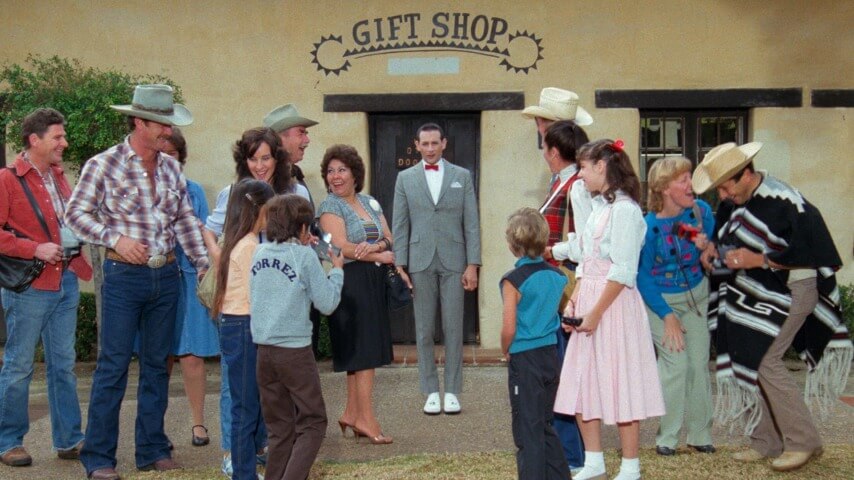
And Pee-wee is just the kid to tell it. In his form-fitting Glen Plaid suit and shiny Alfalfa haircut, he looks like an especially bullied kid was on his way to picture day when he got Big-ified. He’s a kid’s idea of an adult (they wear suits, right?) sneering through life, laughing at his own jokes, fighting off the advances of the girl who’s got a crush on him, and taking on bullies. He’s also a Looney Tune. For every improbable success Pee-wee pulls off with his Bugs-like cross-dressing and costume-swapping, there’s a Daffy-like plummet to earth—a moment of rage, failure, slapstick, hubris blowing up in his face. It’s Bugs who wins over the biker gang with what’s effectively a drag performance of “Tequila,” and it’s Daffy who immediately crashes a motorcycle afterward.
It’s all part of the silly-scary balance that Burton would make his kid-enticing hallmark. Creating a world not just navigated by a grown kid, but one that had a kid’s burgeoning understanding of safety and danger, Burton infused Pee-wee’s Big Adventure with fantastical threats. It’s not the escaped convicts you need to worry about, or the grumpy bikers, or the furious bulls, or even the jealous boyfriends. The terror had to also be, in its way, a punchline. From Hansel And Gretel and his short Vincent, Burton brought in stop-motion animators Rick Heinrichs and the Chiodo Brothers in order to create these playful scares. Together, they made Large Marge, whose scene is all but a movie reaching out and goosing you.
This is the thoroughly childish spirit permeating Pee-wee’s Big Adventure: The volatile, puckish, myopic-yet-charming energy of a kid recounting their day spent playing pretend. And it’s the complexity within this tone, the sourness that comes out when Pee-wee blows up at those he’s gathered to search for his bike, that situates its fantasy in reality. There’s no false schmaltz or saccharine cutesiness, none of the cloying child-courting fluff that softens so much disposable children’s media. The stray sass, the random venom, the whiplash between innocence and indignation—these are what makes Pee-wee’s Big Adventure an enduring encapsulation of childhood.


 Keep scrolling for more great stories.