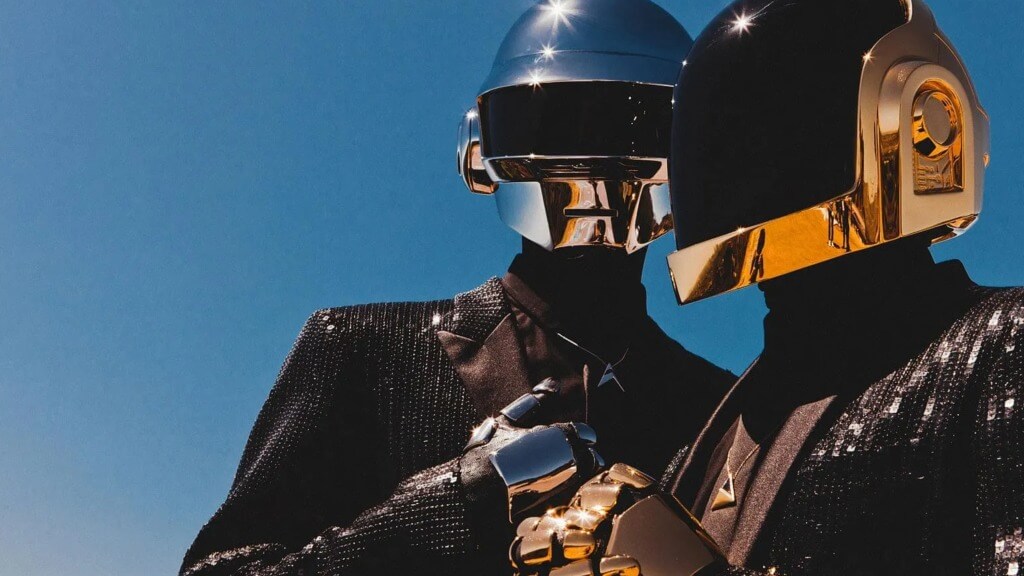
When Daft Punk broke up in 2021, eight years removed from their Grammy-winning final album, their legacy as the defining electronic act of the 21st century had already been cemented for some decades. By the time Homework was released in 1997, Guy-Manuel de Homem-Christo and Thomas Bangalter had spent some years massaging the world for its revivalist take on house music during a time where everything felt either freaked out or incredibly moody, as if the entire world of electronic music was still coming down from the ecstasy burnout of the earlier decade.
At the turn of the millennium, the options for a great electronic dance music LP ranged from the big beat insanity of the Prodigy and Fatboy Slim, the brazen drum and bass of Squarepusher and Amon Tobin, or something deeper and slower from Everything but the Girl, Theo Parrish, or Moodymann. When the Avalanches presented Since I Left You at the turn of the millennium, it signaled that optimism could accompany daring experimentalism, that people could hear something they never have before. Building upon the pillars of digital experimentalism but yearning for a return to dancefloor simplicity, Discovery was a watershed moment for the world of electronic music, proving that something bright and brilliant and daring could have a resounding place in the world.
The optimism of the dancefloor is seldom on better display than in Discovery’s first act. Other than the first pulses of Donna Summer’s “I Feel Love,” there is no track in all of dance music that will evoke a larger reaction than the stabs of “One More Time.” The song, built off Romanthony’s ecstatic vocals about infinite celebration and a horn sample that sounds like it’s streaming out of a transistor radio, encapsulates the infinite nature of dance music, its celebratory and perpetual spirit. It’s rare for a song heralded to such heights to live up to its reputation—but even after 25 years of constant playtime on the radio, high school proms, and club floors, it still stands as a masterpiece.
Tasked with the impossible feat of following that track, “Aerodynamic” is just chaotic, bumpy, and magnificent enough to keep the momentum rolling. Rock bravado, disco drama, and electro sheen meld effortlessly together, a synthesis that was previously unseen in house music’s bottled styles. After the famed guitar solo, Daft Punk’s own “Eruption,” totally halts the track for 16 bars, it’s shocking how seamless the wider track’s reintroduction feels. Rather than allow its perfect phrases to keep looping, as would be typical of a house track, “Harder Faster Better Faster Strong” refuses to stay on one idea for more than a few bars, creating a sense of indeterminacy that still surprises at every turn to this day. “Face to Face” features Todd Edward, the benevolent creator of UK garage and a major influence on French house’s jumpy collage style, on vocals. The song subverts the expectation of the DJ/producer, who is typically silently crafting in the background, and instead brings Edwards to the forefront with his unexpectedly tender vocals. Much of Discovery shows off Daft Punk’s ability to challenge the norms of dance music to create something that’s firmly rooted in the genre’s signatures but aspires to break standard molds.
Unlike the explicit tributes on Homework, Discovery prides itself in its detachment from the prior sounds of French house and American club music. There’s a distinct kind of perfectionism on Discovery that was unheard of throughout house music at the time, which explains its status as one of the only great house LPs. But some of the best moments on Discovery are when their influences bleed through. On the hard house epic “Crescendolls,” the swinging rhythms of Cajmere or DJ Sneak come alive. The tight rush on “Superheroes” feels at once footed in the minimal energy of Robert Hood and the lush expanse of Paul Johnson. One of the more straightforward house tunes on the record, “High Life,” borrows heavily from their frequent collaborator Todd Edwards and his jumping collages.
“Digital Love,” which features the duo on vocals, becomes the album’s most explicit statement of intent. The lyrics are perfectly uncanny, reading as if a robot is imitating what a sexy moment on the dancefloor feels like it should be. “It looked like everyone was having fun, the kind of feeling I’ve waited so long” read like they were written by someone who’s only been told of the idea of a fun time. Combined with the vocoder-drenched vocals, “Digital Love” feels like Daft Punk pushing the limits on a computer’s ability to express nuanced emotion, a challenge that somber indietronics like James Blake and Burial and plastic surgeons like A.G. Cook took on later in the century. The song explains the persisting relevance of Discovery in a century where digital love has become a predominant theme. Though its optimism has disappeared in the face of the haunting reality of chatbot romances and society-wide loneliness, Discovery reminds of an optimism that was once held in the advent of technologic interpersonality, when a computer was seen as a tool to bring people together rather than keep them apart.
Discovery established many of the maximalist and pristine aspirations of the next 25 years of digital music production, which is ironic considering how retro much of the record’s production was, even for the turn of the decade. The little breakdown on “Digital Love” is played with a Wurlitzer organ, heavily processed but real guitars fly throughout the record, while the rest of the album is built off of a generous amount of soul and R&B samples. But quickly, electronic music became an arms race for the biggest, brightest, and cleanest thing. Later in the century, electronic music once again became a breeding ground for a strain of emotive tunes expressed through the computer. Porter Robinson’s heartfelt expression on Nurture and Ninajirachi’s icy technopassion both feel baked in Daft Punk’s original mold. The wide timeline of hyperpop—from the bright-eyed robotic lyricism of A.G. Cook’s “Cos I Love You” and SOPHIE’s “Bipp” to the layered extremities of Jane Remover’s frantic dariacore and femtanyl’s digital hardcore—rely heavily on methods set forth across Discovery. And a classic in its own right, many of Justice’s best cuts from Cross feel like an amalgamation of Daft Punk’s best inclinations, if a little sleeker and sexier.
Within the rest of Daft Punk’s discography, there’s an inescapable sense that the duo spent the rest of their careers in conversation with this masterpiece, hoping to expand, disfigure, or complicate the legacy it had left. Attempting to invoke many of the same ideas, the celebration on Human After All never feels quite as precise as Discovery, overwrought with excitement like watching a race car careening off a cliff. Spurred by weariness with sample-based music, Random Access Memories feels like a vehement rejection of the digital precedence established on Discovery, an analog journey in order to “Give Life Back to Music.” Here, they made their intent more explicit than ever, a classy and indulgent crusade to do for disco what Homework did for house music and honor its forefathers while looking towards its future. And while the Grammy win and chart-topping hit helped cement the record and the band’s lasting legacy as a beloved group, these records didn’t so much cast new frameworks as reintroduce old ones.
Daft Punk’s contribution to digital production would be expanded on their Alive 2007 tour, which singlehandedly established the integration of DAWs like Ableton Live into live rigs. Touring Human After All but broadly celebrating their entire discography, the mashups and blends get nearly sampledelic, like they’ve rebuilt their music from the ground up. The extremity of the show became a crucial puzzle piece to the electronic music experience of the 21st century. When so-called raves morphed into a high budget production that could take place at the Sphere, there was an inescapable sense that Daft Punk had opened a Pandora’s box with its unbridled aesthetics of optimism.
Perhaps the most compelling of their works in light of Discovery may be their contributions to Yeezus, Kanye West’s 2013 masterpiece of industrial austerity that changed the face of hip-hop and electronic production. Its mangled digitality feels like an inversion of the bushy-tailed brilliance of Discovery, as if the robots realized the true potential of digital creation lies in its ability to be ugly rather than beautiful. Producing four of ten tracks, the duo crossed paths with a number of key 2010’s players that were extensively influenced by Daft Punk’s work: wonky pioneer Hudson Mohawke, trance revivalist Evian Christ, experimental extraordinaire Arca, and fellow Frenchman Gesaffelstein. Daft Punk’s participation in the project feels like a testimony to the strength of their innovation, so lasting and permanent that they’re the ones that must break it apart.
Back in 2001, the fact that Discovery’s impact was felt nearly immediately indicated the readiness for electronic dance music to return to a more explicitly optimistic tenor. Released the same year, Roger Sanchez’s megahit “Another Chance” shared similarities in its jubilance. Electroclash and French house hits like Fischerspooner’s “Emerge” or Shakedown’s “At Night” touched on notes of Discovery’s sheen, maximalism, and excitement. Overnight, Discovery became the most significant model for an entire generation of electronic dance producers. The overwrought radio EDM of David Guetta and Avicii, the emotive festival brilliance of Odesza and Porter Robinson, or even the plastic authenticity of the PC Music clique all extended from Daft Punk’s immense rapture.
It’s an impossible feat to age without feeling, well, aged, especially when so brazenly aiming for the future. Even classic material—say, digitally futuristic records from A Guy Called Gerald and LTJ Bukem, or the android dystopia of Björk’s “All Is Full of Love”—have contemporaneous qualities that firmly root them in their respective times. But like eternally relevant acts like Kraftwerk and Yellow Magic Orchestra, Daft Punk were able to see the future they predicted actually come to fruition and enjoy a pertinence that helps them remain among the most formidable heroes in electronic music history. It seems like in this newfangled digital world, the robots just can’t rust.
Benny Sun is a writer and the managing editor at STATIC Mag with additional writing in a handful of places. Based in New York, he splits time running around underground rap shows, back-of-bar punk rock gigs, and the Brooklyn club circuit. Follow on Instagram @bennysgreatesthits, X @bennysasianera_, and email at [email protected]


 Keep scrolling for more great stories.