Over the last 10 years or so, throwback shooters have fully come back into vogue with games like Doom (2016) and Ultrakill, reviving an emphasis on speed and pulpy carnage that was all the rage in the late ‘90s. While Funny Fintan Softworks’ Don’t Stop, Girlypop, with its vibrant colors and rhinestones,doesn’t match the traditional look of these grisly FPS games, its emphasis on mile-a-minute movement very much does, putting players in a rhythmic loop that has you bopping and weaving as you free a planet of fairies from a colonizing corporation. It’s a total sensory overload, but in a way that perfectly matches its loud Y2K fashion sense: basically, it’s what would happen if you took an early aughts girlband chart topper, and handed it a gun.
Don’t Stop, Girlypop follows Imber, the chosen champion of the Fairies, who is their planet’s only hope against the resource-extracting Tigris Nix corporation. Unfortunately, our hero’s quest is cut short when they are bested and captured by a cyborg middle manager from hell. When they eventually bust free of their containment unit some time later, they find that this scheming company is on the verge of a plan to destroy the planet for good, setting up a race against time that involves shooting a whole bunch of AI robots while listening to high-tempo pop jams.
This sense of narrative urgency is very much reflected in Don’t Stop, Girlypop’s moment-to-moment first-person shooting: this game is extremely fast. Building on the arena shooters of yesteryear, Girlypop focuses on movement above all else. If you’ve played or watched speedruns of older shooters, it’s very common to see skilled players break a game’s physics using advanced mobility techniques. Quake’s strafejumping and Counter Strike’s bunnyhopping are both examples of this kind of emergent gameplay that lets players blast through hard-coded velocity caps, unlocking a skill ceiling that was never supposed to be there in the first place. Girlypop has something like this, too, but in this case, it’s completely intentional (and much less of a headache to pull off). It’s called wave hopping.
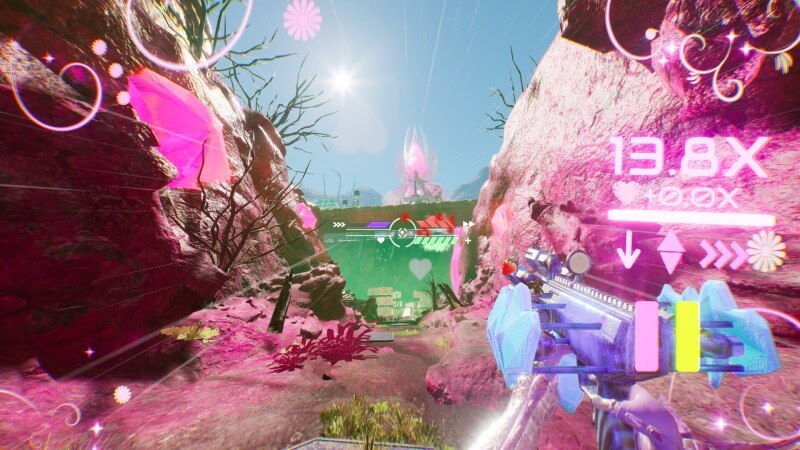
Wave hopping is performed by hitting CTRL to slam downwards, pressing SPACE to jump as you rebound off the ground, and then dashing with SHIFT. If you do it right, you’ll hear a satisfying whoosh anda pink trim will fill the edges of the screen as you zoom across the stage like a sequin-studded projectile. Pulling these off is the heart of the experience, and while your fingers may start to cramp as you repeatedly input CTRL, SPACE, and SHIFT in sequence, clacking these inputs out with the proper timing channels the rush of finally nailing a bunny hop, a wave dash, or any other form of game-changing mobility option.
The big difference is that since the player is actually supposed to move this way, the entire experience is built around wave hopping. Doing this technique builds speed, and the faster you go, the more damage you deal and the more health you heal. With that in mind, the goal becomes to navigate these combat arenas without losing momentum, something that requires a piano-like ambidexterity: your left hand is working WASD, the number keys (to switch weapons), and the CTRL, SPACE, SHIFT rotation, while your right tries to adjust your aim to account for this pixie-like nimbleness. Especially early on, it can be a blast when it all clicks, and it certainly helps that the soundtrack is blaring at a similarly high BPM.
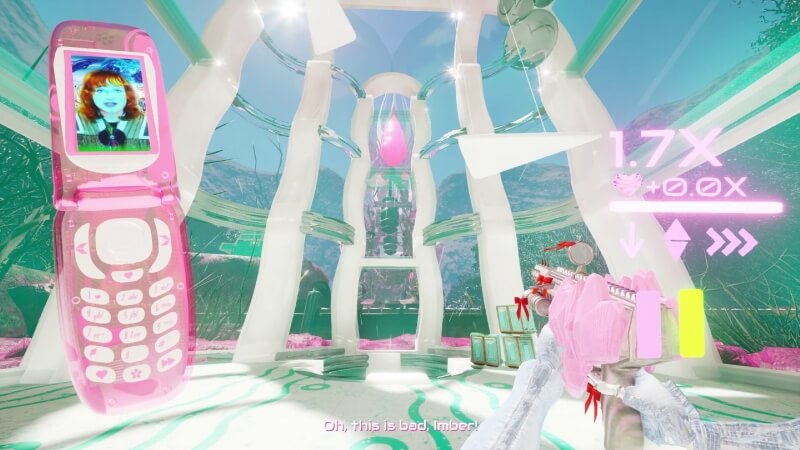
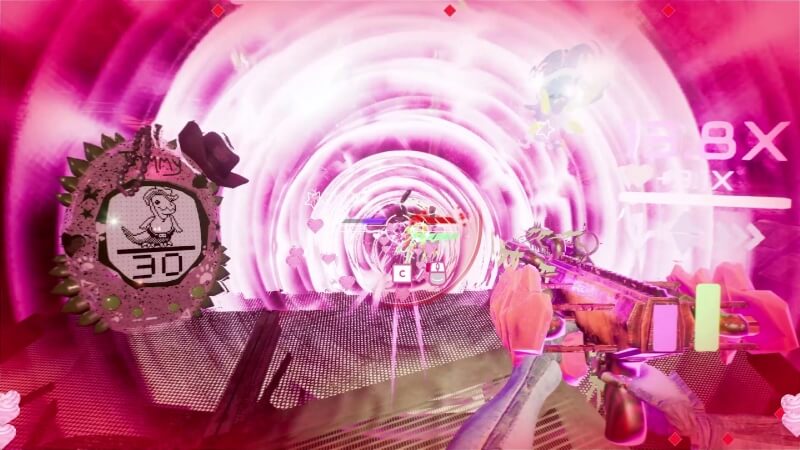
This is pretty obvious at a glance, but Don’t Stop, Girlypop goes all in on a specific brand of visual maximalism, belting its main theme as the screen fills with whizzing projectiles and bubble gum colored UI pop-ups. There’s certainly a lot going on here, but everything remains just readable enough, even when you’re moving so fast you could break the sound barrier, that it avoids being entirely overwhelming. It also helps that this rapid tempo matches the general urgency of your mission, as you take up the mantle of a denim-clad eco-warrior blasting through robots to defeat this evil corporation. Your handler (an FMV recording of the game’s director, Jane Fiona) gives orders via a period-appropriate see-through flip phone, further hyping up your mission before she summons a speaker system that blasts the girlypop anthem during boosfights. It is pretty good.
Unfortunately, there is one big downer that creeps in as you speed through this four to five-hour ride, which is that your foes are deeply uninteresting (they’re a little too good at embodying corporate drones). At least on Normal difficulty, the standard underlings put up next to no threat, and even against the bigger foes, as long as you keep wavehopping, you’ll heal up so quickly that it undermines any need for strategy. Many of the best boomer shooters are carefully crafted murder puzzles that mix brain and brawn, incentivizing smart crowd control and resource management. Doom (2016) and its ingenious core loop forced players to take out the peskiest hellspawn first (rip out that cacodemon’s eyeball) and to slay in different ways to restore ammo or health. By contrast, in Don’t Stop, Girlypop, since health restores based on movement and virtually all of the weapons have infinite ammo, wavehopping basically solves all your problems.
Make no mistake, it is fun to perform this sequence of inputs and get a boost, but this intrinsic satisfaction is pushed to its limit by these ho-hum encounters that lack a feeling of interactivity with your foes. And when the game does begin to increase its difficulty in its final few levels, it does so by breaking the core rules in ways that feel cheap and unearned. For example, a few levels feature instant-kill stage hazards that misguidedly discourage the kind of fast movement the game is built around, and later, there’s a rhythm game component that is cool in concept but awkward in practice.
Still, while Don’t Stop, Girlypop’s bland adversaries don’t leave much of an impression, maybe the game’s biggest contribution (besides its emphasis on hyperpop-tempoed movement) is how it challenges what a “boomer shooter” is supposed to look like. When a game references retro subgenres, there’s always a risk of obsessively recreating their inspiration instead of doing anything new. Girlypop takes the aesthetics and design ideas of a particular time period—the late ‘90s and early 2000s—and mixes and matches to find its own unique configuration. In the end, it combines the arena shooter format, movement-based emergent gameplay, and pre-9/11 pinks and denims into its own brand of sensory overload. Don’t Stop, Girlypop may not be a perfect arena shooter, but its fashion sense is impeccable.
Don’t Stop, Girlypop was developed by Funny Fintan Softworks and published by Kwalee. It is available for PC.


 Keep scrolling for more great stories.