One of the common refrains of awards season is that recognition often goes to the Most, not the Best. While it shouldn’t be disqualifying for a performance to be filled with fiery speeches, for a story to be filled with frenetic editing, or for a viewer to be overwhelmed with a cacophony of sound, it’s a lot easier for voters to pull the lever for something that’s noticeable.
Opening credits sequences aren’t immune to this, either. Even before the days of interactive Westerosi maps, the Outstanding Title Design category was peppered with winners and nominees singled out because of the amount of work it took for them to exist. But as the 2025-26 nominations approach, the time is perfect to honor a show that bucks this maximalist trend and offers a worthy, grounded replacement.
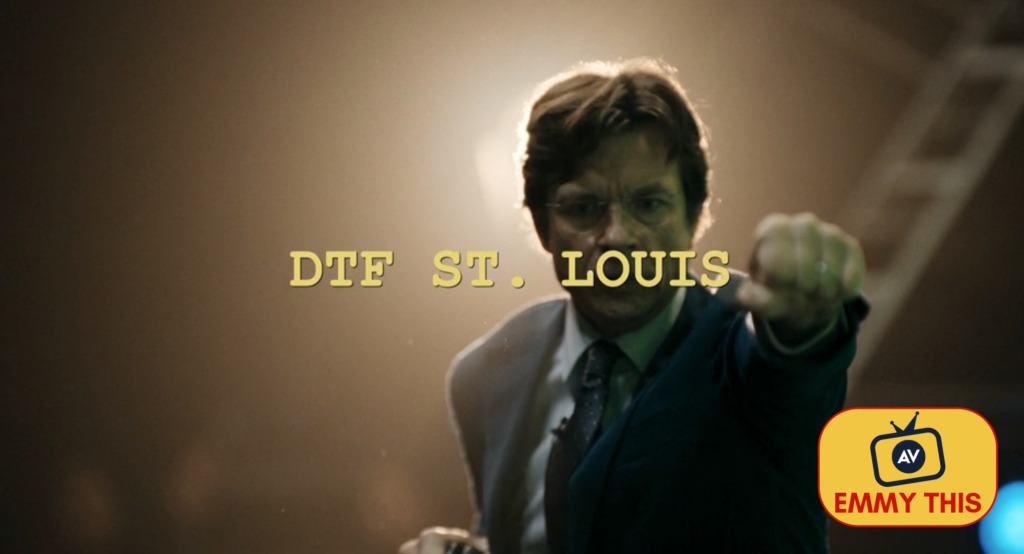
DTF St. Louis was one of spring 2026’s most pleasant surprises—a fictional crime story whose framework subverts the expectations of both the characters investigating the crime and the TV audience watching that investigation unfold. That upending of expectations takes hold in the show’s opening credits sequence, which is mostly composed of slow-motion footage showing weatherman Clark Forrest (Jason Bateman) at work. Before Clark can take a sledgehammer to his familiar life, we see him in the TV studio, seemingly gesturing to offscreen coworkers and locking in as the news desk throws to him for the 5-Day Forecast. Interspersed throughout are glimpses of DTF St. Louis’ other two protagonists, Clark’s ASL interpreter-turned-best-pal Floyd (David Harbour) and Floyd’s wife Carol (Linda Cardellini). A pixelated Floyd is rocking out during one of his other freelance gigs while Carol is hidden behind curtains and bedsheets.
Not content to go with the somber, moody cover of a pop song that a lesser mystery (or mystery-adjacent) series might use as its theme, DTF St. Louis instead enlists the second half of The 5th Dimension’s Hair medley, “Aquarius/Let The Sunshine In.” I can’t definitively say that there aren’t tiny subliminal changes to the credits over the course of the season. But Floyd snapping enthusiastically along to a timeless groove from the session wizards of the Wrecking Crew takes on a different significance every time you decide to forgo the Skip Intro button.
In fact, the whole sequence is malleable enough to fit whatever version of these three main characters the show puts forward in any given episode. From behind the veil of motel-room drapery, Carol could be a temptress, a trapped housewife, or a grieving widow. The affable Clark could be the TV weatherman good guy or a compartmentalizing psychopath denying his own involvement in a homicide. Floyd is Floyd, doing the thing he loves, whether or not he’s guarding some seismic secret, set to be revealed the closer the show gets to its ending.
There’s incredible value in using the familiar in completely novel ways. The 5th Dimension version of “Let The Sunshine In” is a late-’60s repetitive beam of light (a “Rainbolero,” if you will). Over the course of these 90 seconds, hearing the minor variations in the sung repetition of the title, this sequence finds both the promise and the melancholy that run through the rest of the show. And at series’ end, what clearer message could there be from DTF St. Louis than Billy Davis Jr. passionately exhorting you to “Open up your heart”?
Using a stock, typewriter-ly font like Courier New could be a statement of humility or aloof pretentiousness. Here, I think it’s clearly the former, a recognition that whether by budgetary or artistic constraints, there’s no need for a splashy custom or handwritten design. All three of these main characters are trying to write their own stories to the world (two of them very specifically to the detectives working the case), so it makes sense that the title and cast and crew of DTF St. Louis are presented with lettering that wouldn’t be out of place in a “EXT. FRONT LAWN BBQ” screenplay heading.
The TV work of DTF St. Louis creator Steven Conrad often finds an ominous beauty in the banal. In the credits for Patriot—his most enduring show both in length and in the urgency of people who recommend it—home movies become a memory of what’s lost between brothers. Childhood innocence is both shown and proven to never have existed in the first place. The final image right before a hard cut to black is of a kid pulling a Ralphie and shooting his eye out. The DTF credits imagine characters in a similar quantum state, both blameless and culpable in being untrue to themselves. The show surrounding them posits that second option as the true tragedy, even when compared to untimely death.
DTF St. Louis is a series explicitly designed to challenge assumptions. Conrad is taking a TV-watching generation either raised or trained on true-crime stories and using those assumptions against them. These credits are a reminder that assumptions can be insidious, that someone’s own confidence that they have the whole story can be weaponized in any number of ways. That’s what makes the final Bateman karate kick such a perfect tone-setter for the story to come. Whether you take this as an imagined fever dream or a premonition of surreal plot points to come, there’s no way to predict how it will actually surface in the tale that’s unfolding. Genuine surprise is rare currency and this sequence is an invitation to share in the spoils if you have the patience.
It’s a tiny thing, but it may be what really puts this sequence over the top: DTF St. Louis joins the proud tradition of shows that let the opening strains of theme music bleed in from the end of the cold open that precedes it. Some of the most satisfying smaller-scale Succession moments came from this simple idea, one that’s also popped up in series as disparate as Misfits and Justified. (None of those shows were nominated in this category, by the way—though that’s not Misfits’ fault, being as it was a fully British production.) Allowing some of the rest of the show to work its way into the credits, backed by a horn section crescendo, is the best example of DTF St. Louis heeding its own lesson and letting that sunshine in. May the same be true for Academy ballots.


 Keep scrolling for more great stories.