
Enchanted, or: How I learned to stop worrying and love the Disney princess

I’m as guilty as anyone of occasionally framing issues of onscreen representation in terms of how they might impact hypothetical kids watching and internalizing the messages. Yet I was also a kid who grew up having absolutely no problem juggling a deep love of Disney princesses with a staunch belief in gender equality. In fact, far from being something toxic I had to overcome, I see my early (and ongoing) love of Disney princesses as a complete net positive in my current career as a feminist pop culture critic. It inspired my love of film history and musical theater, and I still think fondly of each and every animated heroine I idolized as a kid. Whatever “just sit around and wait for a prince!” messaging Disney princesses theoretically brainwash into young girls clearly didn’t happen to me. Which isn’t to say that it hasn’t happened to others, but is maybe to say that little kids perhaps don’t take the media they consume quite as literally as we worry they do.
And yet there’s no doubt that the Disney princess—which is both a specific line of characters and a broader colloquial idea that condenses 80-plus years of history into one cultural stereotype—remains one of our most controversial cultural ideas. (For some perspective, the first Disney princess debuted under Franklin Roosevelt, the latest under Barack Obama.) The question of whether or not to let their kids engage in “princess culture” is still one many parents agonize over across endless think-pieces. Keira Knightley received rapturous applause when she recently told Ellen DeGeneres she’s banned her 3-year-old daughter from watching Cinderella and The Little Mermaid because of their problematic messaging. Ever since sister-focused Frozen explicitly built its marketing around the idea that its heroines “aren’t like other princesses,” each new Disney princess flick is now destined to be endlessly scrutinized for its feminist credentials against a vague sense of the nebulous “Disney princess” stereotype.
The latest bit of Disney content to pat itself on the back for doing something self-referential and empowering with its princess lineup isn’t actually a princess movie, it’s Ralph Breaks The Internet, the sprawling Wreck-It Ralph sequel that features a much-hyped sequence in which all the Disney princesses appear together. And though our short-term cultural memory about all things princess means the whole thing will likely be hailed as a subversive game-changer, the good news for Ralph Breaks The Internet fans is that Disney has actually been doing this kind of thing for a long time now! Every princess film since 1989 has to some extent been challenging the passive princess stereotype. And Disney gave that stereotype an even more explicitly subversive twist in its pitch perfect 2007 musical fantasy romantic comedy, Enchanted.
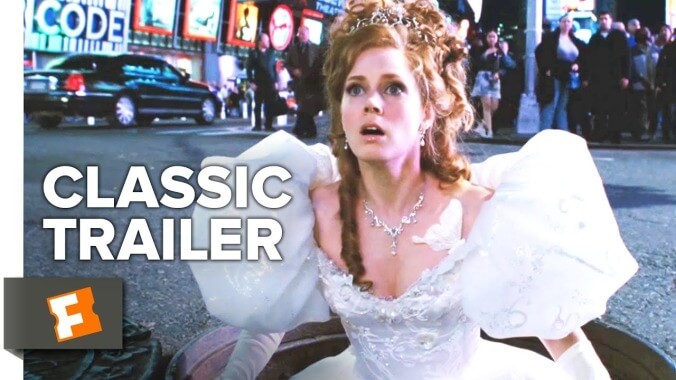
The story of a naïve animated would-be princess named Giselle (Amy Adams) who accidentally winds up in the complicated real world of New York City, Enchanted director Kevin Lima had a very specific sense of exactly what he was lampooning. He designed Giselle to be “about 80 percent Snow White, with some traits borrowed from Cinderella and Sleeping Beauty” plus a little of Ariel’s spunkiness thrown in. Unsurprisingly, given the eras in which they were made, 1937’s Snow White And The Seven Dwarfs, 1950’s Cinderella, and 1959’s Sleeping Beauty are the least progressive Disney princess films and the ones most ripe for parody. (1989’s The Little Mermaid kicked off the Disney renaissance, and Ariel serves as a transition point between the older princesses and the newer, more empowered ones that followed.) Enchanted is happy to poke fun at dated princess tropes (“We shall be married in the morning!” Prince Edward proclaims moments after meeting Giselle—a far funnier gag than Frozen’s attempts to do the same), but it’s never mean-spirited in its humor.
In fact, whereas Bill Kelly’s original script was a racier, more sardonic take on the material, Lima realized the film would work far better as a loving homage to Disney rather than a cynical Shrek-like takedown of Disney tropes. He brought Kelly back onto the project, and they set about crafting a version that was both a light parody of and an earnest tribute to the Disney princess legacy. To some extent it was canny brand management. Disney Animation was in a huge rut in the early 2000s, vaguely chasing the look and feel of its subsidiary Pixar and not finding much success in the process. Enchanted helped revitalize interest in the Disney princess genre and kicked off a new princess era that would eventually lead to mega-hits like Frozen and Moana.
Yet when you read interviews with Lima, it’s clear his enthusiasm for the material is entirely genuine—the equivalent of J.J. Abrams’ excitement at getting to play around in the Star Wars sandbox. A lifelong Disney fan and animator who had worked on classics like Beauty And The Beast and Aladdin before directing A Goofy Movie, Tarzan, and the live action 102 Dalmatians, Lima was thrilled to get the chance to return to 2-D animation for Enchanted’s opening and closing sequences. Because Disney no longer even employed a cel animation team, those 13 minutes of animation had to be done by another studio.
Directing both the animated and live action portions of Enchanted, Lima packed the film with enough Disney easter eggs to make your average Marvel movie look like an empty nest by comparison. From recreating specific shots to recruiting Disney princess voice actors to play minor roles to naming a fictional law firm after the composers of Snow White And The Seven Dwarfs, Lima has claimed there are literally thousands of easter eggs and references in the film, at least some of which are categorized on a whole Wikipedia page devoted just to the topic. Lima also brought an animator’s eye to the composition, physical comedy, and visual jokes of Enchanted.
 Keep scrolling for more great stories.