A timely Sundance doc is an ICE-breaker around community action

Everybody To Kenmure Street shows what's possible when immigration officials aren't allowed to murder at will.

A timely Sundance doc is an ICE-breaker around community action

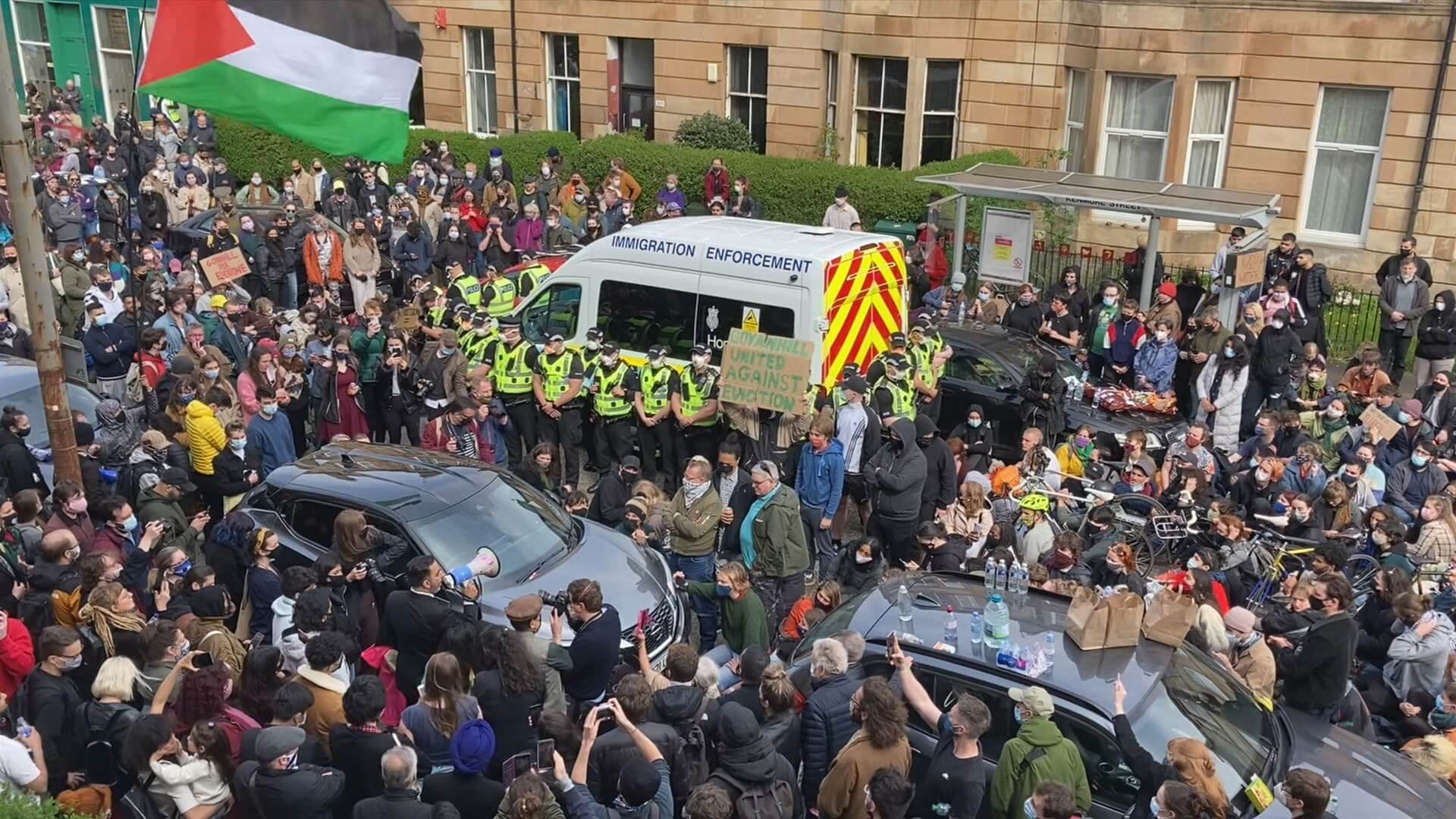
The most timely documentary playing the Sundance Film Festival this year takes place in May of 2021. From two dozen different angles, filmed by professional and citizen journalists, it watches as a community rallies together to stop immigration officials from snatching two of their neighbors from their homes. Five or six people with their phones out become a dozen, then a hundred, then three hundred. An outsized government response is no match for the full force of pissed-off locals. The amazing thing is that it works. The cops relent, the detained men go free, and nobody gets hurt. It’s not hard to guess that this film doesn’t take place in Chicago or Minneapolis or anywhere else in America where ICE has been brutalizing residents. Yet, even though the protest at the heart of Felipe Bustos Sierra’s Everybody To Kenmure Street takes place in Glasgow, in a world that might seem far-fetched to us in the U.S., a place where masked agents of the state aren’t allowed to murder at will, it’s still an invigorating and inspiring ICE-breaker around what is possible with targeted community action.

While the sheer volume of violence wreaked by those attempting to stuff residents into vans may be different, the cowardly animosity of the Home Office agents and the bravery of the protestors will be familiar to anyone whose city has been recently under siege. On Kenmure Street, in Pollokshields, home to a large South Asian community, a “dawn raid” stormed in on the first day of Eid, detaining two Indian men who’d been there for a decade. As many of the local Muslims who join the protest, some coming straight from the mosque down the street, note, this seems intentional. Targeted cruelty. 

It is met, almost immediately, with equally targeted benevolence. Not only do angry neighbors start pouring out of their homes, one quickly dives under the Border Agency van holding the detained men, latching onto the chassis and refusing to let go. (This burly punk hero, defined by a cut-off vest festooned with anti-fascist patches, conducts his interview through a proxy: Emma Thompson.) Reluctant to drive off and doom this Samaritan to the asphalt meat grinder—certainly another difference between the doc subjects and ICE—the immigration officials are stuck.

That gives the burgeoning protest—growing from the unassuming seeds of babysitting exchange groups, apartment WhatsApp chats, religious communities, and friends of friends—the time it needs to mature. But it’s not the turnout that’s all that impressive; plenty of demonstrations have organized larger groups of people for mass public showings of indignation. It’s that the outpouring of support was immediate enough to be protective, and organic enough that this essential speed was possible. 

Much like the literal whistleblowers currently helping keep their streets safe from federal agents in cities around the U.S., the people of Pollokshields were simply ready to drop everything and stand up for a stranger. In Everybody To Kenmure Street‘s endless series of interviews, what’s winning isn’t just that the bad guys lost, but that they lost to a high school student who skipped an exam to stick around, to an older guy down the block who worked from home, to young parents wondering what all the ruckus was about, to a nurse who spent her day facedown on the pavement checking in on the “van man.” Each new talking head has a different story about how they got involved, but they’re all driven by the same simple compassion. 

They’re also able, in that same organic and rapid way, to coordinate the necessities for a day-long protest—bathrooms, refreshments, sanitation, warmth—amongst themselves. They won’t be dispersed because there’s nowhere to pee, no water to drink, no blankets to fight off the cold. It’s a perfect encapsulation of how public safety can be maintained sans law enforcement, created off the cuff by a few hundred strangers united by decency. It was also peacefully sustained for eight hours, an unimaginable amount of time for an ICE agent to go without assaulting a bystander.

At the end of those eight hours—a time during which local cops were called in to support the immigration officials, and one additional person dove under a car to prevent its escape—the police chief called it in: For the good of public safety, the men must be released. It’s a heartwarming end to a feel-good documentary, a festival film that gleams with optimism as it’s released into an era bludgeoned black and blue. Those demonstrating the same civic-minded care Stateside as the people responsible for this film are being kidnapped, gassed, beaten, tortured, blinded, and killed. And still, Everybody To Kenmure Street makes me hopeful. Not because these are one-to-one situations, with similarly sane governments and gun control laws. But because these are one-to-one communities, composed of individuals who surprise each other with their own interconnectedness. Even if Americans have to respond to attacks on their own Kenmure Streets in different ways, adapting to the rampant aggression they meet at every turn, this film is a start-to-finish example of why it’s worth fighting back in the first place.

 
Join the discussion...
Keep scrolling for more great stories.