The thing you need to understand about the end of the world is that nothing really ended. Humanity survived, because that’s what humanity does. The plan to wipe out the whole, big, messy problem of Us vs. Them in one fell nuclear swoop was a bust, not because the middle-management types masterminding it didn’t do a pretty good job of killing people—they did, with piled-up skeletons in the billions!—but because there’s always more Them out there. Humanity generates division as a byproduct of existing. And human nature, like war, never changes. But what if it could? What if some big, brilliant business brain could find a way to “fix” the bug in our collective firmware? What if it was just “Us”—or maybe just “him”— forever?
Welcome back to Fallout, which returns to us in season two with a funny, scary, lively, and slightly disconnected premiere that catches us up on (most of) our main cast, while also introducing a few key new characters and themes that will likely weigh heavily on this latest sojourn through the Wastes. We waste no time—give or take a mammoth, six-minute “previously on” recap— in introducing one of these major movers-and-shakers, either, as Fallout tosses up one of its rare title cards to introduce us to the guy with his finger on the doomsday button: “The Man Who Knew,” Robert Edwin House.* (*I’ll get into the weirdness surrounding this character’s casting, and the show’s odd reluctance to name him, down in the sStrays; for now, I’m just going to go ahead and treat the character Justin Theroux is playing in these opening scenes as though he’s House.)
Introduced smugly smoking in the back of a bar full of tough men striking against his own company, Theroux’s House is presented as a sort of Transatlantic Tony Stark, sneering about the triumphs of capitalism, while insulting men much bigger and stronger than himself on the nature of their “obsolescence.” The effect is simultaneously queasy and charismatic: We’re trained, as audiences, to gravitate to the smartest, most confident guy in the room, and House qualifies on both counts. But he’s also, under the calm veneer, an obvious preening tech-bro monster, attempting to bribe one of the blue-collar workers into letting him jam some kind of mind-control implant into his neck and, when that fails, just sneakily doing the job himself. The façade of confidence slips, for just a moment, when his new cyberzombie seems like he’s about to rebel, having already brutally beaten his friends at House’s command. But it’s only a temporary blip in the glorious road toward progress, as House cranks the settings on the device and produces our first (but not last) head explosion of the season. Cue credits!
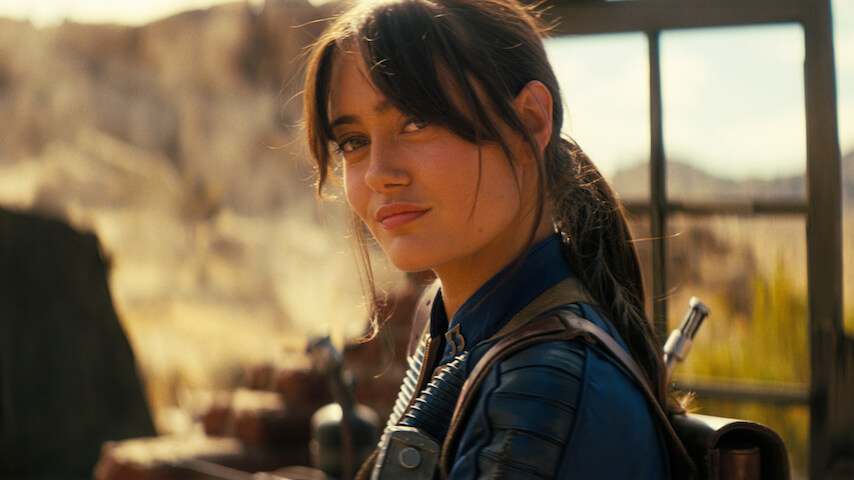
When we return, it’s to what I can’t help but think of as Fallout’s version of The Good Stuff: the tentative and friction-filled partnership, formed in the last minutes of last year’s finale, between Lucy MacLean and the man who used to be called Cooper Howard but is now, forevermore, The Ghoul. Walton Goggins and Ella Purnell’s double act was one of the highlights of the show’s first season, and it’s only gotten better now that the two are forced to rely on and navigate the Wastes together. Purnell, especially, remains a revelation: It would be easy for Lucy, as written, to come off as stupid or naive. But Purnell’s ability to make her character’s optimism and kindness feel like a deliberate choice, one she makes despite knowing that it’s all probably going to end in “a lot of violence,” allows one of TV’s most surface-cynical shows to function with a surprisingly bright light at its center. It worked last season, and it continues to pay dividends here.
Fallout is still able to generate a crowd-pleaser of an action scene like the one that breaks out in the tiny settlement of Novac, where local “matching jacket” crew the Khans have seemingly captured The Ghoul with the intention of paying him back for two centuries of picking them off like flies. A standard bounty hunter double-cross goes awry when Lucy can’t help but stand up and ask whether these drug-addicted psychopaths might opt for a non-violent solution. They, uh, don’t. (“Whoever kills the girl gets to eat the dog!”) And so we’re plunged into some pure video-game nerd fan service, as Lucy is forced to fire flesh wounds from her sniper spot in the mouth of a big concrete dinosaur, while The Ghoul starts killing everybody to the tune of Marty Robbins’ ballad “Big Iron.” And while my own personal geek brain might quibble a bit at a gunslinger needle drop accompanying an action sequence in which our cowboy zombie killer never actually uses a revolver, the ensuring violence is still satisfying enough—and Robbins’ song is such an obvious “Fuck yes!” trigger, especially for fans of 2010’s Fallout: New Vegas—then I can’t leave the sequence feeling anything but pumped.
From there, it’s a trip back to flashback land, as The Ghoul reveals that he knew, or at least knew of, House back in his pre-war, pre-nose-loss days. There’s an argument to be made here that, given how incredibly spread out in time and space this episode will end up being—we’re basically following six different groups of characters who never interact—you could maybe stand to lose at least one of Cooper Howard’s flashbacks here in the interest of pacing. (The first one is at least part retread, as we once again see the scene where his wife Barb—now with a shadowy Theroux looking on—reveals Vault-Tec intends to start the war that will not, in fact, end all wars.) But the honest truth is that a show that can go as broad as Fallout frequently does need these moments and the humanity of Cooper trying to figure out where he can take his daughter in a world where the apocalypse is not only coming but has been aggressively branded with his cheerfully complicit face. Later on, he’ll meet with our old pal Moldaver, who suggests that Cooper use Barb’s connections to get close to House—supposedly the guy who’ll actually launch the missiles when Judgment Day comes—and kill him. She seems to read his reluctance to contemplate the deed as a fit of moral compunctions, but Goggins plays the moment closer to bone-deep weariness: We’re watching the formation of The Ghoul in real time at this point, including when he returns home and, with lies and heartbreak hiding in his eyes, reconciles with Barb.
Elsewhere (and, yeah, there’s going to be a lot of “elsewhere” here), we catch up with Norm MacLean in his makeshift tomb in Vault 31, where he’s been locked in by former management guy/current brain in a jar Bud, who insists he’s only got two “rational” ways out of his current predicament: climb into one of the cryo pods that Bud’s been using to periodically decant old Vault-Tec staff—including Norm’s dad Hank—to come run vaults 32 and 33, or die. These sequences walk a nice line between comedy and menace, with Michael Esper doing a fine job of making the Bud-bot both ridiculous and chilling—and, ultimately, ineffectual. In the end, Norm chooses a non-rational option, by releasing all the drones from their cryopods on the theory that a brief burst of chaos might be more productive than a long, slow slide into death.
Elsewhere, we also check in on the other residents of 32 and 33, and it’s here where, had I my druthers, Fallout would be trimming some fat. The show’s first season got some decent laughs out of showing how hapless and insulated the non-management Vault dwellers have become after a few centuries of isolation, and we certainly get more of that here, as we follow hapless idiot Reg around on a pretty typical day of trying to feel like anything he does matters. (Since he has a “PhD in party planning,” he probably won’t be pitching in on the Vault’s current water-chip crisis.) There are decent jokes and character beats lodged in here—the show got a laugh out of me when it revealed that Reg was hosting a “products of inbreeding support group,” and Annabel O’Hagan is having fun as brusquely chipper new Vault 32 manager Steph—but, hoo boy, does it feel like a distraction. Fallout has always struggled to give the impression that it’s telling a cohesive story when it has such a struggle getting more than two of its characters in the same room together for anything more than a scene. And it’s never been harder to buy it than when we’re watching a bunch of characters we barely know make a series of extremely broad incest jokes. As far as first impressions for a season premiere go, it’s especially dire: Any urgency we might have been carrying into this thing after last season’s big climax gets poured down the drain as we watch Rodrigo Luzzi idly putter about like the comic relief sidekick in a ’60s sci-fi flick.
Luckily, we also have more Lucy and The Ghoul to check in on, as the pair end the episode by tracking Hank to yet another Vault, 24. (That’s after a brief digression for some far more effective Wasteland comedy, when the duo meet a “flea soup” vendor who’s grimly happy to supply her own fleas.) Down in 24, they quickly realize Hank waltzed in, stole something, and quickly left—but not before leaving his little “Sugar Bomb” a message, in the form of a guy who’s been rigged up with one of those neck devices from back in the episode’s first scene. It’s here (and in the epilogue that follows) where Fallout makes it clear that it still has firm grasp of its ability to blend uncomfortable humor with the horrors of a technologically advanced world, as The Ghoul and Lucy both watch, terrified, as the poor guinea pig mumbles out the message Hank has left implanted in his brain—and then explodes. Even if we didn’t get the episode’s last big showpiece, it’d be a chilling demonstration of where Hank’s head is at these days: The creatures living on the surface are tools, not people, and he’ll cheerfully use them as meat to advance whatever twisted agenda is kicking around in his brain.
Speaking of—which is to say, [deep breath] elsewhere—we end tonight by checking in on Hank himself, as Fallout reveals one of the very specific legs up it’s probably going to have on the show’s first season: a Kyle MacLachlan unleashed. We only really got MacLachlan’s Hank in two episodes of the show’s initial run, and he was obscured from us for most of that, trapped in a cheerful sitcom-dad shell. Here, though, we get to watch the actor channel his inexhaustible boyishness to far darker ends, as he takes up residence in an old Vault-Tec research facility, suits himself up in some dapper duds, and leaves an ominous message for an unnamed “sir”—presumably House—who he tells he intends to complete the “brain-computer” interface. As he speaks, MacLachlan lets the madness slowly bleed through Hank’s veneer of middle-management cheer, until we’re watching the light go out of his eyes as he promises that “When this is all over, you will be begging me to help you.” It’s chilling, effective stuff and the chance to see more of it is one of the things I’m most excited for in Fallout’s second season.
So it’s very much a table-setting premiere, walking through where all of our characters (minus Maximus, who never appears) are at. Which has the unfortunate effect of leaving Fallout at the mercy of the quality of any individual given scene, with no overall sense of momentum and cohesion to impart energy to the whole. When the show is cooking—when we’re with Purnell, MacLachlan, or either version of Goggins—it’s easy to be reminded of what was worth missing about this series in the year-plus since we last got new episodes. That push and pull of cynicism and idealism remains bracing, just as the similar war between the show’s comedic and horrific impulses keeps either side from dominating. When we don’t have those anchors, though, it’s easy to feel the show veering off the rails: This series can’t function successfully for very long in either pure comedy or pure action/sci-fi/horror mode, and when it tries, the quickness with which it begins to wobble can be alarming. This is a pretty good collection of scenes, all told, and my grade for the episode reflects that overall quality. As a single episode of TV, though, it’s hard to perceive it as much of anything at all.
Stray observations
- • Okay, so in season one, Rafi Silver played Robert House in the big boardroom scene, and he’s still credited in that role when he makes a brief appearance here. (Theroux, meanwhile, is credited for the episode, but without a character name attached.) That being said, both the episode and a GQ interview make it clear that Theroux is the one actually playing House, so the guy at the table is pretty clearly some kind of body double. (I have a theory that he might be playing House’s brother, who ran the hardware company whose products Theroux’s character speaks so lovingly of in the video game, but that’s just me fan-wanking.)
- • “Every dollar spent is a vote cast.” “It’s hard to imagine being so dim as to be caught off guard by the inevitable.” Theroux is really nailing the seductive entitlement of the “smartest guy in the room” type.
- • I remain slightly cool on The Ghoul when he’s in pure badass mode, which feels like it gives Goggins too much permission to get cliché. That being said, I liked him opening with “Didn’t there used to be a store there?” to the “matching-jacket motherfuckers,” and his hat-tip to Lucy at the end of the fight looked undeniably cool.
- • “Big Iron,” written and performed by Marty Robbins in 1959, is not just the song that plays over The Ghoul bloodily exploding the Khans. It’s also probably the most beloved soundtrack selection in Fallout: New Vegas, the video game that this season is expected to take a lot of cues from.
- • That being said, the suburb Cooper escapes to in the flashback—complete with a smiling Vault-Tec salesman traveling door to door—is very clearly modeled on the pre-war version of New England town Sanctuary in Fallout 4. (Ditto the Starlight Drive-In from later in the episode.)
- • “Nowhere near Robert House is safe.”
- • We don’t get a lot of Leslie Uggams tonight, but Betty’s very pointed delivery when she asks Reg if he’s wrestling with feelings of “Shame? Uselessness?” was a nice beat.
- • Brain-Bud spells it out nice and loud for all of us: ”Reclamation Day” comes “when there’s no one left on the surface to disagree with us!” Given what House and Hank were/are up to, that’s even more ominous than it used to be.
- • I really enjoyed the flea-soup seller shaking her head out enthusiastically over the bowl.
- • We get a shot of a poster for a Cooper Howard Roman epic. My New Vegas brain asks: Foreshadowing?
- • I appreciate whatever restraint it took to not have Hank give a “Damn fine cup of coffee!” after he savors a cup at the Vault-Tec building.
- • Our closing-credits sequence shows Primm, one of the first towns players are likely to encounter in New Vegas. The roller-coaster is real, by the way—it used to have the Guinness record for tallest coaster in the world—although it hasn’t run since the COVID-19 lockdowns.
- • Welcome back to our coverage of Prime Video’s Fallout! I’m excited to dig back into this show—not just as someone who considers New Vegas to be the best of the Fallout games but who’s genuinely excited to see what this show can do with some sophomore energy (and hopefully a tad more focus).
William Hughes is a staff writer at The A.V. Club.


 Keep scrolling for more great stories.