When it was announced that Bones Film was going to be adapting Gachiakuta, a popular new battle-shonen manga, fans of the source material were quite excited. And justifiably so, because Bones has about as good a track record with this kind of anime as it gets: Full Metal Alchemist: Brotherhood, Mob Psycho 100, Soul Eater, and My Hero Academia are just a few of the celebrated series they’ve handled over the years.
Thankfully, their latest keeps that streak alive, elevating strong source material with animation that captures the bubbling rage of its slighted protagonist; the action is weighty, and the show translates the urban punk flourishes of mangaka Kei Urana’s stylish art. However, perhaps the biggest surprise is how this narrative, initially a bit too consumed by teen angst, matures like its main character, eventually centering on the compelling tension between the protagonist’s lingering hatred for a society that threw him out and the sense of belonging he gets from his new found family of “freaky weirdos” (in the words of the author).
As for where this revenge story begins, Rudo has a tough run of it. He grew up in a slum that sits in the shadow of a wealthy metropolis, where he’s shunned by his own people due to being the son of a convicted murderer. Then, after losing the one person he truly cared about, he’s framed for a crime he didn’t commit and dumped like human trash into an abyss called “The Pit.” It was supposed to be a death sentence. But against all odds, he survives the fall and soon discovers the truth. “The Pit” isn’t a big hole, but a trash-filled wasteland, and the place he came from is a flying city referred to as The Sphere. Down on the surface, he runs into a new problem: giant garbage monsters. Thankfully, he’s saved by a mysterious warrior named Enjin, who quickly recruits him into an organization called the Cleaners, who fight these creatures using items imbued with special powers. Rudo, having awakened his hidden ability, decides to join, not to keep this place safe, but so he can gather information to get back to The Sphere and destroy those who wronged him.
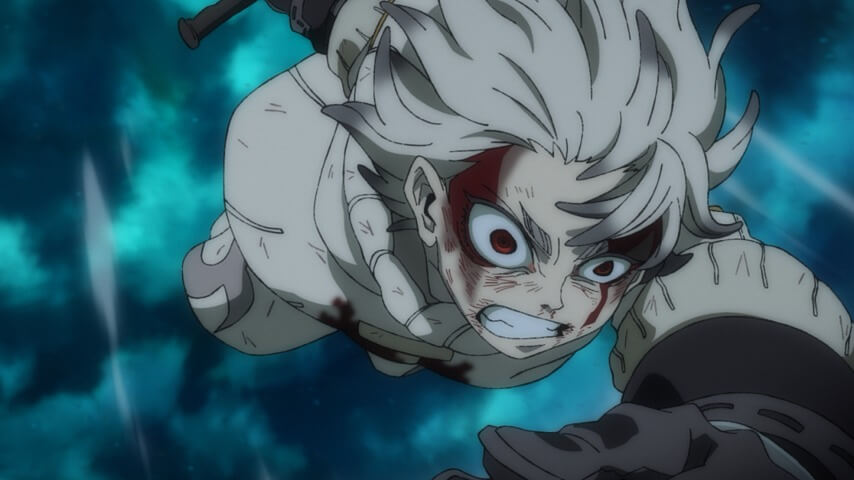
As this setup implies, everything begins with Rudio’s anger, a deeply rooted hatred conveyed in violent cuts of animation and the murderous expression in his blood red eyes. But while he’s justified in despising the Spherites for how they treated him, especially the wealthy section of the city that discriminates against and punishes the “tribesfolk” with impunity, it’s less that he wants to “change this shitty world,” as his foster father puts it, and more that he’s guided by a festering misanthropy. Initially, he doesn’t want to create a more just society; he simply wants to smash everything in his path.
While this element of his character makes it hard to get emotionally invested in his story at first, thankfully, it turns out that this upfront toxicity is very much the point, as the series mulls on this kind of dangerous ethos parroted by many troubled young men. From here, there are interesting ups and downs as he gets to know a colorful group of characters who make him question his path forward. But now he has a new problem, as his growing attachment to his allies causes his anger to suddenly explode to the surface in other ways, as we see that controlling these impulses isn’t as easy as flipping a switch. Instead, it is a long, complicated, and more interesting journey of learning to reach out with an open hand instead of a closed fist. This dude may need therapy, but for now, beating up monsters with his pals will have to do.
Beyond these musings on Rudo’s masculine anger, there’s also the rest of his group, whose appeal begins with their sharp character designs. Sick haircuts, dusterpunk fashion, and improbable weapons give each member of the Cleaners a sense of personality even before they open their mouth for the first time. There is a general aesthetic cohesion to this world, one that looks like a Mad Max post-apocalypse that was filmed for an MTV music video, as street art and a genuine sense of community contrast against rock-wielding hoodlums and organ dealers. Again, Kei Urana doesn’t miss, and she’s especially good at realizing badass women, something sorely lacking in the battle-shonen space. And while some of the cast are here just as fun one-off side characters (at least so far), a few get compelling backstories that are teased out during extended fight sequences, ensuring that even during the very long battle that makes up the last half of the season, there is room for deeper moments of characterization.
It also certainly helps that, as you would expect, Bones Film brings the juice when the Cleaners are forced to wield their Vital Instruments (items with magical powers due to the wielder’s emotional attachment) to dish out some damage. There is a good balance of well-chorographed, weighty strikes mixed with a tactical element brought out by these various fighters’ unique abilities. While not as intricate or off-the-wall as something like JoJo’s Bizarre Adventure, it still very much features those classic battle shonen-style mind games where opponents attempt to untangle an opponent’s abilities and strategy to find a weakness, lending a cerebral element to these scuffles.
And when the blows start to land, Bones brings in many of its most talented affiliated animators, like their ace-in-the-hole talent Yutaka Nakamura, who delivers a particularly brilliant sequence defined by agile movement, impact frames, and terrain-crushing violence—obviously, not everything looks this good, but the standard is quite high across the board. The previously mentioned emotional angle and backstories meld with visual imagery, like two warrior women smashing symbols of stereotypical femininity while exchanging punches, ensuring that these sequences are extensions of the storytelling and not empty spectacle.
If the series has one major flaw so far, it’s that it takes a while to get to these fireworks, both in terms of its more visceral fights and its crunchier narrative beats. While the class disparity and general inequality depicted in the opening hour are an interesting setup, it takes a while to warm up to Rudo, who is initially all bluster, and to learn more about the rest of the Cleaners, making it difficult to connect to the series’ ethos upfront. Thankfully, this eventually changes, with the only other major gaffe being some abrupt tonal shifts, including one particularly disquieting episode depicting grooming that could have used more time to explore its heavy subject matter.
Overall, though, Gachiakuta is off to a strong start, an action series that delivers flashy throwdowns while also proving it has a bit more on its mind than cool-looking violence: allusions to a concerningly relevant type of “troubled” young person and persistent undercurrents of class disparity. Compared to many works of fiction that superficially ape the aesthetics of counterculture, this one embraces graffiti, street art (the manga features a dedicated graffiti artist, Ando Hideyoshi), and the culture around it through its anti-establishment themes; these characters are here to smash some monsters, literally and figuratively, and look damn good while doing it. As long as Bones and Kei Urana’s source material keeps bringing their A-game, Gachiakuta will remain a confidently executed genre piece that’s a step well above the action anime landfill.


 Keep scrolling for more great stories.