This is heavy stuff—but also material frontloaded into the vampire myth, sitting as it does in the queasy intersection between sex, manipulation, the treatment of other people as objects, and everything else that crops up when one sentient being is put in a position to view another as food. Nighthawks doesn’t flinch from any of it. You can do a lot of terrible things with your power in this game, from the petty cruelties of forcing the employees at your titular nightclub to subject themselves to degrading costumes, all the way up to rampant murder sprees. But one of the very worst things you can do is nothing, once you notice that something really awful is happening right under your nose.
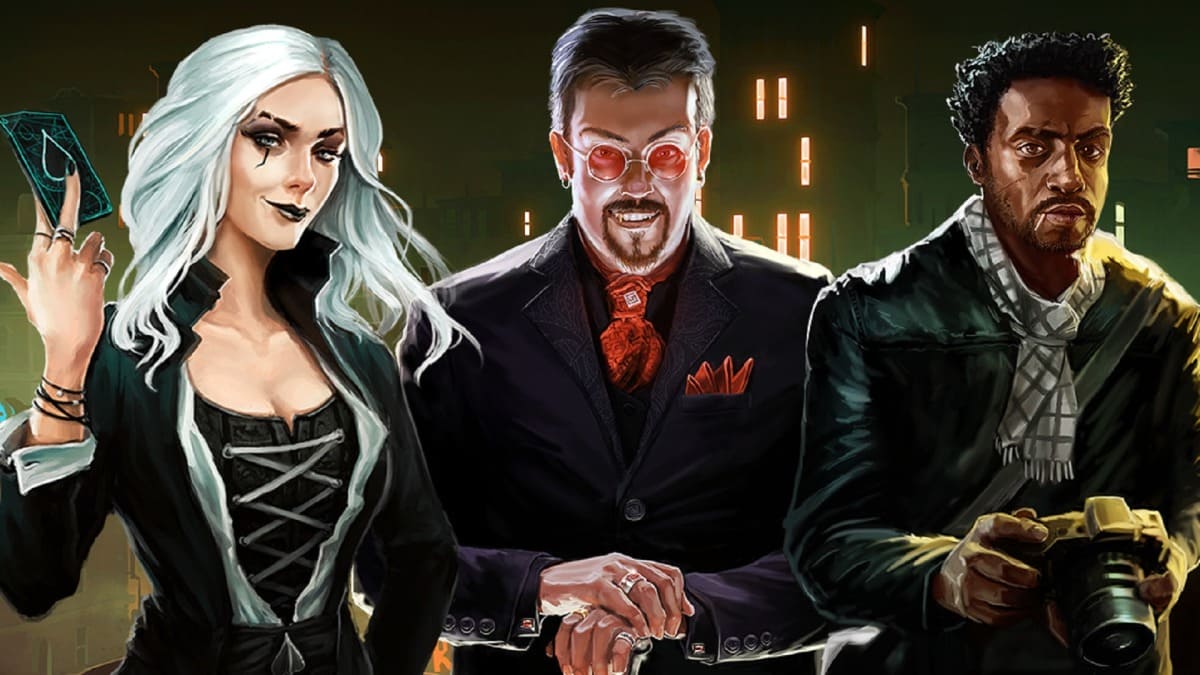
Some context: With a presentation not unakin to a visual novel, Nighthawks plays out mostly through dialogue choices and reading (with some occasional dice rolls along the way); notably, it doesn’t have a traditional combat system, or a traditional RPG party. What it does have are Companions, who journey out into the night with you while adding their skills and abilities to your own; in practice, they serve the same purpose as the teammates you’d accrue in a Mass Effect or Dragon Age game: friends along for the ride, who give a unique perspective (and, frequently, a chance for romance) as you complete various quests. The first one you get in Nighthawks is a guy named Maze, a charming, smooth-talking conman who runs both a rarely frequented bookstore and a sort of mini-cult/self-help group, one that operates as a (mostly) harmless way for him to fleece some blood from human saps lined up for his “wisdom.”
When introduced to your fledgling vampire—fresh off getting the shit kicked out of them by anti-vamp gang members in a city where the Big Undead Secret recently broke—Maze is a vision of helpfulness, providing you with shelter, blood, and protection, all entirely gratis. Sure, he makes no secret of being a cad, or that his decision to help you now has as much to do with making a long-term investment in your success as any sort of free-floating esprit de corpse. But he’s an early, charming, friendly presence, one who sticks around through the whole game: Helping you on quests, participating in buddy banter with your other Companions, and generally contributing to the game’s “make the most fun you can out of eternity” premise. The issue with Maze isn’t Maze, really. The issue with Maze is Hazel.
Hazel, you see, is Maze’s thrall—an extension of vampire lore that Nighthawks spends quite a bit of time on. In this universe, as it turns out, humans regularly infused with vampire blood get all sorts of nifty benefits: Their wounds heal; terminal diseases slow to a crawl; lifespans extend indefinitely. Sure, it’s not all blood-colored roses: You wind up with a compulsion to eat bugs sometimes (“The Renfield Effect”). And you don’t sleep anymore. Oh, and you start calling the vampire giving you your fix “Master,” and come to believe that nothing is more important than serving their will. Not just slavery, but the belief that it is right that you are enslaved; truly hideous stuff.
Although it frontloads other stories about the horrors of this kind of compulsion, the game deliberately softballs Hazel’s personal hell, at least at first. She’s introduced early on as Maze’s bumbling assistant, her frequent suffering at his blithely inconsiderate behavior pitched in almost sitcom terms. (She eats bugs! She has to stand out in the rain because Maze told her to wait on him and then forgot! It’s all a lark!) It’s only in the aggregate that players realize how thoroughly her agency has been stripped from her. Eventually you find out that Hazel isn’t even her real name—Maze just started calling her by her eye color, so he wouldn’t have to bother remembering the person she used to be. But even then, you can’t directly intervene. It’s not until one of your other teammates (a human, naturally) takes you aside to ask “Isn’t this kind of genuinely fucked up?” that you can begin to try to make things right—if you’re so inclined.
To describe this plotline further would be to spoil one of the most interesting parts of one of 2026’s most interesting games. But suffice it to say that I’ve rarely played an RPG where my views of a character operating in my inner circle were altered more radically. Once you understand that your funny, helpful buddy is a serial abuser—and recognize the ways you were encouraged to laugh off that behavior, or simply ignore it, because it would be inconvenient to lose him as a resource—many of the through-lines Nighthawks has been building about the insidious uses of power come into focus as sharp as a predator’s fang. I didn’t love every moment I spent with the game. It frequently struggles with the often-vast gaps between its ambitions to have choices and consequences matter, and its relatively linear main story. (And its efforts at humor are decidedly hit or miss.) But I can’t take away from it the moment where the game asked me to really look at a dynamic I’d been glossing over for several hours, to see the thing that both gameplay considerations and the established rules of bloodsucker society had encouraged me to ignore. A pit opened up in my stomach then, as I realized Nighthawks was really willing to go to these depths: A true, gut-wrenching story about how and why people turn a blind eye to evil, simply because it’s coming from inside “the party.”


 Keep scrolling for more great stories.