Each grain of rice is cooked with patience. Fresh wasabi lovingly grown in-house. Soy sauce is sacrilege. These are the rules at Jiro’s tiny sushi restaurant in the Outer Ring of a dystopian Los Angeles, and when a menacing patron plunges his nigiri into the salty brown condiment (with the added insult of it being rice-side down), Jiro (Brian Tee) responds as any reasonable chef might: he decapitates him.
Rather than prompting a nationwide manhunt, the chef’s crime is met with a shrug in the world of Get Jiro, where extreme dining-related violence is commonplace. “No one gives a shit about a decapitation in the Outer Ring,” a jaded detective explains shortly afterwards. Perhaps not, but murdering a cuisine is another matter entirely.
The late, great Anthony Bourdain—who created the original Get Jiro! graphic novel with Joel Rose—traveled the world, always meeting cuisine and culture on its own terms. He had little patience for the tourist who arrived in another country demanding that dinner accommodate their set ideas of what a meal should entail. Get Jiro takes that conviction and pushes it to its most gloriously unhinged conclusion: What if culinary integrity were quite literally a matter of life and death?
In the future Los Angeles envisioned by Bourdain and Rose and shepherded to the screen by Alessandro Tanaka and Brian Gatewood, food is power and chefs wield it with unremitting brutality. One of the biggest is Bob, a kingpin and purveyor of haute cuisine who takes an interest in Jiro after the sushi chef kills one of his loutish muscle men. Bob presides over a kitchen empire with all the grave menace of a gangster who’s just waiting for a reason to flambe his own patrons. His great rival is Rose, a vegan chef whose legion are styled as idealistic young anarchists with tattoos and unfortunate haircuts, and considerable access to both meat substitutes and automatic weapons. Jiro, taciturn, lethally skilled and primarily interested in being left alone to make excellent sushi, inevitably finds himself caught between them.
The joke of chefs as gangsters shouldn’t sustain 10 episodes any more than eating a sliver on tuna on a small mound of rice should become a transcendent experience for the senses. Yet, they somehow do.
Partly that’s because Get Jiro keeps finding increasingly demented ways to fuse the vocabulary of food with the mechanics of an ultra-violent neo-noir. Young men are waterboarded with buttery sauces, chef de parties slice arteries as often as they do vegetables, and a crème brûlée technique is deployed to particularly grisly effect. In The Outer Ring, owning a small neighbourhood restaurant appears to involve roughly the same occupational hazards as trafficking cocaine in 1980s Miami.
It is impressively gnarly stuff. The statistical odds of any newly introduced character surviving an episode often seem to hover in the single digits. Yet for all the self-seriousness of the near-growled dialogue, Get Jiro is very funny. It tosses casual strays at food trucks, fine dining haughtiness, and every other indignity of modern food culture. Bob insists that in the kitchen it is known that only idiots eat brunch—spending $50 on eggs Benedict while tanked up on mimosas is a testimony to a poor palate and even worse priorities. As anyone who’s worked in the industry might attest, opinions like these are as close as Get Jiro comes to documentary realism.
There is something wonderfully Bourdain-ish about treating these petty culinary grievances with exactly the same gravity as murder. The series understands the particular mixture of snobbery and generosity that made the No Reservations host’s reflections on food so compelling. There were pretensions he considered unforgivable, certainly, but beneath the swagger was an abiding respect for the craft.
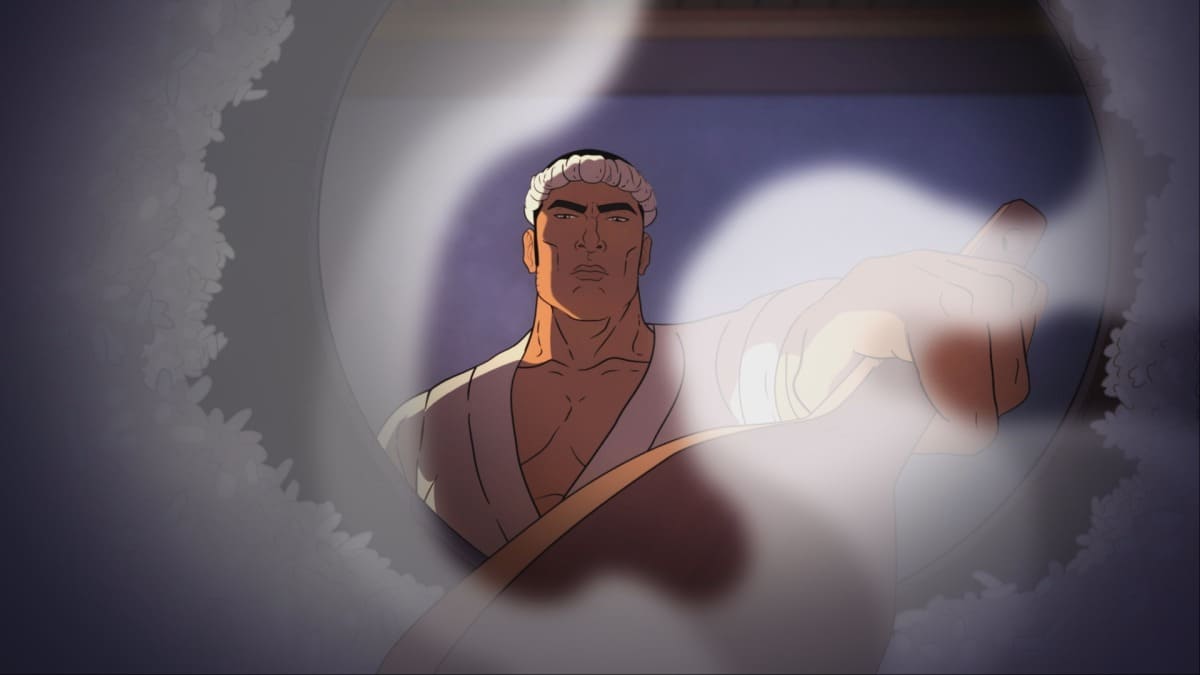
Jiro certainly shares this quality. Tee gives him the gravelly antihero gravitas of a Japanese Sam Elliott, never confusing a taciturn nature for a lack of personality. Jiro is the rare man in this world who doesn’t seem especially interested in acquiring territory, followers, or power—he truly cares most about sushi. Asked for his secret, he explains that every ingredient must be treated equally and with the same care: focus too much on the individual pieces and you lose sight of what they make as a whole. Unfortunately, because this is the restaurant industry, his dedication to making uncompromised, wonderful food has also made his business financially unsustainable.
The pressure is soon on Jiro to turn what he does into something bigger, safer and more profitable, his cooking repackaged into a watered-down “retail” version of itself. Here Get Jiro‘s apparently ludicrous premise begins revealing how much it can actually accommodate. Its food wars become arguments about authenticity, cultural appropriation, gentrification, commerce, and what happens when something made with obsessive care becomes a product designed to be a pale imitation of its purest form. Some of these parables land more elegantly than others. The gentrification material can become dour, and occasionally the writers’ contortions in service of their central, organized-crime metaphor come out as dialogue straining to sound like human speech. But this, like many of Get Jiro’s excesses, eventually becomes part of the fun.
The zippy 20-minute episodes help enormously. There simply isn’t enough time for the show to become as ponderous as its characters occasionally threaten to make it. The world-building also gets more impressive as the story expands beyond Jiro’s little restaurant. Car chases tear down Los Angeles highways, cruel prisons form labyrinths of concrete and steel, and the animation finds a scale that isn’t immediately apparent from the series’ comparatively restrained opening scenes. The voice cast is solid if occasionally predictable, while the sound design can feel strangely neat and pristine for a world this grubby. Tee, though, remains terrific throughout.
There is an obvious joke in imagining Bourdain as the patron saint of a world in which improper sushi etiquette is a capital offense. But his interest in food was never really about enforcing arbitrary rules and strict adherence to culinary traditions. It was about understanding what those rules meant: the history, labour and cultural memory embedded in a dish, and the arrogant dismissal involved in deciding you’d want soy sauce anyway. A full-blown Anthony Bourdain origin story came to theaters barely two months again, and yet it is this deranged little cartoon that feels like the more loving and apt tribute to the man. Get Jiro has his hard earned expertise and his generosity, his impatience with bullshit and his romance in the ceremony surrounding every meal time. More importantly, it understands what’s worth caring about. Food was never just food to Bourdain. It was one of the most immediate ways of understanding somebody else’s world.
Transposing that weight into animated carnage is ridiculous, but also in line with the wicked sense of humour that Bourdain brought with him wherever he traveled. You can’t help imagining him watching this show, gently chuckling at the television, delighted by every terrible pun, little gripe, and lovingly rendered arterial spray. Get Jiro sees the same darkness, beauty, and absurdity in the world that he did. What a pleasure to spend a little more time with him there.
Get Jiro premieres October 3 at midnight on Adult Swim, and streams on HBO Max October 4.


 Keep scrolling for more great stories.