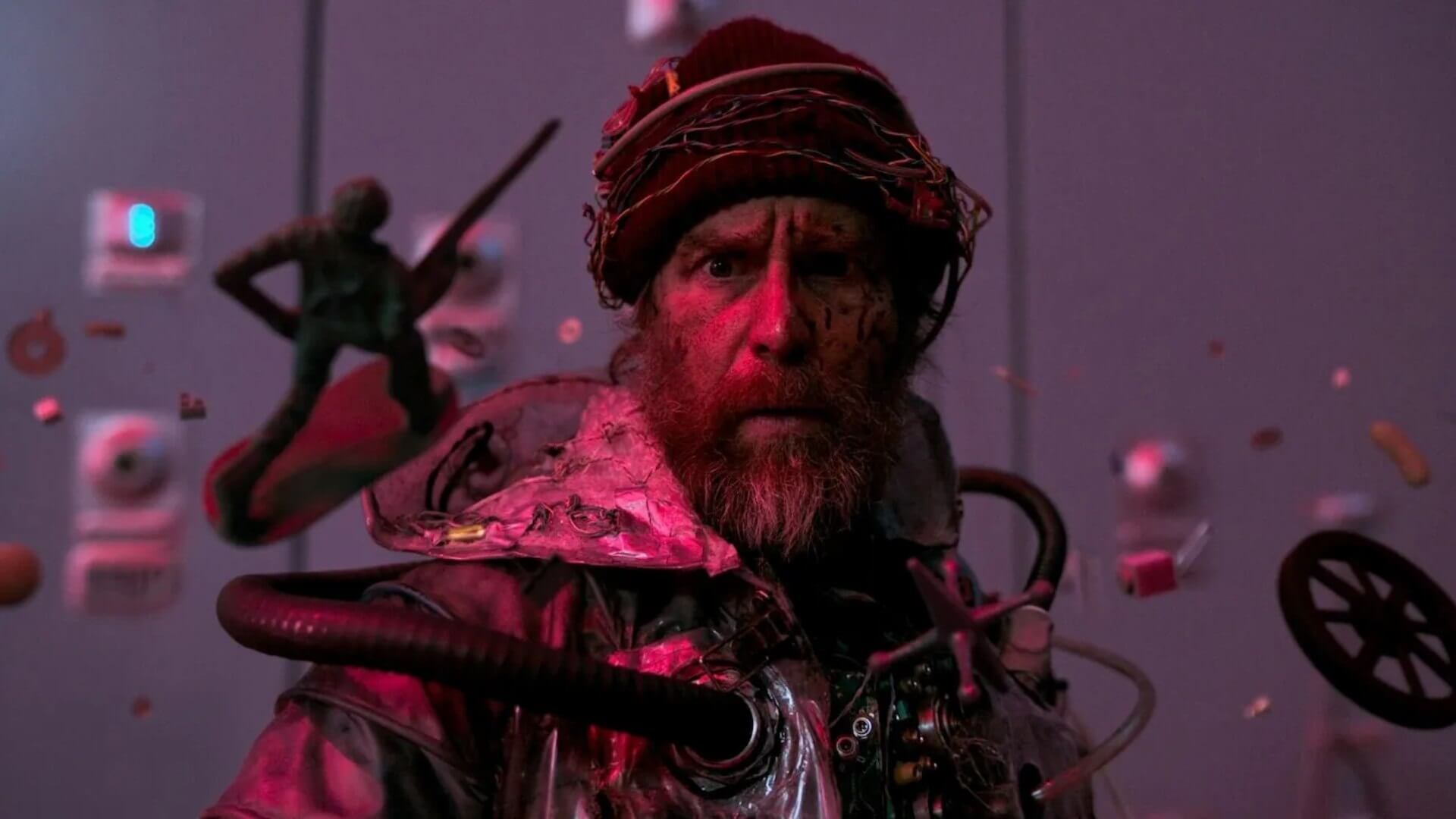
Everything about the man from the future (down to his lack of name) exudes the kind of over-designed quirkiness that defines the film’s style, tone, and story. He waxes on constantly about having done this world-saving exercise 117 times (all of which have failed, of course), shouts odd non-jokes like, “See if you can survive the calorie burn of a temporal rift!”, and dons an offbeat plastic robe overflowing with tubes that looks like it was pieced together from toy scraps in a children’s science museum. He playfully insists it’s the height of future fashion when he’s accused of looking homeless (“Our homeless look dead!”). This is all shot by director of photography James Whitaker, who delivers dull, dark, and grimy cinematography with pops of over-saturated color—a strange combination seemingly designed to heighten the film’s oddities, but one that simply makes the aesthetic seem more inconsistent than off-beat.
Though the film’s messaging positions it as a protector of humanity, an advocate of originality, and a staunch protester of AI-generated content, Good Luck, Have Fun, Don’t Die reeks of market research aimed at triangulating the buzziest topics in the U.S., leading to a potluck plot featuring school shootings, phone addiction, virtual reality, and AI’s growing dominance in society. This marriage of subjects has the potential of any collection of headlines, but the messy combination is both contrived and campy—a bit like The Faculty, but it’s the students who are peculiar this time. There’s a brief period at the beginning where the intersection of kids glued to their phones, the disturbingly casual treatment of high school students routinely getting killed in class, and the ominous presence of a strange corporate entity called “Again” show some promise of that potential. Intriguing questions blossom. “Why are the kids advertising to each other on their devices?” “Why are they so rude and confident in their stonewalling of the teachers?” “Why aren’t the adults doing anything about it?” Yet, it’s all handled with such obvious lack of realism that it’s clear there must be something else going on. Instead of revealing their cards strategically to conjure more mystery, Verbinski and Robinson simply lay them all out on the table.
Bouncing back and forth between the past and present—diving into each character’s backstory and returning to the central, world-saving scenario—Good Luck, Have Fun, Don’t Die tries to cleverly piece together a puzzle-like reveal as if to surprise an audience who’s been staring at the cover of the box the whole time. Editor Craig Wood—who worked on all of Verbinski’s early career classics—can’t seem to shake the standardized studio editing trends he’s picked up over the last decade editing films prescriptively for Marvel and Disney. And, at two hours and 14 minutes, the predictable movie’s obvious plotting never seems to end. The starry cast (including Rockwell, Zazie Beetz, Haley Lu Richardson, Michael Peña, and Juno Temple) seems promising enough to lift the script from its cringe-inducing commitment to engineered eccentricity, but even they can’t save this hyper-trendy content-farm film from itself.
Good Luck, Have Fun, Don’t Die ends up being the latest and least engaging entry in a kind of 21st-century quirkcore cinema, which reached new heights with films like Sorry To Bother You, Kajillionaire, and Everything Everywhere All At Once and has since fallen flat as a certain type of constructed oddity has become normalized. This silly, simplistic sci-fi journey means to be thought-provoking, but the irony of its banality is more recoiling than provocative.
Director: Gore Verbinski
Writer: Matthew Robinson
Starring: Sam Rockwell, Haley Lu Richardson, Michael Peña, Zazie Beetz, Asim Chaudhry, Tom Taylor, Juno Temple
Release Date: February 13, 2026


 Keep scrolling for more great stories.