Those who feared that they’d have to wait for Angel Studios to release Zero A.D.: The Birth Of Christ in order to see the dramatized story of a messianic leader of men who also happened to be a notable distributor of tasty treats will be pleasantly surprised that Hershey, the company’s collaboration with the chocolate manufacturer, is as hagiographic as anything from scripture. This is unsurprising, given The Hershey Company’s extensive involvement with the biopic, but it does make the inept drama into an unintentionally amusing experience that often feels more like a David Wain comedy than an overlong commercial.
But the cast and crew don’t seem to realize they’re participating in Wet Hot American Chocolate, whether that manifests as the screenwriters’ dead-serious devotion to hitting the biographical and business-history high points, or the admirable straight faces maintained by its stiff ensemble. It’s even helmed by washed-up comedy director Mark Waters (Mean Girls, Freaky Friday), who commands day-players like Alan Ruck to say things like “Unicycles are the future!” and who dresses Richard Kind as the candy-striped owner of the candy store. All the markers of comedy are present, but instead of punchlines, scenes climax by earnestly bowing down to the good-hearted Milton Hershey (Finn Wittrock) as he pursues his dream of running a candy empire.
Well, really he starts with the dream of just not screwing up yet another confection store, as he piddles away all the money loaned to him by family members. But this—like an opening dissolve that rivals Brotherhood Of The Wolf‘s breasts-to-mountains transition, where a Hershey’s Kiss morphs into a lump of coal—is present only to establish Hershey’s hardscrabble bonafides. Like so many biopics, Hershey is a film about what its audience already knows. Where dramatic irony exists for comedy or tension, films like this use their viewers’ knowledge to coddle and reassure them. No matter his financial struggles, we know Hershey won’t be a candy failure forever. We also know that despite his company’s initial focus on caramel, chocolate is his future. And despite his film-long experiments trying to get things right, we know the shapes and names of his lasting products, which the film deploys like grand epiphanies.
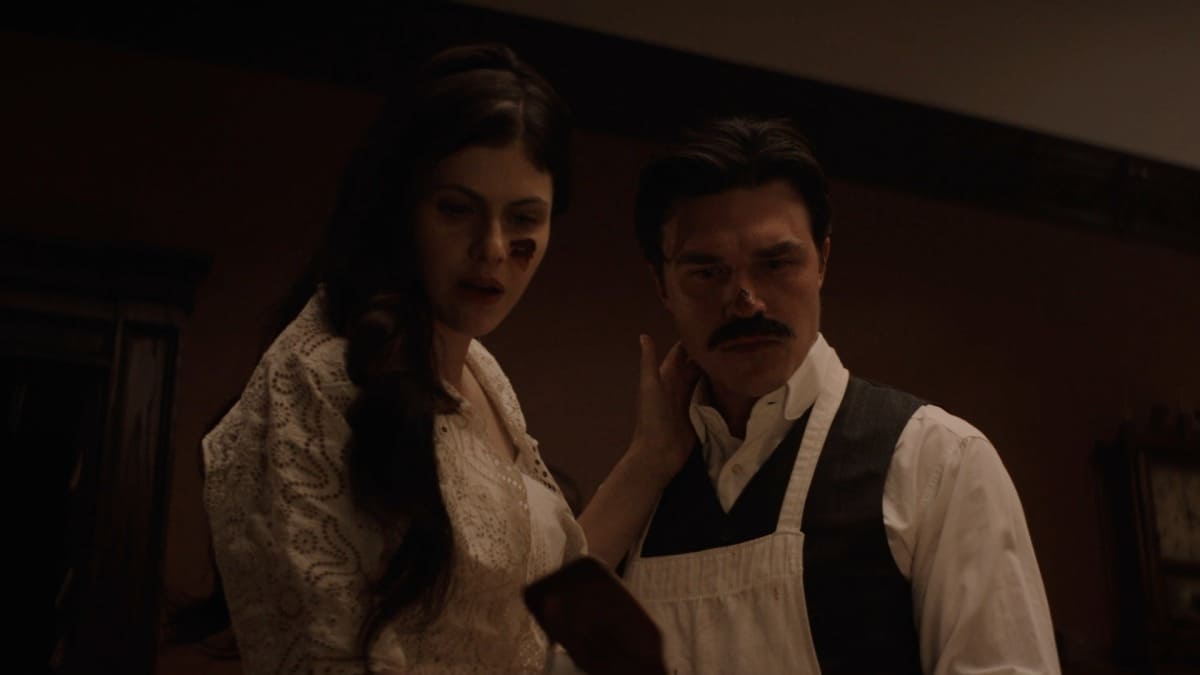
That means the plot of the film, Hershey’s trajectory from hardworking urchin (who even has one of his bosses yell “Hershey!!” at him like he’s Garfield) to married mogul, is hard to pay that much attention to, despite the film’s dedication to the chatter of industry. There’s a constant background hum about orders and loans and revenue and growth, of overhead and product diversification, but really all we can pay attention to are the ridiculous characters who drop everything to praise Hershey and his similarly candy-crazy wife, Kitty (Alexandra Daddario). There have been corporate biopics before, all about the capitalistic acumen of its employees and founders, but rarely have they been so blatant and silly. None boast dialogue like “I don’t want to talk about Tobias Thornhill and his dubious business practices!” Hershey is like if every Charlie And The Chocolate Factory adaptation was about Willy Wonka going to the bank, and then the banker tried to fellate him.
Only, that implies that there might be some kind of detail to the film’s financial reports, or color in its sugar-plumped cheeks. No, Hershey has a parody’s broadness throughout, including in its drab brown “it’s the past, stupid” palette. Everything’s the color of a Hershey’s bar, which might be good for branding but bad for viewing. As Hershey’s successes continue—his company grows, his town (also Hershey) flourishes, his wife lusts after him (the film wants us to know that Hershey was a great and sexy man)—Wittrock evolves from handsome actor to top-hatted Monopoly Man to Orville Redenbacher. He meets fellow chocolatiers, given the same gravitas as a Marvel cameo (is that George Cadbury??), and establishes his legacy in scenes that could be shown at morale-boosting company gatherings. The always-humble scion shrugs off, but never refutes, the endless flattery: “I’m a businessman. Business is about human service.”
Certainly, this man probably did some good things with his wealth. But Hershey is interested in the school to which he bequeathed his fortune (and which has been referred to as “the charitable-trust Enron” by the president of its alumni association) like it’s interested in his candy business: It slobbers over success and turns everything, even his wife’s diagnosis with a neuromuscular condition, into another reason to deify him.
More saccharine than milk chocolate and much harder to swallow, Hershey is lucky it’s almost too funny a corporate puff piece to hate. Glazing the candyman by turning his life into a bootstrapping myth about hard work, good products, unimpeachable values, and American opportunity could’ve made for unwatchable corporate onanism. But Hershey marches towards that epithet with such golly-gee glee that you might get a few good laughs out of it.
Director: Mark Waters
Writer: Sharon Paul, Timothy Michael Hayes
Starring: Finn Wittrock, Alexandra Daddario, Alan Ruck, Richard Kind, David Costabile, Heléne Yorke
Release Date: November 25, 2026


 Keep scrolling for more great stories.