How do we get more comedies like Long-Haired Businessmen?
Director Scott Gairdner on the “rare truffle” of his feature debut, a deeply silly movie based on the Funny Or Die series about jargon-spouting middle managers with luxurious locks.
You might not know Scott Gairdner’s name, but you’ve probably seen or heard his work. At some point in the past 20 years, a friend or coworker is bound to have sent you a link to “Beatles 3000” or “Sex Offender Shuffle,” two Gairdner-helmed clips that each have more than a million views on YouTube. As the inside joke on Podcast: The Ride goes, if your significant other subscribes to the show, they’ve probably subjected you to Gairdner or one of his co-hosts going comically deep on some piece of theme-park or pop-culture ephemera. And if you watched the last two Academy Awards ceremonies, then you’ve definitely seen something Gairdner made—cold opens that pulled host Conan O’Brien out of Demi Moore’s back, The Substance-style, and then sent him racing through the Best Picture nominees with the kids from Weapons hot on his tail.
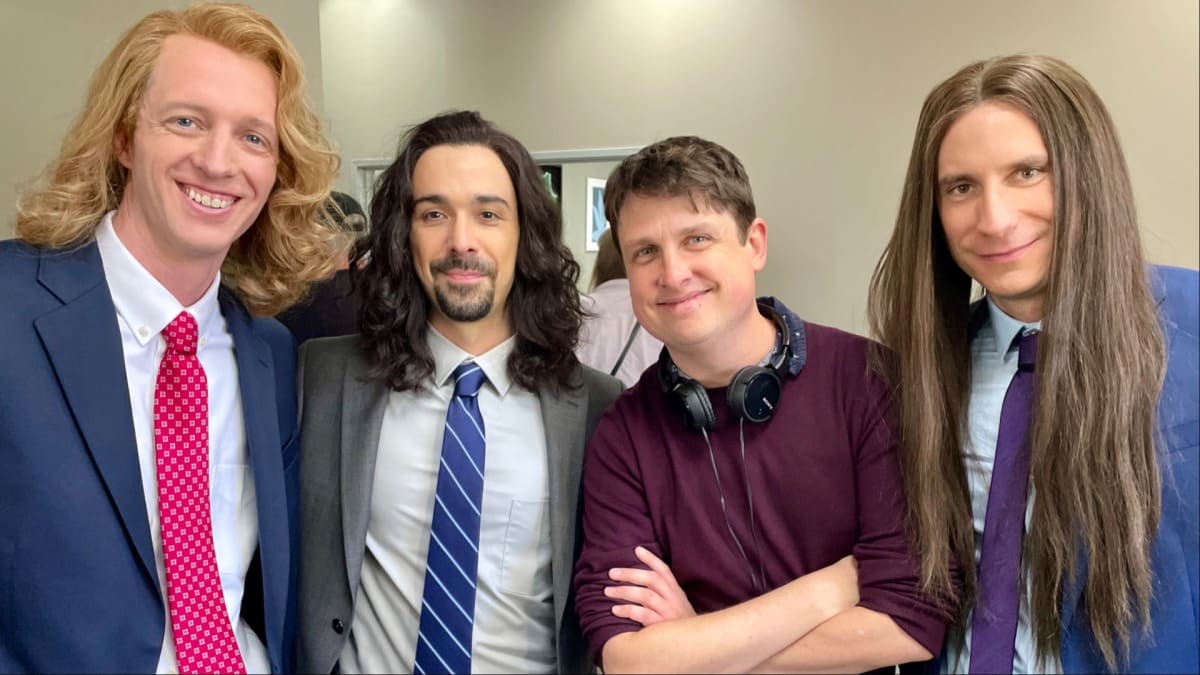
But until last week, no one had ever seen a Scott Gairdner movie. That’s all changed thanks to Long Haired Businessmen, the movie adaptation of the long-running webseries created by Gairdner’s fellow Funny Or Die alumni George Kareman, Pat O’Brien, and Ben Wietmarschen. In the roles of middle managers who all sport shoulder-lengths ’dos and speak almost exclusively in meaningless workplace clichés—“let’s put a pin in that,” “on the same page,” “core competencies,” etc.—Kareman, O’Brien, and Wietmarschen embark on a deeply silly, slyly soulful journey beyond their natural conference-room habitat, opposite the similarly well-coiffed likes of Dean Norris, Judy Reyes, Rhys Darby, and Edi Patterson. It’s all of a piece with a comedy comeback that The A.V. Club has been tracking and championing throughout 2026, and so we wanted to check in with Gairdner to talk about directing Long Haired Businessmen, how he and his peers have weathered the genre’s lean years, and how the film industry can—to borrow a phrase from the long haired businessmen themselves—get its ducks in a row to start making more funny movies again.
This interview has been condensed and edited for clarity.
The A.V. Club: What was going through your head when you read the Long Haired Businessmen script for the first time?
Scott Gairdner: I remember being about 10 pages until the end, and really crossing my fingers that they did not explain what the business is or why they have long hair. It’s like, “We’re almost at the door. I think I know where they’re going with this, which is not addressing it.” And by the time I got to the end, I said, “Thank God, that rules.” They have left these elements—primary elements that are in the title—obtuse and just open to the viewer’s interpretation.
So much of it was so dry and subtle about what a certain type of office job is like. I thought, “Well, this is going to get compared to Office Space, no matter what.” No matter who directs it, no matter what direction it goes in, that’s just inherently going to be a comp. There’s a choice that needs to be made to differentiate it from Office Space. Office Space is all that drudgery on purpose. It’s a nightmarish office to be in. I read about Mike Judge taking items on cubicle walls and desks meant to brighten up the image and shoving them off the desk to make sure that these cubicles were absolutely joyless.
[Long Haired Businessmen] can’t be that because these guys love being there. This is their life’s work. This is their ultimate dream of a lifestyle. They don’t have much going on in their lives besides being in these rooms and spouting this jargon. So you have to treat this like the Promised Land. This is Home Tree, to speak in Avatar terms. So when it’s stripped away from them, you care. We have to use the tools of the filmmaking to convince you that this is a warm place and a positive environment, even though someone else might get a job there and go, “I hate this. These middle managers are nothing. They do nothing.” But the movie has to make the choice to celebrate them. It has to be as if Lumberg was the protagonist of Office Space.
AVC: Were you excited by all the different types of filmmaking within the movie? There’s a music-video parody, there’s a Karate Kid training montage, and there’s animation, too.
SG: I was thrilled to see that stuff because one fear you have reading a script like that is “Is this going to feel claustrophobic?” Are you not going to want to be stuck in an office for an hour-and-a half? And so that’s why, step one, let’s make the office like a warm and fun environment so you’re not feeling that claustrophobia. That it goes into these unexpected places and that it becomes about these guys returning to nature in their specific stunted way—in a very base sense, I was just thinking in color. Like you want to be in editing and you want to see all the little thumbnails on your timeline and you want to see it go through a range of color, which implies a range of moods and locales and emotions and a journey. And I thought they did a great job at getting that stuff in there and I can just come in and amend and support.
Having the writers also be the stars was just such a fun format of production and set to be on. I felt lucky that that was the setup that I was walking into because you can’t force chemistry—I was getting to plug into the energy of these three guys who love each other, who vibe off each other, and who knew what an exciting opportunity this was. They’re making a movie based on a phrase that meant nothing that they wrote down on a notepad 14 or 16 years ago. You don’t want to be working with people who are blasé or cynical or over it. You want to be working with kids in a candy store. And that’s how I felt about those guys.
AVC: Had you been looking to direct a feature, or was your focus more on stuff like the Oscars segments?
SG: It’s interesting—this movie happened before the Oscars. The movie was a crucial piece in giving me the confidence to put myself out there to work with the Conan team. Doing the Oscars cold open for that first year, I didn’t know there’d be a second, didn’t know there’d be a third, which is exciting and on the horizon for me.
In a childhood dream sense, I thought, “Yes, I would like to do features,” but I feel like it has not been top of mind for me professionally for the last decade or so just due to the oft-spoken-of downturn in comedy movies—and certainly in mid-to-low-budget comedy movies and very silly, joke-forward comedy movies. They’ve never fully gone away, but they have to happen in an odd, on-the-margins way. And it feels like in the last few years, some turn has happened. It’s not like you’re on Easy Street if you get a little comedy greenlit, but they certainly are happening. They’re getting made in this post-apocalyptic, the-cockroach-survive fashion—life is finding a way on little comedy movies. Coming from the Funny Or Die world, that’s really made my network and group of friends almost entirely comedy directors. And it’s what we’ve all been thirsting for—this kind of thing to be back.
AVC: So how do we get more of these kinds of movies made?
SG: I have no idea, in a broad-prescriptive sense. I can only speak to my experience on this. It felt to me like the opportunity to do a comedy feature is a rare truffle [Laughs.] and you got to hunt and grab it when you have the opportunity.
This was utterly unideal timing for me. I got involved in the process knowing that I was going to have a baby the month they wanted to shoot it. And so I went and talked to [the producers] and I said, “Does that take me out of the running?” And they’re like, “Well, we don’t want it to.” And everything worked out and they were willing to work with me on it. But I think even my wife, who was put in a difficult situation by me being off and making a movie while she was with a newborn, she felt like, “This is so rare that this would ever happen that you gotta pounce on it and we’ll figure it out.” So I think that’s part of it, too: If you could find an opportunity, go for it, because the door might close entirely.
I mean, this thing also happened: [Long Haired Businessmen] was made by a division of Paramount two mergers ago. [Laughs.] I have a whole career of getting to make a project for somewhere that stopped existing after the project was made. I don’t think due to myself. I don’t think that there’s any sort curse on me—for my own sake, and for future employers, I swear I’m not cursed. But it’s like so many areas implode: All the comedy websites that I came up with imploded or evolved and companies merge and downsize. It’s a strange climate. So you just got to look for an opening and grab it because the opening might be gone by the end of the week.
AVC: In those intervening years, did it feel like you and your cohort of comedy filmmakers had kind of missed out on that opportunity?
SG: So many of my peers went up similar steps at the same time: Like you graduate from making things on your own with your friends or putting stuff on YouTube to doing things with a little bit of financing and support and crew and maybe even a famous person and then getting to do stuff on television. And you would think that the next step of that would be getting to make a movie. But I think it did correlate with a time where it seems, arbitrarily, like the one genre that everyone has decided is completely extinct is comedy. And it’s like, why? It doesn’t make sense for something that gives people joy on a big level, and seems like there’s such a giant hunger for.
I don’t think anybody was bemoaning being part of some sort of lost generation. I think it was about trying to hang in there and survive and make stuff however you can. One cool thing for me has been during some leaner years, when I had time on my hands, one of the ways that I spent a lot of time was working with my dear friend and close collaborator Nick Corirossi. We have this character we’ve done since Funny Or Die, Craig Healy, who is this absolute hack comedian who is a shape shifter who will go be part of whatever genre is getting made. We put him in this world of dramedies about comedians’ real lives and we made an annoying “clapter” liberal comedy show during the first Trump administration. And it felt like, well, this is for us. This is just for us to stay busy and be doing something and do stuff that makes us laugh really hard. And some of those things are why both Nick and I now are getting to make features and do things on a bigger scale today. Like things that we truly are doing with absolutely zero help, out-of-pocket, have ended up being the impetus for us to do a bigger, better thing later, which has been very life-affirming and a lesson for me to just always be making stuff no matter what.
AVC: Have you found yourself getting self-conscious about using Long Haired Businessmen phrases in real life? Since watching the movie, I’ve stopped myself from writing “circle back” in multiple emails.
SG: That’s very exciting. The first email I got about the movie, I think a producer, Mike Farah, said something about “You will never hear business speak the same way again.” And I wasn’t sure what that meant until I read the script.
By putting all of this phraseology in one concentrated place, I think and hope it’ll make people feel self-conscious about the phraseology. I’m very much of the school of you should retire phrases—things like “Is that a thing?” And it would be amazing if this movie had any impact as far as limiting the use of this kind of meaningless business jargon.
And yet some of it does kind of have a purpose on a film set. There is a lot of functional stuff you’ve got to do and you need to communicate and you need to make sure that the same vision is being conveyed from the AD to the DP to the different departments. And there were things where you say, “Well, we should have a meeting and make sure we’re on the same page.” [Laughs.] And it does really efficiently communicate what you’re trying to do. So it’s very surreal to be on a set, to have meetings where you’re using the phraseology, and the movie that you’re making is calling out the phraseology. It’s just a funny refraction going back and forth at all times.


 Keep scrolling for more great stories.