“Let this hijack continue. Let’s finish this properly. Send this train to the end of the line.”
Of course, Idris Elba’s Sam Nelson is talking about an actual hijacking in the above quote, but it’s almost a meta recognition of where the second season of this Apple TV show is at the end of this episode. As much as I hope they “finish this properly,” this clunky season has given me little reason to hope they will. One thing we know for sure is that, unless they have the nerve to end with a cliff-hanger and carry this into the third season, the train will reach “the end of the line.” There’s nowhere else to go.
The wheels come off the train a bit in “Contact,” which has a higher body count than most episodes (Jess, the suspicious agent) but still struggles to maintain the suspense we should have for a show like this at this point. I hate to run the same tracks (sorry) over and over again, but this year has really struggled with the lack of a villain. In this episode, we finally learn, at the very end, that Stuart, the hijacker from season one, has likely been behind this whole thing. It’s just not that thrilling of a reveal, is it? Why hold it for so long? Why not just play vengeance from the beginning, clueing us in that this is directly a plot to get back at Sam for the action of last season? Holding that for seven hours feels like such an inert way to tell this story, keeping us in the dark instead of revealing exactly what Sam is up against and why.
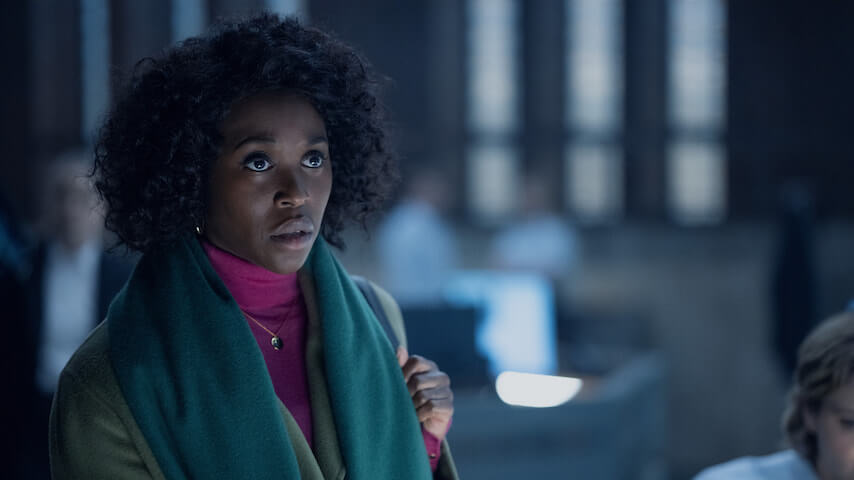
The one thing that’s keeping Hijack together is the work by the ensemble, especially Elba. The scenes between the Luther star, Christian Näthe (as Otto), and Karima McAdams (as Jess) in the front of the train are easily the best parts of this episode and probably the season to date. They are reluctant villains, forced to be allies in a mission they never wanted to take part in, an idea that could have been explored more thoroughly if we knew the outline of their predicament earlier. Elba has always been deft at conveying weary resignation, characters forced into action by circumstances they can’t control, and he bounces well off the very different characters of Jess and Otto, two people who would never otherwise interact if they both hadn’t been forced into this convoluted plan.
It’s too bad really that McAdams didn’t make it to the finale. We learn in the opening scene of this episode that Jess was only injured by Commander Wolf’s gunshot. But then the writers do so very little with the twist (that they know she’s a hostile and not a hostage) other than giving McAdams a bit more awareness that her character is doomed. And she sure is, shot again at the end of this episode. And she won’t survive this one.
Above ground, the writing bends under the convoluted idea that Chief Winter suddenly would insist on Sam being taken by force when the train finally reaches its new destination, a depot. It’s to build tension in a show that shockingly lacks it, but would Winter really be that insistent that Sam is the big bad here when so much evidence is pointing otherwise? It’s a contrivance that gives the episode a bit of a ticking clock of a question: Will someone prove to Winter that Sam isn’t the bad guy before Wolf and his team shoot him?
Of course, the answer is yes. Way up in Scotland, Marsha Smith-Nelson finally gets far enough from her remote cabin to get a signal on her phone, using it to contact both Daniel O’Farrell and then trying to reach Sam but getting Olivia. She records Marsha begging Sam not to let his love for her lead to tragedy, which is proof that Sam is being manipulated by the people threatening his estranged wife on the anniversary of their son’s death.
So where do we stand before the end run? First, we learn that Stuart not only had something hidden in his soap in his cell but had assistance from a guard to keep him in charge. Is he the head of the snake? Or could he have a boss or ally yet to be revealed? Jess is gone, but she helped separate the front car from the rest of the train before she died, meaning most of the hostages are safe. It’s just Otto, Sam, and a few of the kids from the tour group on the train, which the final shot reminds us still has a bomb strapped to it.
Winter & co. seem convinced now that someone is pulling Sam’s strings, but they still have to get the remaining hostages to safety. Who’s going to stand in their way? Well, there’s the handler who killed a colleague suspicious of him at Bergmanstrasse. He’s likely going to play a role in the finale and probably get what’s coming to him. And Marsha still isn’t fully safe, likely regretting going so far off the grid that she can’t get help from anyone while being hunted by those pesky Scottish assassins.
Sam and Marsha will almost certainly survive. The outlook for Otto is a little murkier, although he hasn’t really been a villain enough to die. Jess was sacrificed, in part, because she killed Freddie. The writers needed to give her a little bit of justice for that choice. Everyone else probably gets out of this unscathed beyond the trauma. We’ll know in a week when this clunky train finally reaches its destination.
Stray observations
- • We’ll know, right? Could they possibly drop a cliff-hanger to move this season’s action into a third? While it feels like there’s not quite enough dangling plot threads for that to happen, it’s not out of the question that we get some sort of cliff-hanger. Maybe Sam can hijack a cruise ship.
- • The spray paint on the door to the subway room in which Jess’s handler goes murderous says “Die Mauer muss weg.” It’s a phrase from before the fall of the Berlin Wall that means “The Wall must go.” It was a rallying cry that came to mean more than just the physical destruction of the wall but something people used against any sort of barrier or corruption. It’s an interesting beat in a show that’s actually pretty thin on political/world context beyond the idea that evil money groups like Cheapside are behind most of the bad shit that happens.
- • McAdams did a lot with relatively little in the last couple episodes, but even her work is a reminder that this ensemble is pretty thin, mostly due to writing, not performance. No one is particularly bad but consider how much worse it would be without Elba to ground it. Too many of the other characters are just cogs in the plot machine—and one that’s been moving way too slowly.
Brian Tallerico is a contributor to The A.V. Club.


 Keep scrolling for more great stories.