It’s a foreboding start. The tapestry of history stitching together House Targaryen since the days of the Conqueror rips apart before the title card can even pull into frame. House Targaryen frays beyond repair, and the realm burns. Queen Rhaenyra Targaryen frays, too; this week, she struggles to sit atop the Iron Throne, torn between the dragonfire that would destroy her enemies for good and all and the crushing obligations of her hard-won crown. And there’s the not-insignificant matter of reconciling who she is with what her rule needs her to be.
One aim of House Of The Dragon has been to show the inevitability of a dynasty forged in fire and blood turning that fire on itself. It dovetails neatly with the series’s deeper fascination with gender and power: a patriarchal order with no patience for female strength, reacting belligerently whenever that strength asserts itself. In fact, the misogyny is so thick this week that you can cut through it like a serving of poached rat.
A crisis of identity has defined Rhaenyra since her late father, King Viserys, named her his heir. The realm that once celebrated her as its “Delight” wasted little time deciding she’d make a poor king by virtue of being a princess, and she’s struggled to prove herself as capable a sovereign as any man ever since. It’s no coincidence, then, that she refers to herself as a “conciliator” this week. She wears the crown of Old King Jaehaerys, the stylization meant as a deliberate poke at the petulant boy king Aegon, who donned the Conqueror’s circlet at his coronation just because he could. She borrows the memory of one man to bankrupt the reputation of another. After what the Lannisters did to the treasury in Aegon’s name, fair’s fair.
The irony, however, is that conciliation isn’t necessarily her strong suit. She proclaims this virtue to the lords and ladies of King’s Landing, of whom she intends to make an example, accusing them of hoarding food that would otherwise feed the hungry smallfolk. Her justice is unmistakably Targaryen, direct and theatrical: as Gold Cloaks clean out the nobles’ stores for redistribution, she feeds them the rats the common folk have dined on since this civil war began. Under Queen Rhaenyra, conciliation doesn’t preclude humiliation, and a fed population makes for great optics.
This is another break from the books that fits the story House Of The Dragon is trying to tell. Rhaenyra’s selfishness isn’t a byproduct of the crown’s many indulgences—she doesn’t gorge on treats or celebratory feasts as in Fire & Blood, but instead focuses on the needs of the realm she’s meant to govern. This change may idealize Rhaenyra (the season is still in its early days; her inner Maegor could still reveal itself), but it speaks to the complications her maternal instincts face in a world governed by patriarchal class and brute strength. In this light, it’s thematically appropriate that, instead of the Iron Throne rejecting her outright by drawing her blood, she bleeds by virtue of her moon’s turn. Rhaenyra’s period arrives right on time, just as she’s about to see a horde of petitioners—an already arduous but necessary duty, suddenly made much more grueling. Aegon blew off his kingly duties for less.
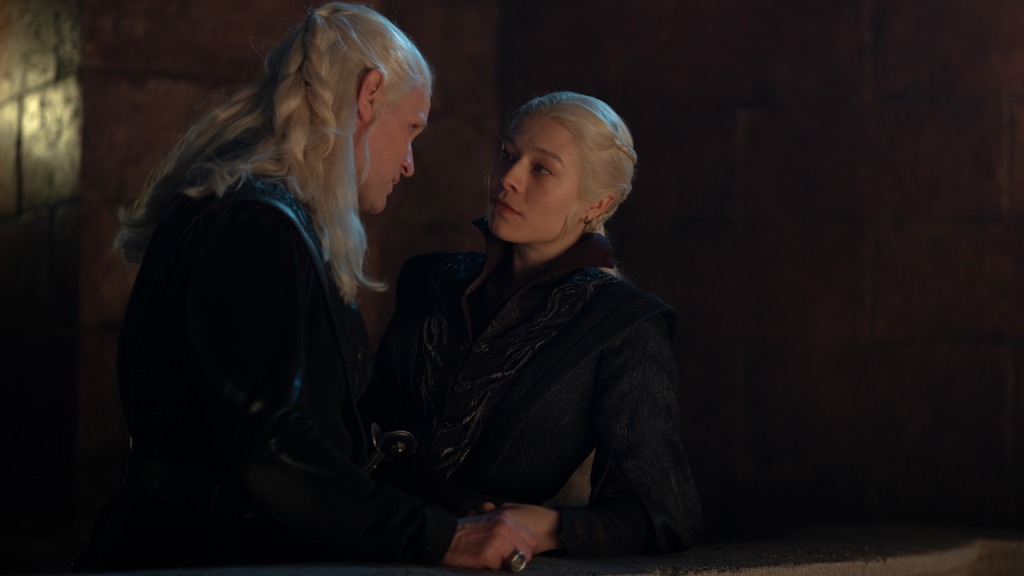
No, Rhaenyra’s true blind spot isn’t indulgence but vengeance, and revenge has an annoying habit of crowding out reform. She wants to rule as a king without losing the qualities that distinguish her from one, a balancing act this episode suggests may be impossible. “You have come so far,” Daemon tells her, “and yet you still don’t know who you are.” Earlier, Alicent offers her two cents: “You may not rule and remain yourself.” Rhaenyra has trouble accepting that.
After all, reform is, in part, why Mysaria earned her queen’s trust. The realm’s latest Master Mistress of Whisperers (and newest member of the small council) knows something Daemon never will: the key to a long and healthy rule is through the smallfolk, not over them. Yet there’s Daemon, still looking at Rhaenyra like she’s still played by Milly Alcock, tempting her with Targaryen fire, blood, and conquest. “You will have an empire unassailable,” he says to her as she squirms. There is such a thing as too much power, she says, as her father once tried to teach her—and him. “I must rule as he wished.” Has she forgotten how little Daemon cared for Viserys’s reign?
Of course, these early days of her sovereignty aren’t a simple case of What Would Viserys Do?, as Rhaenyra discovers during the knighting of Addam of Hull, the bastard son of Corlys Velaryon. He receives his knighthood without being legitimized by the crown, and soon, his father’s indignation clashes with patriarchal privilege. Earlier, Corlys tells his queen that this boon from the throne is “simple enough,” as though her judgment meant little and less. (She has her reasons, but they seem selfish in comparison to what’s right in this instance.)
Later, he calls Rhaenyra out for her hypocrisy, reminding her that her sons, two of whom are now dead, were bastards, too, and that her waffling stems from shame. This raises a question: would Corlys, who never dared challenge Jaehaerys when he named Viserys his heir over his late wife Rhaenys, have called out Viserys for this slight in view of the court? Probably not, but at any rate, how Corlys walks away from that conversation with his head still attached is one of this week’s biggest stumpers.
The royal ledger thickens by the hour. Vengeance and sovereignty pull Rhaenyra in two impossible directions as she squirms beneath her own skin and her new station. How much of this uncertainty belongs to grief, and how much to the impossible task of being a woman asked to rule like men? Would her reign have been happier and more prosperous if her ascension had gone unchallenged, or is this simply the price of sitting the throne? How can the Red Keep ever feel like home when every corridor is haunted by ghosts and every scurrying rat reminds her of the usurper’s continued existence? Her iron seat never promised stability, only power. Becoming worthy of one will require her to bury the other, even if the Realm’s Delight must be buried with it.
Stray observations
- • MVP this week is unquestionably our new regent, Emma D’Arcy, who charted a complicated episode with remarkable precision.
- • The Daeron twist (which is much different from the books) is tripping me up. If the child masquerading as Daeron had his hair bleached (“blanched?”), then what’s his true hue? I suppose this means the sullen, auburn-haired chap who gave Lord Ormund’s messenger a bath in the premiere is our man, though it was strange to have nobody address him by name despite being in nearly every frame of that scene. But that boy is markedly older than the faux-Daeron who Daemon brings to the Red Keep—were there no other leal squires of appropriate age about? Why did he have the boy’s hair bleached in the first place? Did he get confused about Targaryen genetics? I have questions.
- • Anyway, the image of Bold Jon Roxton bleaching anyone’s hair is an amusing one.
- • Also, good thing purple eyes aren’t a thing on this show.
- • Careful about dangling noble houses in front of Ulf, Daemon—that guy’s shady.
- • Is that… sadness, emanating from Daemon’s face upon the news that Ser Simon Strong has perished?
- • “I cannot be seen to favor Hightowers.” After last week’s botch-job execution, I don’t think mercy towards your enemy would be looked upon unkindly by the people, Your Grace.
- • I may delve further into the Cersei parallels in future recaps, obvious as they are, but it’s worth noting here that Rhaenyra has fumbled the Faith in record time. Can Rhaenyra’s rule, indignant as it already is, prosper without it? She has dragons, after all, but, as the High Septon puts it ever so indelicately, dragons only destroy; they never create.
- • “I have no style.” “So fashion one.”
- • There’s a reason no one ever visited the prosperous milling town of Tumbleton in Game Of Thrones, Hugh; that’s a tough break. (Related: How gnarly do you think HOTD is going to let Tumbleton get?)
- • Speaking of, Hugh’s attitude in this series is among the harshest contrasts from the books. Here, he’s patient and brave and all that noble dross, while in F&B, he earns his Hammer standard with brute force. Perhaps he’s about to break bad, or something more predictable and tragic is in the offing. Or maybe he and his wife and daughter will fly off to Pentos to take in a puppet show. Who’s to say?
- • “Your father lived in a world of his own construction.” Yes, and Aegon made smashy-smashy of it.
- • What a treat it was to see Dan Fogler pop by as Ser Torrhen Manderly, the treasonous cad with the wine-soaked teeth.
- Why did Daemon’s line on the balcony—“You still have to kill Daeron!”—have to sound like it was squeezed in during post? Did the show think we kinda forgot about the prince who’s been promised for three dang seasons?
- “A rage which billows beyond my grasp.” Rhaenyra would have loved Linkin Park.


 Keep scrolling for more great stories.