House Targaryen is hardly known for its temperance. Yet the speed with which it’s tearing itself apart in House Of The Dragon, Ryan Condal’s syncopated retelling of George R.R. Martin’s Fire & Blood, suggests that centuries of inbreeding and unchecked power have genetically stripped the family of all forbearance—say nothing of brains. Retaliation in this civil war has piled so high that everyone involved has been rendered incapable of distinguishing strategy from self-harm. It’s Sideshow Bob stepping on a rake over and over again, so determined to kill Bart Simpson that he blunders into calamity with every furious step.
One dim-bulb decision begets another. The Dowager Queen Alicent Hightower has conspired with her public rival and secret confidant, Princess Rhaenyra Targaryen, to remove her son, Aegon II, from the very throne she helped place him on. What she accomplishes this week—securing the loyalty of the gold cloaks and fighting off Lord Ironrod’s predations—clears the way for Rhaenyra to seize the Iron Throne with minimal fuss and, to boot, remove an enemy or two from the board. This sudden regime change does not come without cost, however, and with the abrupt death of Otto Hightower, HOTD once again raises its most pertinent question: What will victory possibly look like after all the vicious bloodletting is done? Every win feels like someone’s writing checks for future misery.
Recall last week’s premiere, when Alicent manipulated her sexually torqued-up son, Aemond, into flying Vhagar to Harrenhal: the self-styled “Protector of the Realm” planted a passionate smooch on his mom and said he’d host a feast in her honor, complete with the severed head of Daemon, his rebel uncle, looking on atop a spike. This week, Aemond abandons his castle to seize another with a lusty zeal his mother mislikes, only to find his uncle gone, a blade jammed in his side, and Alys Rivers, an avatar of the Old Gods, looking at him like her newest plaything. And what does Alicent get for all her trouble? The head of her father rolling across the throne room floor. It’s one calamity after another with these people.
While Aemond’s clumsy sacking of Harrenhal is not this episode’s chief attraction, it best captures the destructive cause-and-effect that weaves throughout this series’s patchwork tapestry. After last week’s purposeful Battle Of The Gullet, its directionless chaos speaks to the shortsightedness of vengeance—the cycle of pyrrhic victories and failures that demands an eye for an eye and leaves everyone blind. Aemond One-Eye misses the point, but over in the Gullet, looking upon his smashed ship and burning castle, Corlys Velaron sees things very clearly: “If this be victory, I hope I never see another.” Finally, someone’s talking sense.
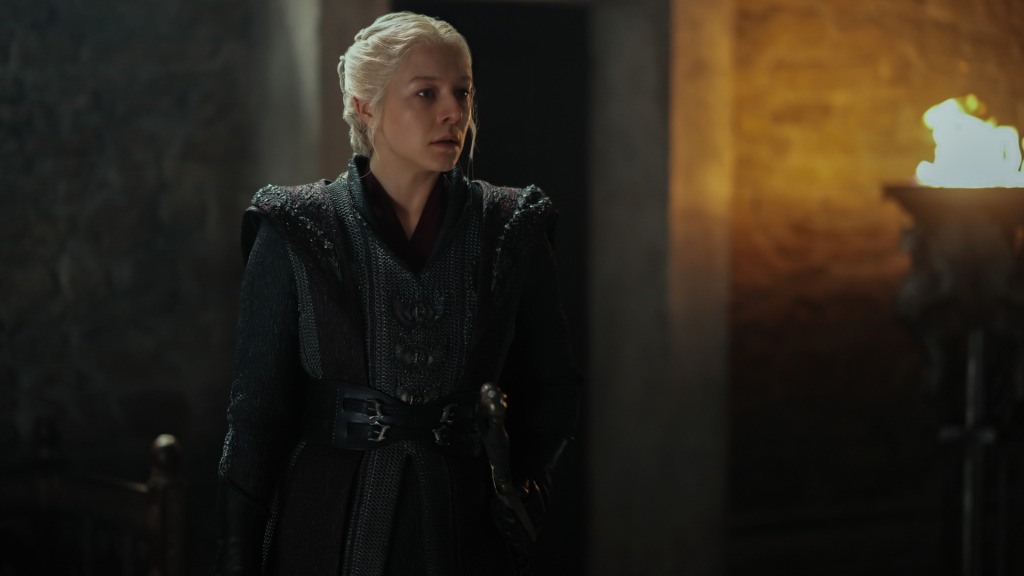
Rhaenyra, however, doesn’t have the luxury of sense. Last week, her son Jacaerys locked her away as he rode to the Gullet in her stead, leaving the princess to pound futilely at the door and tear apart her dress in a furious rejection of the idea that womanhood signifies weakness. “I may appear to have the weak and feeble body of a woman,” she declared, “but I possess the heart and spirit of a king.” One episode later, fate responds with typical Westerosi cruelty: Prince Jace is dead, and his dragon with him. But while the blacks of her riding leathers now represent her mourning, grief has hardened, not extinguished, her kingly spirit.
The best thing about this episode? Rhaenyra finally does something. Last season, she played her game of thrones from the relative safety of Dragonstone while others, mostly men, fought her battles. Her attempts at strategy—trusting Alicent despite precedent and better judgment—felt like the pitiful bargaining of an addict, someone rationalizing behavior that’s destroying her and everyone around her. Despite those torn feminine garments and declarations of royal virility, Rhaenyra’s lack of agency within her own story often made the show’s critique of Westerosi patriarchy feel particularly toothless. Still, tears can’t dampen her dragonfire. “Have you not betrayed your queen?” she bellows at her council of ineffectual men. Her time to act is finally here—though this call to action feels more spurred by the dragon dreams of her father, King Viserys, than by a desire to rule.
Nearly everyone in this war is trapped in the present, reacting to recent injuries with fresh violence. Yet as Rhaenyra struggles with the grief before her, in the Riverlands, Alys Rivers gives Prince Daemon a critical tool for the battles to come: perspective. He takes his own dreams—of the growing darkness in the North, the Song Of Ice And Fire, the girl with silver hair with dragons at her breast and a desert at her back—to Rhaenyra, in an attempt to force her hand. (I sympathize with her initial response to his lore-centric goading: “I am so tired.”) Daemon presents the bigger picture to his wife as the one true reason to claim the Iron Throne. His rationale works: “I am done talking,” Rhaenyra declares. With that, King Viserys’s beloved daughter flies to King’s Landing.
As season three of House Of The Dragon wraps its second episode—which, in truth, feels more like a season finale—the stage is set for the next explosive conflict. It’s hard to shake the ease with which Rhaenyra seizes the Red Keep, given the hardships that led her there. No crossbows attempt to thwart her and Daemon in the throne room; a fickle Kingsguard lays down their swords, and gold cloaks loyal to Daemon usher them to the Black Cells—where Daemon finds a kingly gift in Otto, gift-wrapped courtesy of Larys the Clubfoot. Even Alicent stashes her fury over her lord father’s death for later days.
It’s all rather tidy, even with the bloody footprints the queen leaves behind as she ascends her throne. But after an hour of systematically charting the pyrrhic costs of vengeance, HOTD makes a cogent point: When a house divided against itself goes to war, the line between victory and ruin becomes a red smear. This week, the rule of Westeros changes hands, yet its cycle of violence remains intact.
Stray observations
- • “The rats in the black cells have grown uncommon big!” Farewell, Otto, I’ll miss you.
- • Big, dramatic, trailer-sauce reaction from Rhaenyra over Jace’s death, as Baela quietly stands to the side for the duration.
- • You mean to tell me that Lady Jeyne Arryn, the Maiden Of The Vale, personally embarks on a 600-foot basket drop and a stinky mule ride down a jagged mountain pass to receive beggar dragonriders at the Bloody Gate? Every time?
- • Also, how does Jeyne know that Prince Jacaerys has died in battle? Did ravens go out from Corlys’ shattered ship? If so, who sent them? And, most crucially, do those ravens fly faster than a dragonrider fleeing the scene of a crime?
- • “You no longer ask for milk of the poppy.” “That’s because I’m not fucking speaking to you.” Larys and Aegon, in their exile, give off serious Varys and Tyrion buddy movie vibes. In a grim bit of comedy, Aegon works out his frustrations by killing a Staunton soldier. (Thirteen stabs of an arrowhead, by my count.)
- • So Addam got a dragon, but what’s there for Alyn to claim, to win? “I have nothing left to give you but my name,” Corlys tells him. “And yet,” Alyn replies,”I count that of more worth than a mountain of gold.” Sweet moment, a good payoff, and a solid character moment for Alyn and Corlys, the latter of whom looks on his ruined house yet sees a future in the eyes of his once-discarded son.
- • Daemon might do well to give Alys what she asks for, even if it is Harrenhal. “I ask for food, and you offer me rubies… go home,” she warns,” but do not come back here!” Alys says, reminding the dragonknight of what awaits him in this part of the world—her prophecy of the God’s Eye.
- • “You’ve wriggled your way to the crown like an eel,” Daemon says to Mysaria. Or, if I may, a worm? Eh? Yes?
- • Speaking of whom, Misery’s strange alternate trajectory from her story path in Fire & Blood continues to mystify me. What’s her plan? Phase 1: Smooch Rhaenyra between family tragedies; Phase 2: ?; Phase 3: Profit?
- •It drives me a little nuts to see a giant weirwood tree in the King’s Landing godswood, but maybe it will serve a story purpose at some point—at least until, one presumes, it’s burned to the roots by some dragon.
- • “I think I might like to keep chickens.” I may dig into the “toxic butterflies” issue George R.R. Martin has raised about Prince Maelor’s absence in a later recap. But is this show really as uninterested in exploring Helaena’s grief over her son’s death as it seems?
- • Two reasons why Alicent goes to the City Watch’s bathhouses to speak with Commander Largent: one, to move the plot forward, and two, to squeeze in some full frontal. “I regret intruding on your gold cloaks.” Of course, Your Grace.


 Keep scrolling for more great stories.