Over the last five years, Glen Powell’s film presence has shifted from surprisingly handsome charisma bomb to obviously calculated (yet still undeniably handsome) dud. There seems to be an insistence on someone’s part—whether it’s Powell’s or his agent’s or the filmmakers who deal with them—on keeping the actor confined to a small range of slick, square-jawed smarm, whether he is a rom-com lead, a tornado chaser, a dystopian game show contestant, a fake contract killer, or, in How To Make A Killing, a man murdering his way into an inheritance. He’s always smirking, often quipping, and so strikingly put together that the various ways these films try to diegetically disguise him are laughably insufficient. This strained consistency, this self-typecasting, these in-movie reminders of his irrepressible good looks—it all bolsters the careerist case that Powell is a movie star, sometimes at the cost of the movies themselves.
This is the fate of writer-director John Patton Ford’s sophomore follow-up to his small-scale caper Emily The Criminal. How To Make A Killing, drawing from the same source material as British favorite Kind Hearts And Coronets, is another thin capitalist critique from the filmmaker, this time aimed not at grind culture but at the upper tiers of wealth and the abstract avarice flowing through America’s bloodstream. Attempting to embody greed and entitlement without ever truly seeming unpleasant, Becket Redfellow (Powell) is like a Dickensian hero who grows up to be an off-brand Patrick Bateman. He’s a guy whose heiress mother was kicked out of their blue-blood family, left to die young and alone in the New Jersey ‘burbs. All Becket really has to remember her is a locket of her hair and a promise that he should be wealthy, if not for his damned living relations. Indicative of the film’s uneasy understanding of the haves and have-nots, Becket’s hard-knocks orphanhood leads him to work at an upscale New York menswear boutique—further indicative is that the film’s marketing copy describes this work as “blue-collar.”
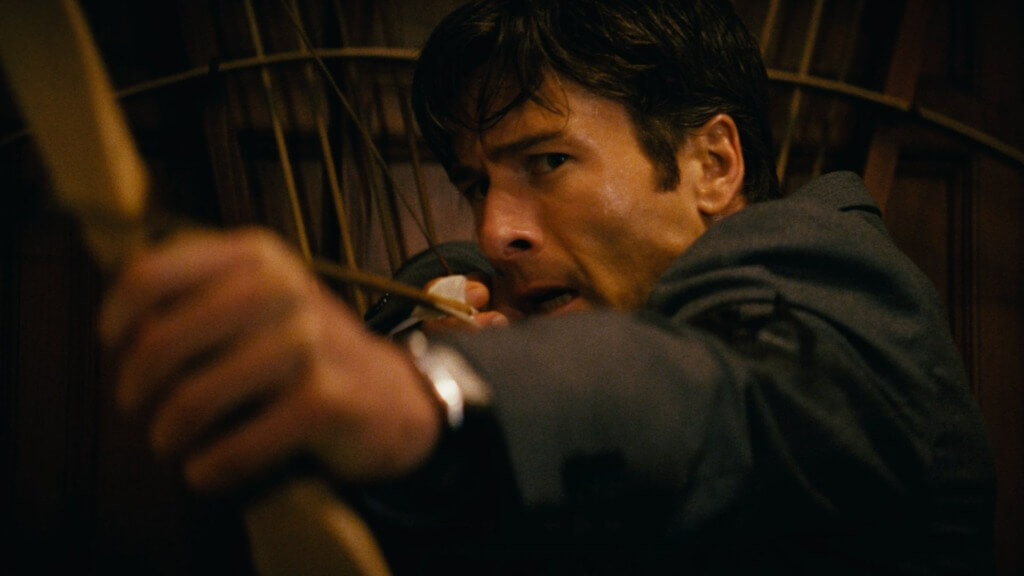
Taking this as a tongue-in-cheek exaggeration, an economic view exacerbated by his upper-class heritage, gives the script more credit than it’s due. Though, How To Make A Killing is certainly trying to be funny. The plan to bump off his older relatives, getting closer and closer to the fortune awaiting him as the last surviving heir, is handled as breezily as the murders themselves, though without the necessary droll wit to fully immerse the crimes in comedy. Some of his loaded cousins and uncles—self-styled artist Noah (Zach Woods) or paranoid pastor Steven (Topher Grace)—are outlandish, silly enough to inhabit the farce that How To Make A Killing is too self-serious to truly embrace. So too are Powell’s assortment of costumes (the man loves a disguise) and a confrontation with family patriarch Ed Harris. But most of the film, especially the constant voiceover (the tale is recounted as a death-row confession) and femme fatale caricature (Margaret Qualley), exists in a state of comic-noir confusion.
Yet, without any noirish style, How To Make A Killing flows as smoothly and palatably as Powell’s narration—and as smoothly and palatably as Becket’s movement through the world. Killing and conning and escaping come naturally to him, as naturally as working on Wall Street. After his first crime, he gets a job working for his uncle (Bill Camp) and begins accumulating wealth the old-fashioned way: nepotism. A savvier movie, one more inclined to dig into the connections between legally siphoning money from the rich and snuffing out those standing in the way of the well, would be able to find organic threats and desires complicating Becket’s life. Rather, the otherwise steady plot hiccups at the film’s innocuous FBI agents, jarring Qualley, and unspoken questions. Can anything be enough for someone raised with the belief that they deserve some limitless and intangible “more?” The unforgiving role of asking this is filled by Ruth (Jessica Henwick), Becket’s schoolteacher girlfriend, who exists to be off-screen and normal, a symbol of contentment who may as well be a photograph on a desk.
At the center of it all is Powell, making the same face for an hour and 45 minutes, too unflappable to root for, too smug to magnetize as an inhuman American Psycho. And How To Make A Killing needed to pick a side, either of clownish class comedy or of bitter sociopathic satire. Its split-difference approach certainly racks up a sizable body count, but its most battered and bruised victim is the truism it keeps hitting: In America, there are no consequences for the rich, unless other rich people desire it. That’s almost funny, in an empty and respectable way, like how a New Yorker cartoon is almost funny, or how Glen Powell is almost a leading man.
Director: John Patton Ford
Writer: John Patton Ford
Starring: Glen Powell, Margaret Qualley, Jessica Henwick, Bill Camp, Zach Woods, Topher Grace, Ed Harris
Release Date: February 20, 2026


 Keep scrolling for more great stories.