If there’s a defining characteristic to traditional survival horror, it’s constraint. Fixed camera angles, cumbersome control schemes, and a protagonist with unsteady aim are just a few of the limitations commonly placed on the player. Then there’s the claustrophobia of pushing through maze-like architecture (like an art museum repurposed into a police station) where a sharp turn could lead you straight into the outstretched arms of an unseen attacker. When we’re talking about traditional takes on the genre, limited resources are a given, making you question every spent bullet; ammo, healing items, and sometimes even save points are finite.
Like plenty of the survival horror games that followed more punishing classics, I Hate This Place is far less stingy when it comes to spare magazines. The main difference is that after a somewhat reserved start where extra items are a concern, the game begins to take more influence from something like Don’t Starve than Spencer Mansion, tasking the player with building up a weirdly involved resource management operation next to their aunt’s barn. This odd pairing offers some of the pleasures of survival games and Resident Evil-style horror without the cohesiveness of either, resulting in a totally acceptable hodgepodge that lacks the stand-out qualities of its paranormal setup.
Very loosely based on the comic of the same name, I Hate This Place follows Elena, a young woman on a trip to her doomed childhood home, Rutherford Ranch. The issue with this seemingly quaint farmhouse? Well, it’s incredibly haunted, naturally. When she was a child, Elena’s mother was abducted by a shadowy figure. She assumes it was the work of this region’s patron god (or maybe demon), The Horned Man. Unable to accept this lingering mystery, Elena meets up with her friend Lou, who conducts a ritual that will beseech The Horned Man’s guidance; this whole process doesn’t go great. Lou ends up missing, and now Elena has two objectives: finding her friend and discovering what happened to her mom.
With this pair of goals, Elena is mostly left to her own devices, and before long, she’ll have access to almost all of the area surrounding her family’s homestead. As for the player, there’s no obvious “main quest” that presents exactly where you’re supposed go with a bread crumb trail; instead, you’ll have to seek out and aid the other oddballs who are eccentric enough to live in this cursed forest, including an armed priest and a cult that worships The Horned Man. This open-ended structure is liberating, setting up breakthroughs as you tug at threads to unravel this mystery. Sometimes, you’ll get little more than vague rumors in return for helping out a local, but that makes it all the more rewarding when you finally stumble on a genuine clue.
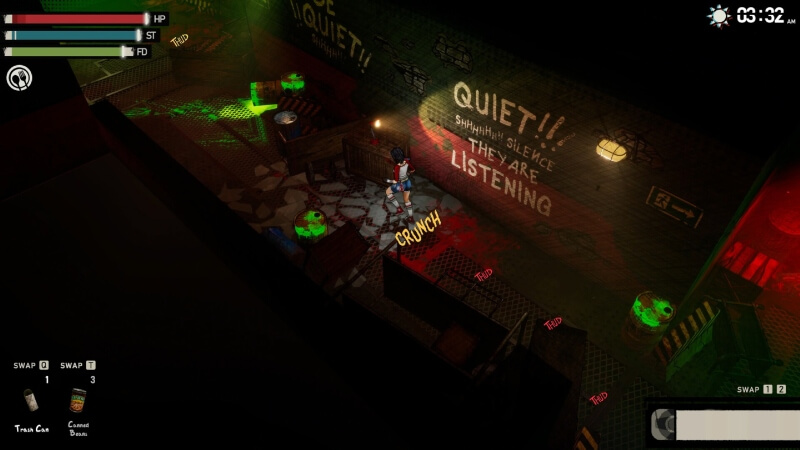
Beyond advancing your goal, wandering through these woods is often eventful thanks to the game’s biggest selling point: its deliberate use of sound. Rustling foliage and distant roars define a forest soundscape more antagonistic than any of the mutated cultists you’re forced to fight. Nighttime is especially unsettling, and moonlit journeys are almost always punctuated by sudden, unexplainable phenomena; you’ll hear a horn moments before a muscle car breaks through the bushes only to disappear into thin air.
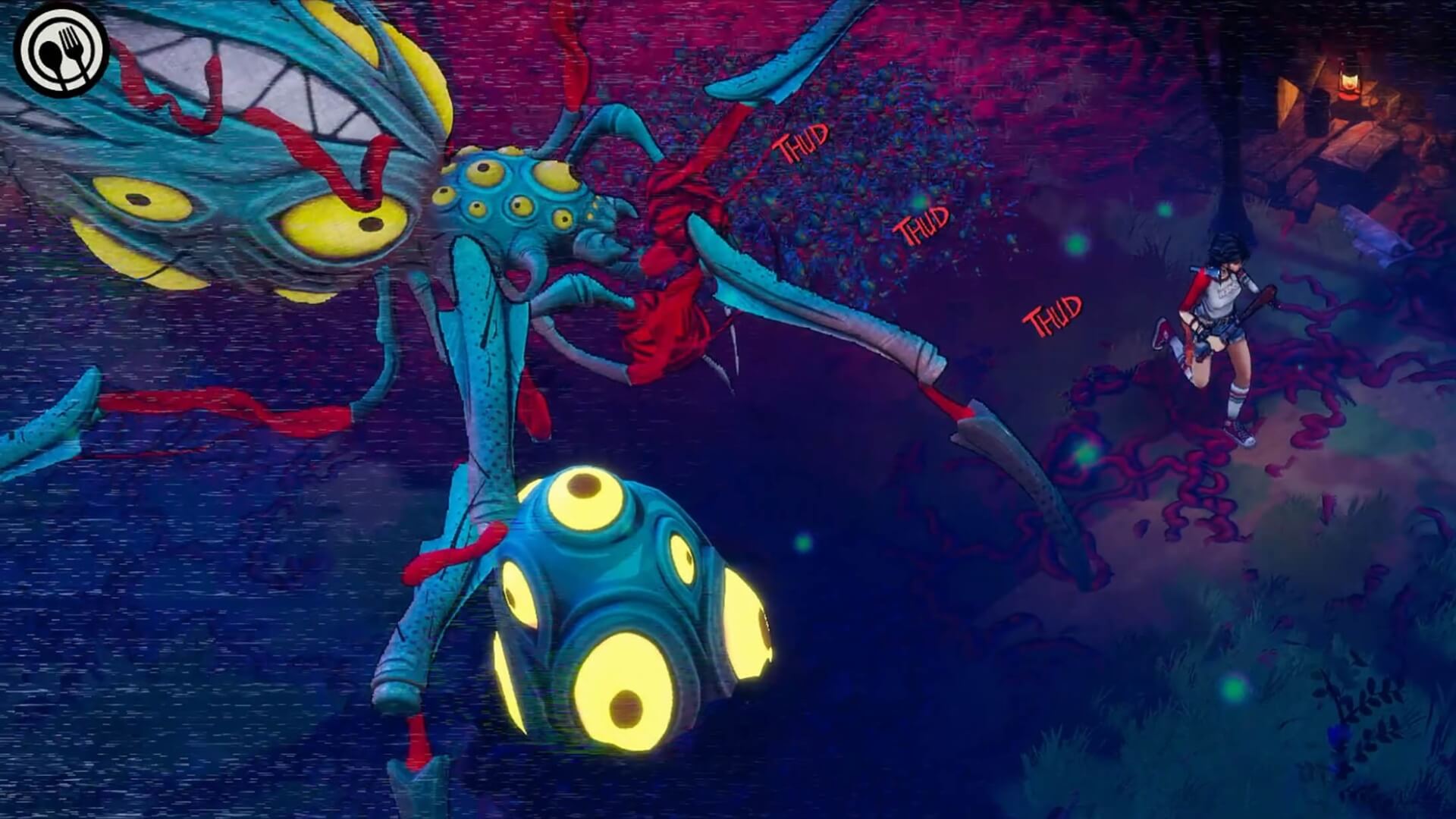
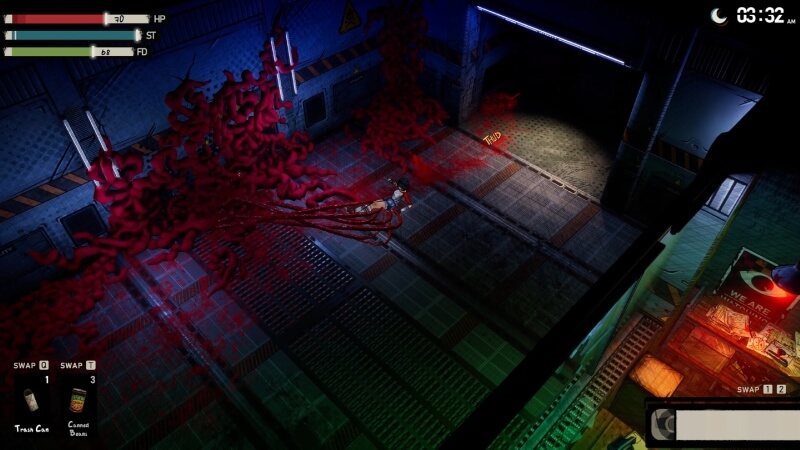
On top of the great background Foley, sound also plays a big role when sneaking around the less friendly inhabitants of this region. These monsters frequently lack sight, which means that stealth is less about managing vision cones and more a matter of avoiding loud, crunchy shards of glass. This is easier said than done; there is a lot of glass. You’ll creep around hulking creatures, and if you’re not careful and bump into a squeaky office chair, you’ll be rewarded with a spine-crushing bearhug. The amount of sound you’re making is visualized in comic-book-style onomatopoeia that’s larger when you’re running and quieter if you’re crouching. It works much better than the shoehorned sneaking sections that plague many other games, adding a horror movie tension as you try to avoid becoming a doomed slasher extra who accidentally bumped into noisy furniture.
As you creep through these bunkers, you’ll come across plenty of loot that can be added to your inventory via an RPG-style menu. You’re not just picking up stray bullets or healing herbs, but a whole variety of materials used to construct buildings that will generate even more resources. This is where the game’s two halves—its horror elements and its survival gameplay—begin to clash. In between missions and subterranean dives, you’ll return to Rutherford Ranch to gather resources and build an implausibly complicated series of automated farms, distilleries, metallurgy workshops, and more. You’re incentivized to engage with this because, while you can avoid ammo shortages by prioritizing stealth, there’s no way to avoid eating food. Your “satiety” meter will drain, and if this bar goes empty, you’ll eventually become unable to effectively swing a spiked baseball bat or even run—and that becomes a problem when killer arachnids are on your tail.
The focus on this degree of construction is a weird choice, to put it mildly, something much more out of place than the man-eating zombie deer and giant spiders you’ll encounter; how exactly did this twenty-something manage to build a Ford assembly line in the middle of a haunted forest? More importantly, while climbing this tech tree of increasingly useful devices is brain-scratching in the way it usually is in these kinds of games, the reward for your efforts is to trivialize any hint of survival horror anxiety. That giant monster you previously had to sneak around carefully? Now you can make grenades and automatic assault rifles on demand. Going from powerless to an action hero is the general arc of even the oldest Resident Evil games, but the ability to basically tap into an infinite ammo glitch makes this even more extreme. It doesn’t help that battling these monsters is fairly lackluster, in large part because there are, like, five variants of them (and almost no boss fights). The early hours may be tense (albeit not quite “scary”), but this fades until the greatest terror is approaching the dreaded “over-encumbered” inventory limit, a fate that leads to sifting through dozens of empty tin cans and stacks of vegetables.
None of this is helped by a barebones narrative, further let down by a deeply underwhelming presentation. The intro cutscene is a perfect example, and instead of making a strong first impression with an animated cutscene, a comic book-style intro (which would fit given the game’s origins), or even just talking headshots, the opening sequence is about as impressive as a machinima clip from 2007: we get a zoomed-in shot of two barely animated 3D models awkwardly chatting. Things don’t really get much better from here. There isn’t much to the cast—especially the nothingburger villain—and dialogue generally consists of characters explaining what they want from you before you’re sent on a task that ends in anticlimax. Narrative doesn’t need to be at the forefront of every game, but combined with the general lack of showmanship almost everywhere else (don’t expect a dramatic “zombie turning its head” moment when you meet a monster for the first time), Elena’s misadventures just don’t have much gravitas.
It’s just one of many factors that make I Hate This Place feel like less than the sum of its parts. It’s not like there’s nothing here: Its survival elements are fine in a vacuum, its sound-based sneaking is very novel, and it’s nice that the game has faith in the player to figure things out. The issue, though, is that many of these components don’t fit together; for example, its crafting elements don’t make any thematic or ludic sense. In the end, I Hate This Place doesn’t even live up to the passionate disparagement in its title, too middle of the road to register. I guess “I Think This Place Has Some Pros And Cons That Ultimately Weigh Towards The Latter” doesn’t have the same ring to it.
I Hate This Place was developed by Rock Square Thunder and published by Broken Mirror Games. Our review is based on the PC version. It is also available for the PlayStation 5, Nintendo Switch, and Xbox Series X/S.


 Keep scrolling for more great stories.