
A mother's resilience becomes revolutionary in I'm Still Here
A revelatory Fernanda Torres leads a Brazilian history lesson disguised as a family drama.
Photo: Sony Pictures Classics
The dizzying part of living under an authoritarian regime is how it makes the very act of caretaking feel like a radical act. When maintaining a home in the face of encroaching fear and paranoia, surveillance and retaliation become emblems of opposition. Yet the mere appearance of normalcy can often also feel indistinguishable from capitulation. In I’m Still Here, director Walter Salles looks back at a pivotal moment in recent Brazilian history to lay bare the ways resilience and resistance are best deployed—not with a furrowed brow or a self-righteous pat on the back, but with a sly smile.
In the early 1970s, Rubens Paiva (Selton Mello), his wife Eunice (Fernanda Torres), and their five children live an idyllic life in Rio de Janeiro. They live right by the ocean, and every day is littered with small joys: a home-cooked meal, a new adopted pup, a game of foosball. Sun-dappled shots of this domestic bliss slowly make way for hushed whispers and rushed plans that suggest not everything is as perfect as it may appear. Their oldest daughter Vera (Valentina Herszage), for instance, witnesses firsthand how military checkpoints can disrupt a fun evening at the movies with her friends—cracking down in response to the increasingly disruptive actions by far-left revolutionaries (including the kidnapping of the Swiss ambassador).
What at first feel like peripheral concerns soon arrive at the Paiva household. A group of men show up and demand Rubens accompany them for questioning. To Eunice and the kids (who see their house cloistered and surveilled by men who stay, insisting they’ll leave once Rubens comes back) it’s a jolting realization, especially once the question becomes not when but if Rubens will ever come back. All Eunice can do is wait, and care for her children and her household. That becomes harder still when she is taken, as is her teenage daughter Eliana (Luiza Kosovski), for days on end, interrogated by a military intent on rooting out dissenters and those who’d aid and abet them.
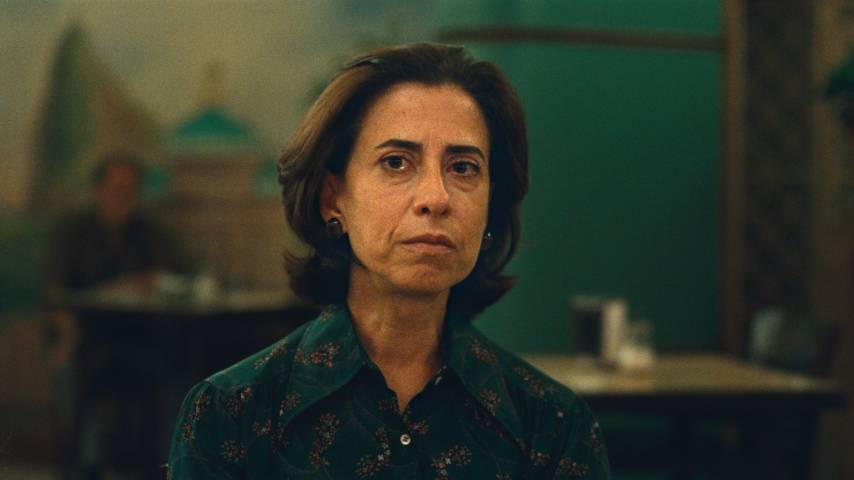
Eunice Paiva’s story, which I’m Still Here traces from the early years in the 1970s through her eventual release and the many years she then fought to get any information about what happened to Rubens—who never did return—is told not within the trappings of a thriller but the rhythm of a domestic drama. Like Eunice, I’m Still Here refuses to allow the forces of the military regime—their fearmongering and their violence—to enter the storytelling frame. Instead, the script by Murilo Hauser and Heitor Lorega, which adapts a memoir by Rubens’s son, Marcelo Rubens Paiva, stays close to Eunice and her home—literally. The film witnesses what a patriarch’s disappearance does to a household, to its finances, to its very existence. But the film also traces this loss in Torres’s face, which Salles and cinematographer Adrian Teijido capture with loving scrutiny.
 Keep scrolling for more great stories.