If you’ll let me be blunt for a second, there’s an awful lot about AI that pisses me off. It siphons natural resources at an increasingly alarming and power-hungry rate; tech overlords are building data centers in low-income communities and stretching the wealth gap even wider; its various models “learn” from pre-existing art, in effect profiting off human creativity while creating absolutely nothing worthwhile; it’s replacing more jobs than it is creating them; everything it produces looks like shit; it’s telling people to kill themselves; oh, and it’s also making all of us really fucking stupid. I’m fed up, as are many other people.
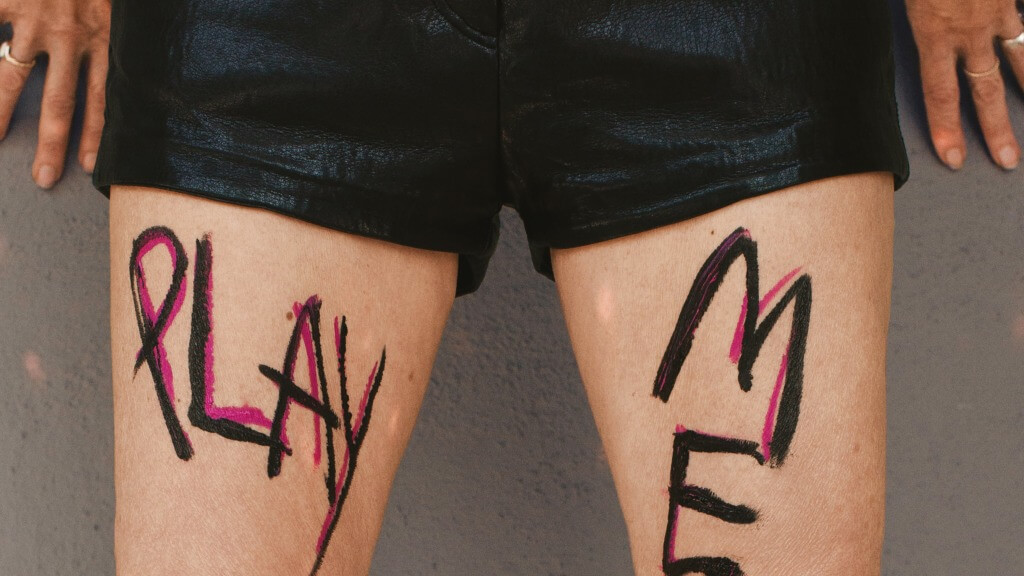
From the sound of it, Kim Gordon is fed up, too. PLAY ME, her third solo album, embodies that fury in both her satire-fueled lyrics and producer Justin Raisen’s booming rage-rap instrumentals. In under 30 minutes, Gordon makes the greatest use of our ever-diminishing attention spans by both frying our brains and nourishing them back to health. Digital detritus, caustic feedback, and elliptical poetics are the dominant traits here, but there’s a tenderhearted imperative to even Gordon’s most aggressive, confrontational work, and PLAY ME is no exception: the record uncompromisingly centers our humanity at a time when it has never felt more devalued or in greater peril.
Often, those critiques assume the form of pointed hypotheticals. For example, what if your next boss was a robot? “Hey boss, terminatin’ with a steady hand,” Gordon utters in a faux-cheery tone on “Dirty Tech,” the growling FM synth-bass emphasizing the pseudo-happiness of the song’s narrator. “Lift me up, fallen down,” she continues, impressionistically referring to AI’s human victims, such as those who take their own lives because of it and the people who suffer from others’ willful ignorance of its compounding ecological harm. “Let’s pretend there’s an epilogue / Let the world burn,” she commands in “Black Out,” outlining the dangers that come from the stock market or, as she repeatedly intones in an increasingly Auto-Tuned voice that sounds like GLaDOS from Portal, from standing by “AI, AI, AIIIIII.”
Yet thanks to Gordon’s sly sense of humor, PLAY ME never comes across as Resistance-core pedantry. She manages to trace the committed evils of technocratic fascists while poking fun at what absolute, total losers they are. She begins the album with a list of Spotify-generated playlists (“Play me ‘Rich Popular Girl,’ ‘Villain Mode,’ ‘Jazz in the Background’), highlighting the absurdity of technology attempting to predict our specific emotional states, prescribing feelings through surface-level typing rather than allowing us to dictate them ourselves. “You wanna go to Mars, and then what,” she half-asks, half-taunts on “Subcon”; on “Square Jaw,” she marvels at how butt-ugly Cybertrucks are by comparing them to the song’s namesake. “No hands on the wheel, it’s a steal,” she brags in “No Hands,” referencing the cavalier recklessness of those who hold political office.
The album is also her most rhythmic yet. “I get inspired by rhythm more than melody because of my vocal ability—or lack of vocal abilities,” Gordon told me around the release of her sophomore album, The Collective, two years ago. On its follow-up, she leans even harder into those impulses. There’s the aforementioned “Dirty Tech,” a veritable contender for the gnarliest beat on a tracklist brimming with them. The jazzy boom-bap of the opening title track, the crackling low-end of “Subcon,” and the melismatic Auto-Tune of “Black Out” are just a few examples of how the Sonic Youth co-founder manages to toy with textures and cadences in still-fresh ways. The Playboi Carti-meets-“Silver Rocket”-noise is even more prominent on PLAY ME than it was on its predecessor, and it’s a style that suits Gordon incredibly well. On “Post Empire,” she intersperses her figurative musings on how the U.S. government disappears migrants with squealing harmonic feedback, and Raisen imbues the track with sub-bass and 808s designed to rattle even the sturdiest car windows.
Although it’s far more beat-oriented than The Collective and her 2019 solo debut, No Home Record, PLAY ME still finds a few avenues that stray from the, ahem, beaten path. “Girl with a Look” summons the dark melancholia of Yves Tumor, a Raisen collaborator, with its swooning swirl of guitars that pull off a smoky feint before the thunderous “No Hands.” Meanwhile, “Not Today” resembles a Dry Cleaning song with its churning post-punk drive, lunging bassline, and new-wave guitars. But Gordon, as always, makes it her own with her unmistakable sprechgesang. Dave Grohl hops on the drumkit for the pulverizing, Free Kitten-interview-sampling “Busy Bee,” embellishing Raisen’s rumbling MPC and drum programming with an analog, muscular heft.
PLAY ME closes with a reworking of The Collective standout “BYE BYE,” newly anointed “BYEBYE25!,” which swaps the former’s itemized grocery list with an index of words that the Trump administration has banned from federal websites. “They/them, tile drainage, trauma,” she deadpans over the deep-fried distortion she cooked up with Raisen and SADPONY. Gordon again proves that she can make anything sound fucking sick, even when she’s just listing a bunch of stuff. But, more than anything, her latest album is a treatise on convenience culture and how it erodes our waning personhood. It asserts that, sometimes, being challenged is a worthwhile endeavor. Not everything we encounter must be reduced to low-effort, thoughtless drivel. When everything is “frictionless” and “streamlined,” there’s a point at which we lose a vital sense of our humanity. Adversity can be beneficial; creativity and, I can’t believe I have to say this, thinking can be good for us. Kim Gordon threads these urgent reminders through her salvos for a better world. Don’t tune it out. [Matador]
Grant Sharples is a writer, journalist and critic. His work has also appeared in Interview, Uproxx, Pitchfork, Stereogum, The Ringer, Los Angeles Review of Books, and other publications. He lives in Kansas City.


 Keep scrolling for more great stories.