You know the feeling: You’re watching a favorite TV show, but something’s off. The writing’s a little creaky, the actors appear to be getting back in character in real time, and though the sets look familiar, there’s an uncanny valley quality to the way they’re lit. Sometimes, it’s hard to tell if the actors who’ve spent years together in this fictional world were even in the same room this time around. It’s Arrested Development season four. It’s That ’90s Show. It’s not Twin Peaks: The Return. There’s no doubt about it: You’re in revival country.
It would be wrong to assert that the TV revival boom is exclusively a phenomenon of the 21st century. After all, Disney Channel was asking audiences to indulge in small-screen nostalgia with The New Leave It To Beaver as early as 1983. But “divorced sadsack Beav” aside, the last 10 years have seen the revival trend swell to epidemic proportions, as dozens of shows—and especially sitcoms—that flickered out in the 1990s, the 2000s, and even occasionally the 2010s have now been brought to the altar of the TV necromancer, that new life might be forced into their rotting bones. And a depressingly large fraction of these “new” shows have, to put it frankly, sucked.
There are a lot of reasons for this—starting with the very obvious one that, despite many creators swearing over the years that they’d only bring a show back “if they have a really good idea for it,” reviving in and of itself is almost always a mercenary act: A confluence between actor availability, IP ownership, and the looming shadow of streaming metrics telling executives “some schmuck will watch another season of this.” Far too many franchise zombies arise with no real creative impulses powering them at all—and if you need an example, look no further than the embarrassing saga of last year’s Suits: LA, which began with series creator Aaron Korsh practically begging fans and executives not to make him make any more Suits, only for the original show’s landmark Netflix numbers to eventually batter Korsh into short-lived, single-season submission.
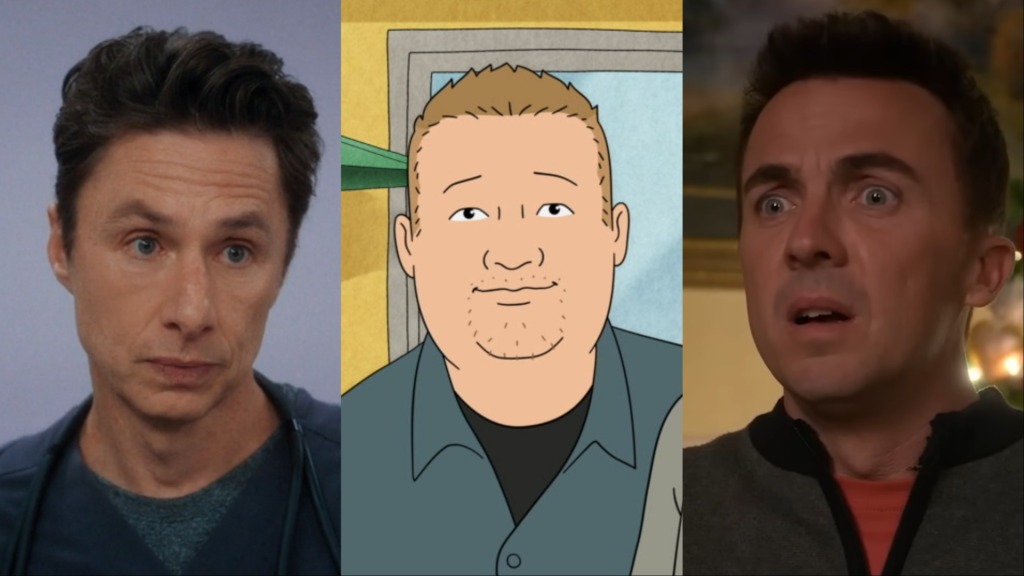
Things do, however, seem to be getting better. Over the last two years, the TV revival machine has begun whirring into something like real working order, especially in the sitcom realm, where projects like King Of The Hill, Malcolm In The Middle: Life’s Still Unfair, and Scrubs have all managed to revive and update their mothership shows in entertaining ways, ably walking the tightrope between giving returning fans what they want and creating half-hours that genuinely work in the context of modern television. Not every revival, turns out, has to be a coldly churning nostalgia factory like Netflix’s Fuller House, or a butchering of delicate sitcom chemistry like the fitfully funny, but ultimately hollow, Frasier. So how do these three shows pull it off? How do they absolve themselves of the sins of their resurrected brethren?
Sin One: Screwing up the casting
The human aging process is the ultimate enemy of the would-be TV reviver. As the years stretch out between a show’s original finale and its own personal Easter, actors retire, die, get more expensive or busy, or—as depressing as it can be to note—simply lose a step or two. New performers have to be brought in to round out the gaps, forced into the unenviable position of trying to do original comedy work while a massive guillotine blade of comparisons hangs over their heads. To see how poorly this can go, look no further than Frasier, which, in its first season on Paramount+, sported exactly one regular cast member from the original series: Kelsey Grammer himself. And, sure, you could argue that this economy of return players simply repeated the opening gambit of following Cheers with the first Frasier: The good Dr. Crane ditching his Boston barfly buddies for a cast of never-before-seen Seattle family members. But despite occasional flashes of wit from Jack Cutmore-Scott and British sitcom legend Nicholas Wyndhurst, the new Frasier cast simply couldn’t help but disintegrate when subjected to comparisons to the likes of John Mahoney, Jane Leeves, Peri Gilpin, and, most especially, David Hyde-Pierce. (Anders Keith, playing Frasier’s feckless nephew David, was especially ill-served by his flailing efforts to recreate Hyde-Pierce’s MVP blend of the withering and the wretched.) Truly great sitcom casts are rare things; trying to order a new one up on a corporate-mandated whim is just asking for a kick in the teeth.
Compare that with King Of The Hill, Malcolm, and Scrubs, which—despite a few high-profile deaths, refusals, and scheduling mishaps apiece—brought back the vast majority of their casts. (See also 2017’s Will & Grace, which helped kick off this whole trend, and couldn’t conceivably have worked without having all four of its principals in place.) It’s important to note that the casting element here isn’t simply a nostalgia factor—as good as it can be to hear Stephen Root’s exquisitely miserable Bill Dauterive, or see Bryan Cranston get balls-to-the-wall silly again. Sitcoms are, ultimately, character pieces, and it’s not rocket science to note that a show helps its chances by stuffing itself full of tried-and-tested characters played by veteran comedy actors. Which isn’t to discount the importance of new blood, either: Both Malcolm, and especially Scrubs, do a sterling job of bringing in new characters who mesh with, but don’t overwhelm, their existing ensembles. (It probably helped that Scrubs learned how not to do this during the choppy final season of its original run.) You just can’t handle a revival of this sort without reckoning with the passage of time.
Sin Two: Letting time get the best of you
There are certain traps that writers working on such a show almost inevitably fall into, simply as part of the nature of the revival itself, and the tendency to make the series about the grinding of the intervening years is first among them. (Followed swiftly by a similarly mandated focus on generational conflicts; why yes, Murphy Brown, these social media-addicted twentysomethings are crazy, aren’t they?) And, to be fair, there’s some meat to be harvested from the fan-fiction-friendly premise “Everybody’s older now, so what’s that like?” This especially applies to shows with protagonists who we met as kids, with a big part of the initial pleasure of the new King Of The Hill and Life’s Still Unfair in seeing the people Bobby Hill and Malcolm (No Official Last Name) grew up into, their existing flaws and traits altered and amplified by the process of apparent maturity. (The former, it’s worth noting, opens with a scene demonstrating that many of the traits that made Bobby “not right” in his father’s eyes as a boy simply translate into charm and confidence as an adult; Bobby Hill, it turns out, pulls.) For adult characters, it’s more a matter of not letting them age out of recognizability: Zach Braff, Donald Faison, and Sarah Chalke are all giving more weathered performances on Scrubs, but all three are still capable of tapping into the madcap energy that made their characters watchable 20 years ago.
Meanwhile, if you want an example of how refusing to reckon with Father Time can ruin a show before it’s even started, look to Disney+’s attempt to bring back Disney Channel sitcom Lizzie McGuire, which reportedly ran into a major wall when star Hilary Duff and creator Terri Minsky’s efforts to do an honest depiction of the title character as a 30-year-old woman—i.e., someone who might plausibly have had sex at some point—smacked into Disney’s desire for another highly sanitized offering like Girl Meets World or the more recent Wizards Beyond Waverly Place.
But good revival writers also have to remain conscious that the past is ultimately negative space: Characters need something driving them now, not just constant reminders of what they were like back then. And while Scrubs and KOTH both do adequate work giving the residents of Sacred Heart and Arlen story reasons for us to still care about them, Life’s Still Unfair is the real exemplar here, driven as it is by an idea so good that it practically justifies the revival all on its own: Malcolm’s family finding out that he’s been lying to them for years about the existence of the now-teenaged daughter he’s been raising as a single dad, a reveal simultaneously totally insane and completely in character. The subsequent spirals not only provide the cast’s newcomers and vets a chance to show off—with Cranston getting practically a whole episode devoted to losing and regaining his mind in a “therapeutic” drug trip that owes as much to Twin Peaks: The Return as it does to sitcom tradition—it leaves the viewer genuinely wondering what’s going to happen next, a genuine rarity during one of these trips down memory lane.
Sin Three: Failing to adjust to modern TV
Finally, shows live or die on recognizing that a TV show made in 2026 just isn’t the same as a show made in 2006—no matter how much people trying to cash residuals on it might hope. Culturally, politically, tonally, and financially, making TV is a much different beast now, whether that means adjusting to far shorter episode counts, drastically reduced budgets, or things like producers looking around a few years ago and finally acknowledging all the problems inherent in casting white actors in non-white roles. (Something that tends to crop up in animation more than live-action, for hopefully obvious reasons, with King Of The Hill bringing in actors Ronny Chieng and Tai Leclaire to voice Kahn Souphanousinphone and Joseph Gribble, respectively, for its revival.)
There’s no one way to manage this transition behind the scenes. The new Malcolm bears the obvious thumbprint of original creator Linwood Boomer and regular director Ken Kwapis, who both did so much to create the first show’s distinctive voice and look; King Of The Hill and Scrubs, meanwhile, have new showrunners working under the auspices of their original creative braintrust. But all three shows rejigger themselves in ways both subtle and not in order to feel modern without alienating past fans: King Of The Hill brings in light serialized elements that make it feel less like the residents of Arlen get amnesia once a week; Scrubs accelerates emotional beats (not always to its advantage, admittedly) in order to squeeze into a nine-episode season; and Malcolm simply goes for broke, shoving its entire story into four installments that successfully channel the chaos of the original series. As the most sharply written of these three shows, Malcolm also does the best job of tackling modern issues without stumbling over its own feet: The nonbinary Kelly, Malcolm’s fourth, alluded-to-in-the-original show’s-finale sibling, is introduced in a way that portrays them as dysfunctional as the rest of their family without ever rooting that dysfunction in their gender identity.
If TV revivals really are getting better, it might ironically be a direct result of all the genre’s utterly lousy failures; TV executives appear to have finally learned that you can’t just And Just Like That… your way to success. If there’s a true defining aspect to the three shows we’ve highlighted here, then, it’s that someone on the creative side, not the corporate one, really wanted to make them, whether that’s Cranston spending years cajoling Frankie Muniz to take off his racing helmet and get back in the comedy game, or Braff and Faison refusing to let their Scrubs-spawned friendship fall out of the spotlight. Revivals are, after all, about recreating great moments, something that occurs behind the camera just as much as in front of it. In these few cases, at least, that urge—and the corresponding one to make more of the same, for fans and creators alike—brings some nobility to the craven act of dragging an old favorite out of the rerun cemetery.


 Keep scrolling for more great stories.