Welcome to Crosstalk, wherein A.V. Club writers discuss their varied (or unvaried, as the case may be) perspectives on a pop-culture topic. This time, contributors Jarrod Jones and Chase Hutchinson discuss the plusses and minuses of including Nathan Fillion’s surly Green Lantern, Guy Gardner, in HBO’s gritty superhero series, Lanterns.
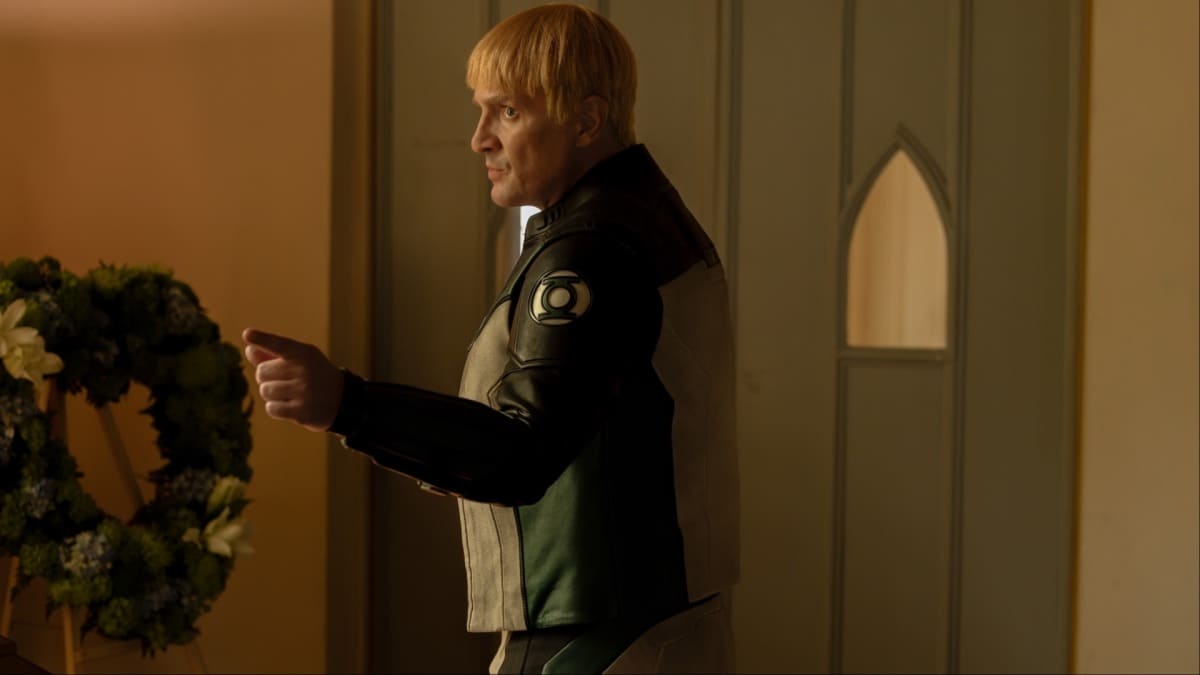
Jarrod Jones: Our editor paired us for this Crosstalk because he felt our differing opinions about Guy Gardner’s function in Lanterns would spark a healthy debate. And I agree! It seems that, regardless of which medium he ends up in, Guy will always be a divisive figure: He’s braggadocious, smug, condescending, and rude. He’s even rude to Superman! And, at least in live action, his gold-tooth/bowl-cut style combo feels deliberately hostile, which I feel Nathan Fillion presents incredibly, hilariously well. Guy’s the dim-witted jock with a chip on his shoulder who just so happened to score the most powerful weapon in the universe—by design, not everyone is going to like him. So I have to know: How are you feeling about Guy’s appearance in this week’s episode? Do you feel the character is adding to the story or distracting from it?
Chase Hutchinson: Going to be honest with you, Jarrod: I’m feeling not so great about the appearance of Gardner in “Bad Optics.” I think your points about how he’s meant to function are all quite interesting, but not only do I ultimately think this show is not one that he fits into, I found his presence detracted from some of Lanterns’ greatest strengths. Though the majority of this episode is engaging, following Aaron Pierre’s John Stewart as he tries to piece together what happened to Hal and observing how the town of Rushville has changed over the years, the moment that Gardner touches down, it makes what was once a vast story feel small.
While I’m more than willing to go along with a character with a goofy-looking bowl-cut (after all, I did watch Stranger Things all the way to the bitter end), bringing in a character like Gardner just feels like a way of connecting a solid show to a broader universe that’s stumbling. Watching the TV shows of the Marvel Cinematic Universe has started to feel like homework; by comparison, the first few episodes of Lanterns, save for a few cheeky throwaway lines, were able to stand alone from the nascent DCU. They built out rich new characters, a simmering conflict between them, and a world that felt unburdened by having to tie into the next season of Creature Commandos, or whatever James Gunn and Peter Safran have planned for Batman. To me, Gardner is the antithesis of all that has been working for Lanterns. While he’s intentionally cartoonish and broad, the scene he shares with a jailed John left me wondering what the purpose of him being there was, beyond a connection to Superman and its upcoming sequel? Not only that, but I thought Pierre acted Fillion off the screen—I felt the Firefly star was rather flat, but that’s a whole other subject. Tell me though, as someone who was more taken with the character this episode, what did you like about him?
JJ: See, I’ve found Lanterns to feel small rather than vast. As a comic-reading dork, I think the show assumes our familiarity with the Green Lantern Corps so it can focus on its characters. And while that character focus is the show’s greatest strength, I feel its take on the Green Lantern Corps is too diffuse to fully grasp the enormity of a ringwearer’s responsibility. For instance: Hal says he inherited “Sector 2814” from Abin Sur, who we know died bringing the Manhunter to Earth—so, what’s that supposed to mean to us? Readers of superhero comics know what policing an entire space sector entails, but does the average HBO viewer? Who are the Guardians, for instance, and why do they get to be the “blue bosses” around here? Why only one Lantern per sector? How big is the DC Universe, and are the GL Corps enough to protect it, especially after the Guardians botched the Manhunters? Lanterns glosses over all of it.
This is only part of why I’m stoked about Guy’s guest appearance. Sure, it’s part of furthering the brand—he’s so brand-focused, in fact, we see him hawking DC energy drinks and mending the wounds he feels John and Hal inflicted on the Corps in Rushville. I like that he’s here. But I also appreciate his inclusion because of the effect his status as Earth’s Green Lantern has on John Stewart. We know the only reason Guy has that ring is that the Guardians settled on him after John rejected it. Despite all those years of desensitizing training and the gulf the Guardians put between him and his family, John walks away from it all. That jail scene, which had me practically jumping out of my seat, nails this dynamic between John and Guy incredibly well. John resents this peacocking chump zooming around with his glory—as complicated as his feelings towards the ring undoubtedly are, there’s no doubt that a big part of John still wants it. And here’s Guy tapping the thing on his jail cell. “Everything you have is because I didn’t take it,” he tells Guy, and Guy, loudmouth that he is, begrudgingly throws some respect John’s way at last. Guy and John’s testy dynamic suggests future drama in the DCU that I feel is worth investing in.
CH: I see where you’re coming from when it comes to bringing in the expansive history of the comics, but I think that’s part of a core disagreement we have on what Lanterns currently is and what it wants to be going forward. For me, smaller-scale superhero stories usually prove more emotionally vast because of how they’re largely not connected to anything else. It frees up the creators of shows like this to offer their own origin stories—with the one Lanterns gives John proving to be one of the series’ most fascinating episodes thus far—that reflect on big questions surrounding history and power. Yes, there are indeed those outstanding world-building questions surrounding the ring, the Lanterns, and the way this universe works that might not be fully communicated in the show. However, to me, I think viewers looking to know more can then go back to the comics and read them. It seems you’re saying the point of bringing in Gardner is to start to bring in all this other context, which is all well and good. However, to me, this feels like a character being used for exposition purposes rather than emotional ones. I feel the hold the ring had on John and his family because their scenes are allowed to be free of this baggage.
JJ: Fair enough.
CH: To extend an olive branch, I agree with you that the “Everything you have is because I didn’t take it” line is a great one. However, I mainly think this is because Pierre is absolutely firing on all cylinders and is really coming into his own as John. We do see he still wants it and that emotional progression has everything to do with the solid groundwork laid by his excellent performance before we even saw Gardener. So while I think Fillion is often a perfectly fine actor in other shows and movies, I found the way he played his scenes to be rather one-note, dragged down by a need to tie into so many bigger, more obligatory, parts of the DCU. To me, the heart of the show remains the dynamic between John and Hal. It’s their relationship, even with one now in ghost ring form, I want to Lanterns to dig into further. So while I’ll give you that the bowl-cut bozo and the broader goings-on he introduces have their place, he lacks the same power as my boys Hal and John.
JJ: I mean, I won’t argue against that! Hal and John mixing it up is the whole crux of the show, though I’m worried John and construct-Hal won’t hit quite like John and surly Hal did previously. I’m just stuck on how tiny that version of this show feels. It’s ostensibly a two-hander (charitably a three-hander between Pierre, Kyle Chandler, and Kelly Macdonald), with almost every other character—save for Bernadette Stewart and Sheriff Kerry—feeling peripheral. There’s not much in terms of a fleshed-out ensemble. Zoe and Will Macon were elusive and schematic by design—and we didn’t really get to “know” those characters until it was time to say goodbye. So, for me, Guy doesn’t really stand out in this regard. He’s just the latest in a string of passersby in the tale of Lanterns. And while I agree with you—clearly, Fillion was either instructed to tone Guy down or felt he should, given the material—he at least has an established personality for John to bounce off of, rather than “discover.”
So, we know there’s been some chatter about a Lanterns season two—co-creator Chris Mundy and Halt And Catch Fire‘s Christopher Cantwell (also a comics writer) have tossed around ideas for one, at least—what would you say about the prospects of John and Guy teaming up for that? Do you feel there’s enough to Guy that Fillion could shoulder a second season alongside Pierre? I mean, there’s that whole bit where Guy clocks John, or “Stewie,” as a “sick fuck” during their funeral conversation, which precedes the next time John visits Hal’s casket with a shovel. There’s real comic potential here, I feel. Can, or should, Lanterns evolve tonally?
CH: I’m glad we could close out with consensus on John and Hal! Because, to be honest, I would follow that wild duo into just about any direction this show wants to take us. While I understand the nervousness about construct-Hal not being quite the same as his wise-cracking, alive self, I wouldn’t be surprised if there was some sort of way we end up seeing a resurrection take place. In the meantime, I will always go to bat for Kelly Macdonald, who I think is the unsung MVP of the season and really brought a lot of needed emotional heft to some key scenes in “Bad Optics” (so much so, I almost forgot about my Gardner gripes from the shattering, unspoken performance she delivers during Hal’s funeral). I’m with you in that there aren’t too many other characters to build around, though I did find the scenes with John’s two brothers over the phone to be both really authentic depictions of sibling dynamics and often incredibly funny. All of this is to say that I would be fine if Guy is ultimately just briefly passing through.
As for the road ahead in a potential season two, I do love Cantwell—Halt and Catch Fire remains one of the most slept-on shows of the 21st century—so I would always be open to them bringing in more of Gardner if they had something interesting to do with him. However, for now, I don’t think he’s enough to build a whole second season around as a co-lead, and I’m currently both predicting and holding out hope that Hal can find a way to remain a critical part of the show. However, to answer your final question: Yes, I believe that the show can and should try to evolve tonally. Still, I think that the strong character foundation of Hal and John remains critical to what has made it all work so far, and the show would be smart to make that central going forward as well. Time will only tell, as neither of us has a lantern to see through the darkness into the future, but I remain excited for what is coming next as they get up to some potential ghost investigating. (Ideally without anyone else popping in with a terrible bowl-cut, at least for the present moment).
JJ: One last question before we go, Chase: Do you think there’s room for Ch’p? How about Kilowog?
CH: As long as they like having a seat at that tiny cafe, the more the merrier. I don’t know how they like their coffee, but I’m open to finding out.


 Keep scrolling for more great stories.