As Lanterns swings into its back half, there have been the usual proliferation of speculative pieces working to ferret out just which DC elements are secretly being seeded throughout the season. Hell, even The A.V. Club did one. (I had to recuse myself because of being a spoiled little screener boy).
I’m not knocking the practice, at all. Part of being a comics nerd is that ticklish feeling (some sort of Spider-Sense, if you will) when you think you’ve twigged on a sly little hint of something you genuinely hope enters this new, adapted reality. Fully aware of my critic’s privilege, I’ve dutifully read/watched through assiduously annotated guesswork that William Macon is the immortal Vandal Savage (yeah, not so much), that the Manhunter’s black fog is the ring-nullifying power of the Black Lanterns (noncommittal shrug), and other geeky-fun guessing games.
But here’s the thing that’s become increasingly clear: Lanterns is, for all its genuinely fine qualities as a piece of superhero storytelling, an exercise in withholding. “Bad Optics” drops at least two pretty major characters from Green Lantern lore into the mix, one practically mandatory, the other fleetingly unexpected. But even in the latter surprise, there’s the sense that Lanterns isn’t interested in bulking out the ring-slinging, universe-spanning GL swashbuckling of it all. Both visitors to Rushville this week bring their sad, decidedly human baggage to town, and the flashy stuff stays resolutely elsewhere.
It was a bold narrative choice to essentially wrap up the Manhunter storyline in episode 5, especially as the 10-year time jump to “Bad Optics” makes it clear that there’s life after the ring. John is now an architect for “rich people with too much money,” pitching Midway City (while citing destructive events in Superman and Gunn’s The Suicide Squad) on investing in his anti-superhero underground bunkers. This John is smooth and slick as he assures the understandably on edge city fathers that the only move these days is to “hide from superhero shit” when it inevitably dusts some skyscrapers.
We gather a few details of John’s time away from being Green Lantern. (John explains he was one “for five minutes.”) He drinks and eats meat now, his business is doing well enough to kit him out in a cool bachelor pad and sharp truck. He’s reconnected with his brothers (Marcus works for him, while Aaron’s music career is funded by John), who both call him “Chosen,” in not-quite good natured joshing. His mom and dad appear to be separated, with John Sr. unwillingly installed in elder care while Bernadette, John discovers to his dismay, has been talking with Hal. Who’s been in prison for 10 years.
Frankly, this sort of piecemeal exposition is just as good for me as Hal’s nonchalant references to Mogo, Ch’p or that time Kerry told someone in Gotham to say hi to Barbara. The cataclysmic fate of Rushville (Laura Linney’s Lianna rightly called it a shitstorm) saw Hal stripped of his ring and identity, John rejecting a fate he’s chosen not to want, and Kerry mourning not just the deaths of her in-laws (one of whom, okay, was a secret killer-bot), but the destruction of the town she’s sworn to protect ever since Zoe saved her life. Rushville’s benefactor is dead, and with it her literally miraculous ability to ensure those hospital machines stay wrapped in their plastic. The people who are left are wounded, shellshocked, and rightfully pissed at anything related to green rings, and superheroes in general.
It’s into that environment that John arrives, after Bernadette Parent Traps him and Hal by swearing that the other wants to apologize. Their diner sit-down goes poorly, as both bristle at the idea they have anything to apologize for. “I took the fall.” Hal states knowingly, while John coldly replies, “No, you didn’t take the fall—you fell. And people got killed.” After Hal snaps that “there’s more than one killer at this table,” John socks him a good one, explaining the broken nose Kerry’s about to find on Hal’s frozen corpse a short time later.
Hal’s fall, the fallout from which informs the rest of the episode, is as undeniable as it is complex, in Lanterns‘ signature manner. He was warned by Kerry that his plan would get citizens killed, and it did. His plan was as tied up in his own need to restore his self-worth as a man and a hero as it was about saving Rushville. (He also burned John up in a car, although that was mostly an accident.) In the comics, Hal Jordan’s most infamous fall was a universe-shaking doozy that took the character years (and DC editorial retconning) to walk back. Here, Hal’s crimes stemmed from insecurity, and buried trauma—he’d been Earth’s first Green Lantern, glowingly interviewed and hounded for autographs as he repeatedly saved the day. Now he’s a tired-looking ex-con in his 60s, resentfully but honestly hoping someone he’s wronged will accept his contrition.
As we find out, Hal came back to Rushville after spending a decade in actual, earthbound prison. (Later we’re told the place had pickleball but, still.) Kerry tells John over Hal’s dead body that he came back for her, and he did. Hal and the divorced Kerry are now more or less a couple, complete with Hal leaving the sort of rascally voice messages on her phone only a smitten old guy with the weight of the universe finally off his shoulders can muster. (“Buttercup” makes a fine nickname, if Kerry will only listen to the lyrics.)
He also came back… to be a hero. Nobody says that word, but Hal returned to the one place he’s hated most (even Kerry’s trusted undertaker pal Bitsy calls him “a has-been” as she reluctantly does Hal’s post-mortem), knocking on doors to ask if he can help. Carry groceries, do yard work—just help. We sense how well it’s gone by the shotgun trap Hal’s rigged up at the front door of his ramshackle rental house. (John warily finds Earl there, offering up a playful bout of shadow-boxing to the bereft alien plant-creature.)
Rushville’s temperament toward Green Lanterns is also seen when John is forced to punch his way ably through a gaggle of locals resentful at his presence. (Including Jason Ritter’s Billy, no longer playing the glad-handing fixer.) Of course, John had just essentially lit a fuse in the form of the thoroughly defaced, Bat-signal-esque Green Lantern beacon in order to lure Earth’s current Lantern to town. (There’s a dick drawn on the pedestal, with John commiserating that is was a dick move to put the beacon right next to a monument for Rushville’s dead.)
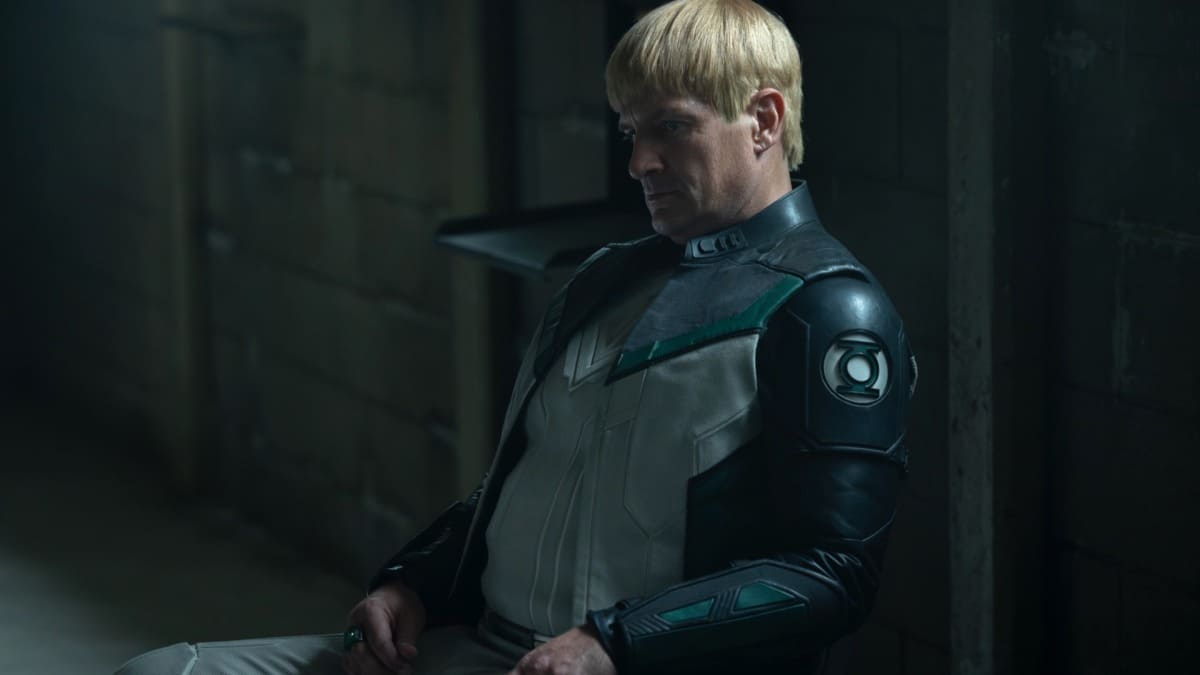
Enter Guy Gardner, Lanterns‘ first real crossover. And while Nathan Fillion still revels in Guy’s dickishness (calling John “Stewie” is just his opener), he’s unequivocally transformed by the change in scenery. As John (locked up by a dutiful Kerry for the brawl) petitions Guy to fly to Oa and retrieve Hal’s depowered ring and costume for a proper hero’s burial, Guy can’t help but flinch at John’s assessment, “Guy, everything you have is because I didn’t take it.”
In the diner, Hal and John had mocked “the gym teacher” who’s taken their place, and it’s good to get some clarity at last about just how got the ring, if not how such a preening jackass was deemed worthy by the Guardians. Aaron Pierre’s given more room to breathe as the ring-less John Stewart (“Motherfucker,” he assesses quietly after Guy’s departure), and while it’s tempting to imagine Hal’s death has softened his anger, we find out in the effective twist that all John’s maneuvers have been designed to bring Hal’s ring back to him. Even though he literally has to dig up Hal’s body to get it.
As ever, Lanterns stays human, as John’s real shock and sadness at Hal’s demise are real enough. (“I just never thought he’d actually die,” John says over the dead Hal, with Kerry answering softly, “I just wanted someone else around that cared that he was gone.”) John cares, but he’s got a plan. Whether that’s merely to solve his mentor’s murder (and clear his name—see the stray observations) or something more bound to his confirmed leap to the big screen DCU in Man Of Tomorrow, we’re left, as is Lanterns‘ way, to ponder.
Stray observations
- • The other notable character here is Carol Ferris (played by Amie Mackenzie), whose comics relationship with Hal Jordan is a long and tangled one. Here, she seems more like an old lover who got tired of Hal’s shit, handing over the self-penned eulogy Hal had preemptively entrusted to her. “I bet he liked you, John. And I also bet he never said it,” Carol says, her exit before Hal’s funeral feeling pretty final.
- • John reluctantly reads Hal’s eulogy and can’t help but let out a bitter laugh when reading Hal’s blessing for him to take the ring. He also can’t help but pause at Hal’s posthumous closing, “I hope I mattered.”
- • Midway City is also home to the comics’ Doom Patrol, and if James Gunn finds a way to squeeze the utterly, suitably bananas HBO Doom Patrol series into his DCU, I will be eternally grateful.
- • Guy even takes off and lands like a dick, his every flight marked by an unnecessarily showy whoosh.
- • Oh, there’s a subplot where the diner waitress named Maggie (Hannah Christine Shetler), who is also the little girl John gave a ruined watch to in the long-ago Rushville ruins, blackmails him? This plot could go somewhere, I suppose, but John and Kerry’s relationship is solid enough (lockup notwithstanding) that it’s genuinely exasperating.
- • John does elaborate a bit, as he reminds her he’s “a Black man in rural Nebraska.”
- • Also not thrilled with the focus on John’s architectural scheme, his Midway bunker seemingly scuttled over the phone as he stands in Hal’s half-empty grave.
- • When Bitsy mentions testing the skin in Hal’s cuts for residue, John clumsily shoves his hands in his pockets. Again, this whole subplot is equally clunky.
- • The facility Hal’s unbreakable safe is in is called The Fortress of Storage.
- • Even though John and the now-teenaged Noah (Shea Pritchard) renew their bond over dinner at Kerry’s, anybody else recalling the meaningful parting the young Noah had with Zoe? Maybe it’s that this Noah is so obviously angling to be a Republican Nebraska congressperson down the line, but I think his forgiveness face is hiding something.
- • Hal takes umbrage with John’s 2026 gruffness: “I’ve been in prison for 10 years, even they don’t swear that much.”
- • Kelly Macdonald keeps getting short-changed in these reviews, for which I apologize. (A lot of plot here, you guys.) But her face when she calls Hal’s quest for forgiveness equally “stupid, pointless, endearing,” is just heartbreaking.
- • Okay, gonna nerd out a little bit. If the rings can always be revived to 5 percent with a little whack on something, then the Guardians are pretty slipshod in their stewardship of one of the most powerful objects in the galaxy, right?
- • That aside, we’re not losing Kyle Chandler, which is an immeasurable benefit. The 10-years-ago Halogram backup has been shown to be a lot more fun, and in a lot less pain, which gives Chandler more places to go. Finally, some of the deceptive buddy cop vibe from the trailers may come to pass.
- • Guy’s complaint that John and Hal “damaged the brand” runs up against the fact that Guy’s licensed himself out to sell energy drinks.
- • Guy tells John that someone busted out Sinestro from his inescapable space prison, so watch out for that guy.


 Keep scrolling for more great stories.