The monster mash-up Trauma Or, Monsters All likely isn’t what you think it is. Cynics may jokingly suggest that writer-director Larry Fessenden’s latest movie is his answer to the Marvel Cinematic Universe, since it assembles supernatural protagonists from three of his previous films: the grimy vampire drama Habit, the neo-romantic Frankenstein update Depraved, and the brooding werewolf pic Blackout. Others might fear that Trauma serves as Fessenden’s last movie, since it feels like an urgent summary of his work as both a filmmaker and founder of the independent horror studio Glass Eye Pix. In a recent conversation with The A.V. Club, Fessenden admits that he did wonder if Trauma was his last movie. But he’s since changed his mind—he’s not sick, and has no plans to retire. Fessenden also leaves room at the end of Trauma for future additions to his shared horror universe.
For Fessenden, Trauma Or, Monsters All is a modern update of the Universal horror sequels that threw together several characters from earlier monster movies, like Frankenstein Meets The Wolf Man or House Of Dracula. Fessenden watched those lovably shaggy follow-ups as a kid, but never aspired to make anything like them. “I certainly wasn’t thinking about my legacy,” Fessenden explains. In fact, he only thought to team up his antiheroic loners when making Blackout.
“My key idea was that the monsters would be objectified for the first time,” Fessenden says. “The first three movies are an exploration of what it would be like to wake up as Frankenstein’s monster, or a werewolf, or a vampire. With Trauma I wanted to say: what if they were among us? Could you tell that they’re monsters?”
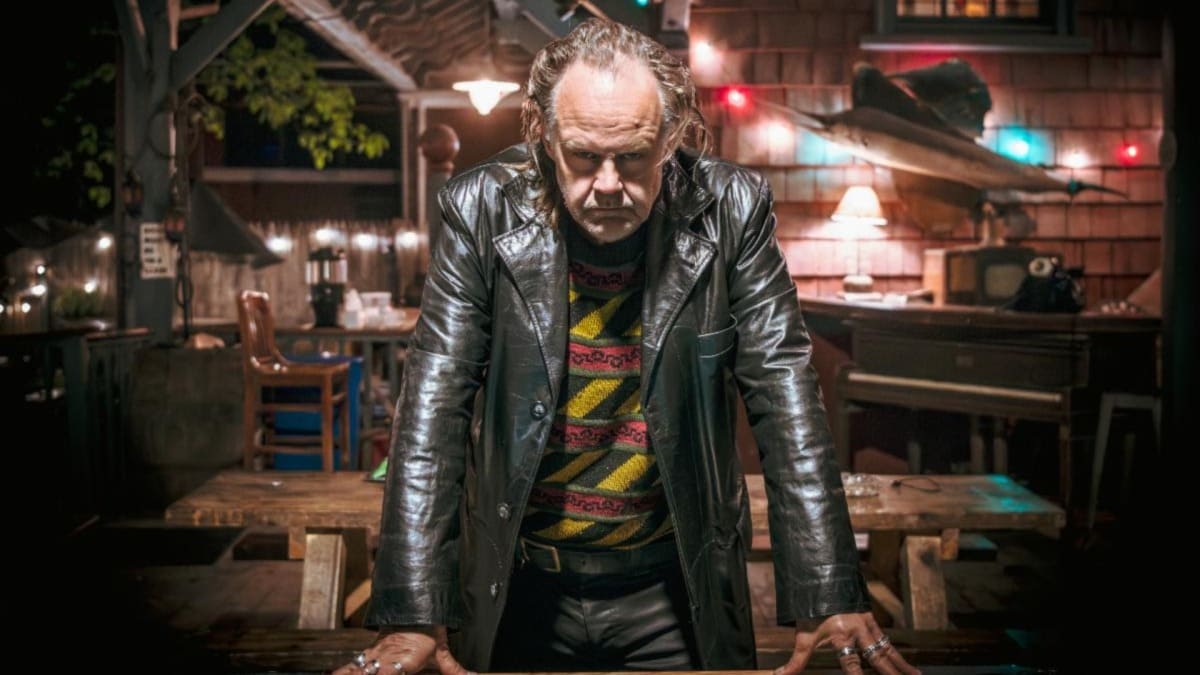
Trauma follows Blackout‘s grisly finale as young writer Cassandra (Laëtitia Hollard) publishes an article in her local newspaper about the monsters lurking in the upstate New York everytown of Talbot Falls, particularly tortured lycanthrope artist Charley (Alex Hurt) and introverted Franken-zombie Adam (Alex Breaux). Cassandra means well, but her article only draws unwelcome attention to Charley and Adam, especially after Habit‘s bohemian vamp Sam (Fessenden) arrives and tries to force a meeting with his fellow cryptids.
Fessenden says that current events inspired him more than any movies could. In that sense, Trauma‘s about the essential but often futile struggle of trying to get along with your neighbors during Trump’s second term, especially if you dare to bring up the country’s troubling past. “The grievances are so deep in this country,” Fessenden says. “If you say, ‘I think people should examine their history a little bit and realize that they’re suffering from trauma,’ a mob will show up and January 6th you.”
In this way, Cassandra and the monsters find themselves on opposite ends of their respective journeys, which makes Trauma a perfect vehicle for the Fessendenian theme of how life ultimately follows its own path, leaving us to judge for ourselves whether it’s taken a turn for the better or the worse. Anybody can appear monstrous in this context and everyone has their reasons for behaving like they do. So while Cassandra’s article inadvertently unsettles everyone, she’s still a young idealist who hopes to effect change in her own backyard. By contrast, Sam and his fellow creatures lash out at the world because they’re worn down and “exhausted from trying to lead a moral life,” Fessenden suggests. “They’ve all slipped into nihilism,” especially Sam, who “has been a vampire for 30 years and it’s a drag.”
Fessenden, on the other hand, has been re-energized by Trauma. He finds relatable qualities in all of his characters and has injected “a lot of autobiography” throughout. Sam, for starters, reflects a spiritual burnout that has hounded Fessenden after decades of struggling to make soulful, melancholy horror dramas that reflect his post-hippie values. Just making Trauma was a challenge, partly because of how demanding it was to bring together 26 actors at the same time on a fairly small budget. “I had to basically convince every actor to come back,” Fessenden says. That’s what made Fessenden think, albeit briefly, that Trauma could be his final film. “I was tired and angry at the culture. That’s what made me say, ‘This is it.'”
Fessenden points to a flashback where Sam identifies with his dead father by calling him “a disappointed optimist” instead of an outright pessimist. In that sense, Sam’s a reflection of what might have happened to Fessenden if he gave in to his darker impulses. “Optimism is what keeps me going,” Fessenden says. “Pessimism is still always there nipping at my heels saying, ‘It’s not gonna work, we’re doomed.’ But then I say to myself, ‘But you still bail. When the boat is going down, you still bail.’ Maybe there’s a day when you go, ‘You know what? I’m not bailing anymore.’ That would be a sad day, but maybe it’s a day you’ll have earned.”
Underscoring this wistful look towards the future is the fact that Trauma is being released while Fessenden’s personal films and the ones that he produced through Glass Eye Pix are enjoying more exposure than ever, thanks to a new slate of Blu-rays produced by Vinegar Syndrome. Fessenden has recently participated in and spearheaded a variety of new interviews and audio commentaries that have reunited him with his older movies’ cast, crew, and other collaborators.
“I’m very content to look back,” Fessenden says. “I feel like we’re setting an example for the next generation of filmmakers.” Fessenden contrasts these releases with AI art, the latter of which he thinks only encourages people to “look back at what’s already transpired by regurgitating it. There’s a sort of stasis to it. I’d rather have a new generation of filmmakers who want to get their hands in the clay and make stuff. And by making our positions known [with these supplements], we’ll hopefully get more people to come to the movies.”
Adding to the solemnity, Trauma will also be released just weeks after the untimely death of indie horror filmmaker Jeremiah Kipp, who started making movies as an assistant director and production assistant on Glass Eye productions like Automatons, I Sell The Dead, and Satan Hates You. Kipp’s passing is especially shocking given his hard-won progress with features like the eerie video game adaptation The Mortuary Assistant, which Kipp spoke to The A.V. Club about earlier this year.
Fessenden’s understandably still processing Kipp’s death, which is why he hasn’t otherwise commented on it publicly. But he fondly remembers meeting up with Kipp months before his death. “There was a sense of the future,” Fessenden says, recalling Kipp talking about all the projects he was either working on or about to pursue. “We had a philosophical alignment, since we both talked about monsters as the Other and with great compassion.” Fessenden remembers an early interaction where Kipp encouraged him to spend less time producing other filmmakers’ work so that he could focus on making his own movies: “I thought that was very compassionate of him.”
At the same time, Fessenden’s contributions as a film industry patron is just another way he’s developed his legacy. He talks admiringly about Ebenezer, Glass Eye alum Ti West’s upcoming take on A Christmas Carol. Fessenden’s excitement for that project is especially remarkable given his own love for Dickens’ novella, which has been the inspiration for a semi-annual puppet show that he directs and acts in at his Alphabet City apartment.
Since he’s not quitting filmmaking anytime soon, Fessenden might even make his own movie version of A Christmas Carol. He imagines that his take would take place in the modern day, unlike West’s period-set adaptation. “I’m fascinated by the resilience of stories like this and how they’re still relevant now,” Fessenden says. “[A Christmas Carol] is about redemption, and I would love to say, ‘Let our villains reform.’ Even though there are serious concerns that arise from that sentiment. Like, can we ever forget the past and forgive others? You’d weep at the idea of somebody as venal as Trump or Musk having a change of heart. But that’s why it’s such a timeless story, because it’s about redemption.”
Or maybe he’ll take a stab at Dr. Jekyll And Mr. Hyde next. It would be fitting, since Fessenden’s first movie was based on the classic horror story. He never finished his debut short, begun when he was 12 years old, so it’s a perfect opportunity to apply the same galvanizing energy that made Trauma seem like it might be a perfect swan song to a property that could serve as a career bookend. “There are still a few seminal horror movies that have meant so much to me that I could revisit,” Fessenden says. “Some have been done really well and some pretty poorly. So I’m not embarrassed to throw my hat in the ring.”


 Keep scrolling for more great stories.