
Love Eternal can't escape the gravity of its influences
This retro-styled psychological horror game wants to say something but it's not clear what.
Images: Ysbryd Gaems

One of the most common ways people talk about games is the “X meets Y” pitch. It’s a pretty self explanatory way of selling a game to the right audience. Let’s use Love Eternal, from developer brlka and publisher Ysbryd Games, to demonstrate how it works. Someone might (and did) write that it is “Celeste meets Silent Hill” or even “Gris but grimdark.” Both are extremely evocative. They might even get enough players in the door. But what lies on the other side? In Love Eternal‘s case, not much.
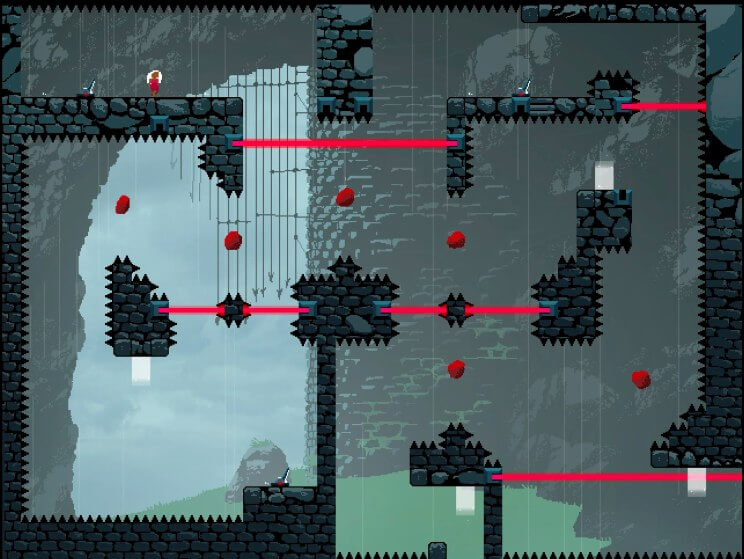
In the spirit of the elevator pitch, let’s start with the “X” factor of Love Eternal. It is, mechanically, a puzzle platformer that owes much to Celeste and VVVVVV. The name of the game is difficult rooms meant to challenge the player’s ability to comprehend complex level design and execute pixel-perfect platforming. There are good bones here, with two aspects of gameplay that Love Eternal introduces and then uses as the foundation of every level, even as difficulty ramps up. First, you have the ability to flip gravity. This can only be done once before resetting upon touching the ground. Second, orbs scattered throughout levels will reset your gravity ability when broken, even in the air. Every level, therefore, is about finding a path through the obstacles laid out based on the right manipulation of gravity via platforms and orbs.
In theory this is a simple but fantastic set up for challenging puzzle-platforming, and for a little while it feels like Love Eternal might live up to its influences. A major drawback quickly becomes apparent, though. Puzzle-platformers rely on precise inputs and the ability for the player to trust that a button press will do what is expected. Love Eternal fails this test. Controls feel both floaty and too heavy in different instances, while movement itself often lacks the necessary precision. Properly predicting the inertia when flipping the direction of gravity mid-movement is especially imprecise. It means that even early challenges can elicit frustration and test your patience. Failure is an essential part of a puzzle-platformer; successful ones make the player understand why they fail, while unsuccessful ones give the player reason to believe the game itself is in the wrong. Love Eternal too often does the latter. To make matters worse, there isn’t a gradual climb to more compelling puzzles; the game’s many rooms quickly hit a plateau in challenge that only really rises at the game’s final half hour or so.
 Keep scrolling for more great stories.