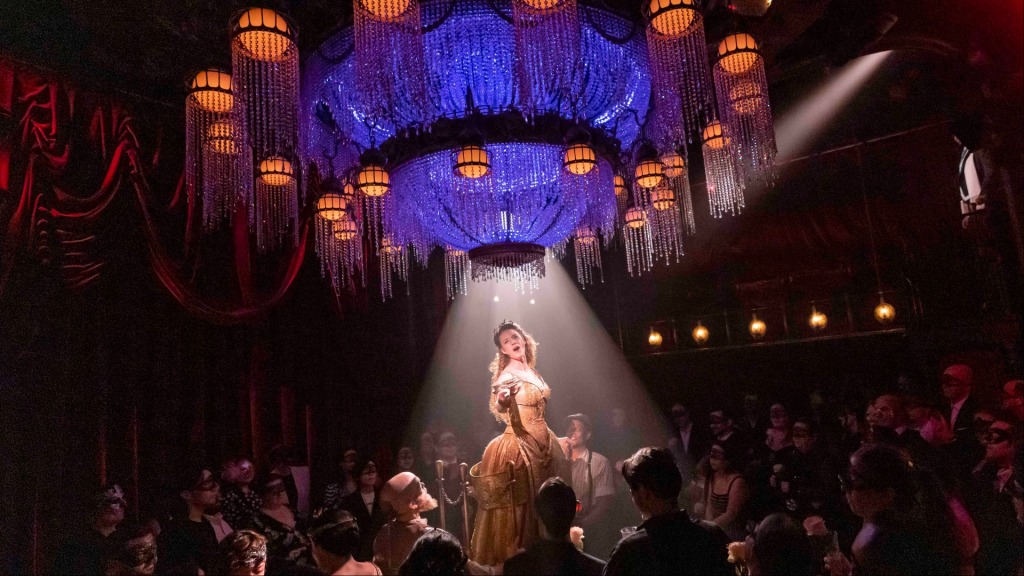
Masquerade is unlikely to challenge any understanding of The Phantom Of The Opera you may or may not already have, nor does it especially try to. It’s a pretty cool experience overall, too, despite my initial reluctance to ever be as close to any actor as Masquerade forces you to be. The space itself is impressive, the actors game and talented, the songs their classic schmaltzy, ear-wormy selves. Eventually, you, to borrow a phrase, surrender to the music and the spectacle of the night. You’re almost constantly in motion—I would guess you’re not really in any of the rooms for much longer than 10 minutes during the two-hour experience—so it helps if you’re already familiar with the show, as most people in my group seemed to be. In fact, it seems designed for people who have already seen the musical and are fans of it.
It’s also priced for people who already love Phantom Of The Opera. Tickets start at $175 per person, and the vast majority of performances remaining on Masquerade‘s calendar run higher. This isn’t especially shocking for those who have been paying attention to New York theater pricing lately; off-Broadway shows with fairly minimal cast and set design can easily run north of $50 per ticket. But for comparison, by the time the original Phantom closed, it was still selling tickets for as low as $29 before fees, with the ceiling for non-premium tickets reaching $169. Of course, there was a secondary market, and demand fluctuated, but the point is that for $29, people might be willing to see something they’re relatively unfamiliar with, and take their family to, for the sake of seeing a Broadway show.
Masquerade is by no means affordable family entertainment; it’s an experience for Phantom fans. As a semi-private Phantom experience in a custom-fitted building with a bit of free champagne upon entry, I would say you’re getting your money’s worth. It’s priced like a luxury, and you’re getting the theatrical approximation of a luxury experience. But the fact of the matter is that Masquerade is not that out-of-step with the pricing of a traditional Broadway show. Orchestra seats at a Broadway musical are regularly priced above $200. If you want to see Schmigadoon!, the most recent winner of Best Musical, this summer, it will cost over $100 per seat unless you want to sit in the very rear of the mezzanine. Theater itself is being priced as a luxury experience, which frankly sucks for people who enjoy going to the theater, and for the artists who make theater.
This is a conversation that’s come up most recently with the news that another reimagined Andew Lloyd Webber joint, Cats: The Jellicle Ball, would close months early. Though the producers didn’t say why, it’s not especially mysterious: If the show was making the kind of money it needed to, it wouldn’t be closing. Running a Broadway show is exceptionally expensive; even the acclaimed Sunset Boulevard didn’t make back its $15 million investment when it finished its run last year. The economics are complex, but the Jellicle Ball closure announcement encouraged some finger-pointing; in addition to theater owners and producers, Webber also pointed to worker’s unions earlier this week as part of the issue of the current economic model, which justifiably annoyed many. But regardless of who’s to blame, commenters on this very site pointed out that for many people, dropping $100+ on a ticket for a reimagined Cats is simply not a justifiable expense when there is a nationwide cost of living crisis, no matter how much someone loves theater.
Perhaps Masquerade represents a way forward, though hopefully not the only one. The scale of the production is even bigger than that of a typical show, but with a smaller audience, one willing to pay top dollar for the experience. It is a unique production, landing somewhere between a piece of theater and a haunted house (something that was said, though presumably less literally, about the original Phantom), and it’s poised to make the already well-known original enjoyable in a new way. Its success will be difficult to replicate, even if the ticket costs nearly the same. If Phantom was a populist experience, Masquerade imagines it as more of a boutique one. It is just one show, and it’s technically not on Broadway. But in a couple of weeks, it’ll be the last Webber show standing in New York—until, of course, the Evita revival touches down, in a stripped-back, sparse new staging, direct from London.


 Keep scrolling for more great stories.