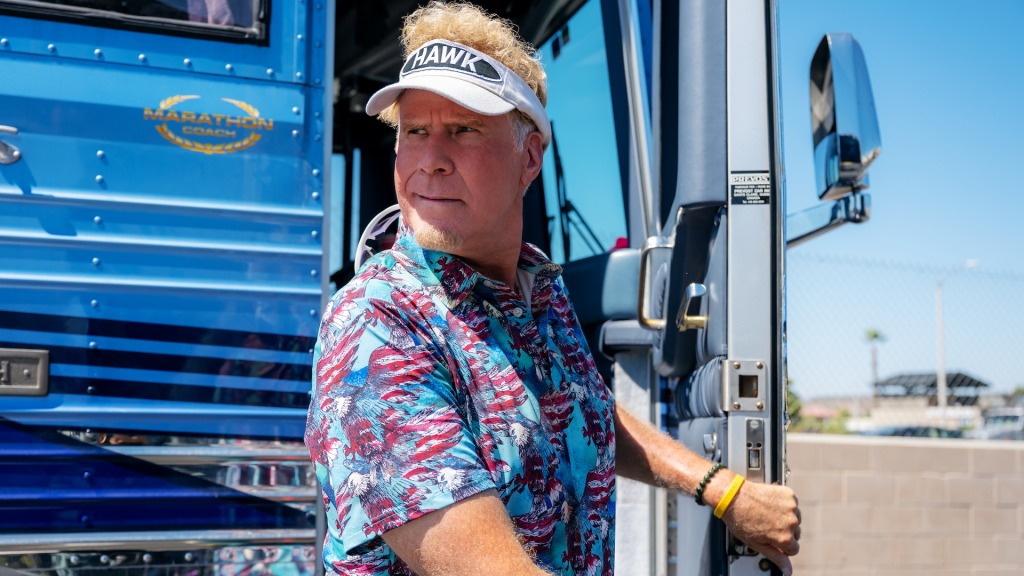
Lonnie “The Hawk” Hawkins is deep in the rough, with his haystack hairdo peeking out of his signature visor and a farmer’s tan shown off by a sleeveless purple golf top clearly designed for a woman. He asks for a two iron—which his caddy can’t believe he’s carrying—and blasts his ball out of the woods. Against all odds, it lands on the green. The play-by-play announcer sums it up for the imaginary audience watching the Genesis Invitational on NBC Sports, but everybody watching The Hawk on Netflix knows the score: “He’s been inconsistent today, but only Lonnie Hawkins would try that shot.”
And only Will Ferrell could play Lonnie Hawkins. He’s been inhabiting this type of guy for more than 30 years: Loud, arrogant, poor impulse control, dumb as a rock. A “walking bag of burps and farts,” to quote Anton Floyd (Chris Parnell), the haughty PGA official who is none too happy about the return of Lonnie’s rock ’n’ roll ways and rowdy fans to golf’s biggest stage. The aging Hawk has lost some of the oomph from his swing, but the star of Anchorman and Step Brothers still has his superpowers—even if he’s really not putting them to use to distinguish this high-status buffoon from all the others in his repertoire. He’s been out of this particular game for a minute, and it’s the first time he’s doing it in a half-hour TV series, but The Hawk proves once more that nobody commits harder to a silly costume, or puts more conviction behind an anguished scream, than Ferrell.
Nobody loves a lopsided sports comedy like Ferrell, either. The man’s IMDB page contains more Semi-Pro airballs than Talladega Nights triumphs; his new one lands somewhere in the mid-to-upper tier of the standings. With these projects, it comes down to the supporting cast as much as the material they’re performing, and The Hawk is an all-star affair. It reunites Ferrell with his former Saturday Night Live castmates and fellow virtuosos of comic bluster Parnell and Molly Shannon; the latter plays Lonnie’s estranged wife, Stacy. Mr. and Mrs. Hawkins’ high-pitched sniping gets a quieter, drier contrast from Jimmy Tatro in the role of the no-longer-a-couple’s son, rising pro golfer Lance. Fortune Feimster carries The Hawk’s clubs, easily getting on Ferrell’s wavelength as the excitable, tracksuit-clad Sam.
About that material, though. The laughs are big here—think Feimster firing off “I have nothing against the Danes—they have the biggest dogs”—but The Hawk tends to space them out, and that makes it harder to look past some shaggy, noncommittal plotting. Despite the shape the first season gains from Lonnie’s tournament schedule and underdog quest to complete the Career Grand Slam that eluded him in his prime, the show isn’t immune to chasing a go-nowhere subplot or letting characters drift in and out of the story episode to episode. Much of the conflict is rooted in the age-old war between snobs and slobs, with only the show’s taste for a tricky camera move or editing flourish adding any variation or advancement on the theme that wasn’t there when Al Czervik and Judge Smails duked it out at Bushwood Country Club. Eastbound & Down’s Kenny Powers may like a word with The Hawk; Happy Gilmore, too: Lonnie has a Happy-Chubbs thing going on with his original caddy, Old Henry (Keith David), and seems to perform best on the links when he retreats to the dirtbag classic-rock-soundtracked happy place in his head. Cameoitis is apparently transmittable between Netflix projects: The Hawk shares Happy Gilmore 2’s yen for roping real-deal golfers into scenes. If only they all had the comedic chops Rickie Fowler shows off when he drops some deep hors d’oeuvres knowledge during a party celebrating Lance’s engagement to self-proclaimed aspiring wellness influencer Natalie (Katelyn Tarver).
Luke Wilson is on hand to give Lonnie a rival in the form of Golden Fisk, a more polished veteran with Arnold Palmer’s sense of style and a sponsorship from Mike’s Hard Lemonade. Golden doesn’t amount to much more than a pretty-boy nuisance, however, and The Hawk squeezes a lot more juice out of the various competitions and tensions within the Hawkins family. Ferrell and Shannon have a great love-hate dynamic: Lonnie is guilelessly trying to get back into Stacy’s life, while Stacy flies into a profane rage by the end of almost all of their interactions. There is a hereditary fire within Lance that no amount of Natalie’s manifesting exercises can extinguish, and it’s a lot of fun watching Tatro try to hold that side of his character in. Sam eventually picks up a daddy-issues thread that parallels Lonnie and Lance’s, only it’s not as substantive—nor does its commencement pay off a few episodes of ominous teases.
The Hawk sure is interesting to look at, though. It’s only rarely in service of the comedy, but the slick visual aesthetic established by director David Gordon Green (speaking of Eastbound & Down) in the premiere certainly corresponds with the way Lonnie lives his life like one long music video. The camera zips along with the tee shots or flips 180-degrees to put a fresh perspective on familiar golf-course imagery (which only grows more familiar as the season carries on); during a pan across a convenience store, some post-production magic puts Lonnie in every aisle. This is one aggressively color-graded show, whose surplus of greens could have any number of inspirations: a fairway, Lonnie’s jealousy, the jacket awarded to a Masters champion. It feels somewhat disrespectful to then clutter these thoughtfully composed frames with corporate logo after corporate logo—for the circuit of chain restaurants the title character frequents, for the big box store whose parking lots he likes to park the bus in—until you realize the same would be true if you were watching real golf. Maybe somebody behind the scenes is having a lark, trying to see just how many brand insignias can fit into a single shot.
Such a game of “I spy” would be the move of a show that’s more consistent than The Hawk. The further the show gets into its first season, the more evident it is that it’s either uninterested or incapable of blending its earnest, more grounded elements with its live-action cartoon stuff. The latter seems to be where The Hawk’s true heart lies. But even with Ferrell, Shannon, Wilson, and Parnell giving it their good, goofy all (additional shoutout to David Hornsby, absolutely sinking into the caricature of a genteel Southern gentleman Stacy has taken up with), the show just can’t commit as hard as its lead does. It’s almost conceivable that the real thrust of The Hawk is these characters from an older, gaudier world intruding on or maybe even reclaiming the more antiseptic, ascetic one Lance and his peers have made. Almost. What we’re really talking about here is a slightly more gussied up opportunity for Ferrell to do stupid comedy things like whispering “Tell no one of our transgressions in the greater Scottsdale area” to a golf ball. Like that shot Lonnie takes to get out of the woods, The Hawk is a bold move. But unlike that little miracle, the show can’t quite hit its target.
Erik Adams is The A.V. Club‘s senior TV editor.


 Keep scrolling for more great stories.