Does filmmaker Timur Bekmambetov somehow own all of the software needed to create a screenlife movie? Though the director of Wanted doesn’t technically have a producer credit on every single found-footage-style movie that takes place primarily on a series of device screens, he’s had a hand in most of the famous ones, including the Unfriended series of horror movies and the thriller companion pieces Searching and Missing. Weirdly, Bekmambetov’s involvement extends to the highest-profile rip-offs, too; he produced 2025’s consensus choice for worst movie of the year, a screenlife version of War Of The Worlds that, despite his involvement, didn’t seem to like or understand the mechanics of the subgenre beyond that it was something that other, more popular movies have tried. Mercy, directed by Bekmambetov himself, may technically fall closer to Searching or Missing than War Of The Worlds, but only in the sense that earthworms are closer to the sky than to the deepest pits of hell.
In a twist that’s half clever and half meaningless, Mercy doesn’t need to unfold exclusively through an actual screen, because it’s set in the near future, where an experimental justice program has integrated artificial intelligence as a way of expediting the oft-clogged court system. In 2029 Los Angeles, accused murderers whose probability of guilt is assessed above a certain percentage get 90 minutes in front of an A.I. judge, with full access to any related evidence, to mount a DIY defense. If the defendant can present evidence that nudges the probability of guilt below 92% in the allotted time, they will go free. If not, they will be immediately executed.
At first, the exposition video outlining this procedure seems unrealistic, because it doesn’t bother couching any of this in language duplicitously trumpeting its efficiency, humanity, or fairness. But then, there certainly exists a political faction for whom a single entity serving as “judge, jury, and executioner” does indeed sound like a brag rather than the centerpiece of a dystopia; they’re the same people will nod in approving disapproval over the film’s characterization of future Los Angeles as a crimeridden cesspool where the lawless unhoused strike constant fear into the hearts of citizens, protected only by our “heroes in blue.” That’s the movie’s wording and alas, the filmmakers don’t appear to be satirizing anything with this generically reactionary (and very 1990s-coded) vision of three whole years from now. For that matter, by the end of the movie they don’t even seem especially bothered by the idea of A.I. justice, so long as our hero gets his shot at vindication.
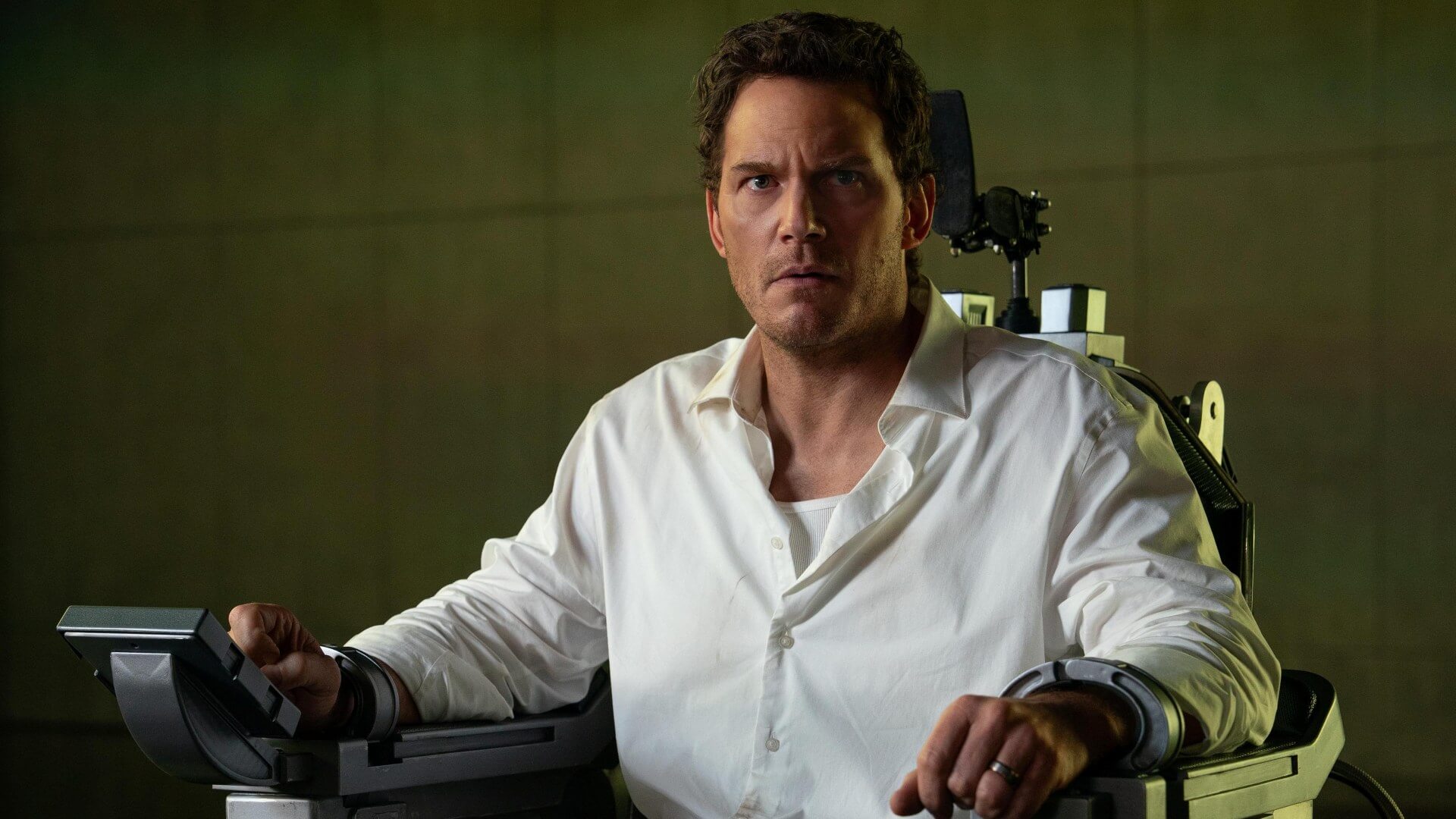
As in Minority Report, the movie Mercy most ineptly and shamelessly imitates, that hero is someone who previously championed the technology now holding him in its grip: Detective Chris Raven (Chris Pratt), whose surname only exacerbates the sense that we’re watching something like a video game. Raven wakes up as the procedure begins, surprised to learn that he’s on trial for the murder of his wife Nicole (Annabelle Wallis). Classic-movie fans may recognize this as a variation on the “blackout noir,” where a crime picture depends on at least one character suffering some manner of memory lapse. Despite their recent history of marital problems, Raven insists that he didn’t kill his wife, as the placid face of A.I. justice called Judge Maddox (Rebecca Ferguson) essentially gives him the Sam Gerard treatment from The Fugitive: I don’t care (unless you can present hard evidence within the prescribed timeframe).
So Mercy proceeds as a screenlife noir where we’re not strictly confined to the frame of the screen, but instead identify with a character who is confined more or less within one, as various case files, protected data, surveillance footage, and video calls pop up in front of and around him, at his command. (Raven is strapped into a metal chair, but given enough leeway to steer the graphics from his seat.) Even in IMAX 3D, which seems ideal for these effects, Bekmambetov fails to generate much visual interest from the information overload. He seems to have a great advantage in Ferguson’s looming face, but by design she’s forced to tamp down her charisma for an omnisciently nothing role.
It doesn’t help that Pratt scarcely comes across as any less synthetic. Through a punishing decade-along process of brand triangulation and franchise work, Pratt seems nearly incapable of delivering anything resembling spontaneity or hidden dimension. Tasked with playing a darker, grittier character than usual, Pratt gives a broadly telegraphed, subtext-free performance straight out of a cheesy wronged-cop thriller, obliterating any noirish tones in favor of pure plot-twisty hokum. Also, it’s a minor point in the scheme of things, but when trying to sell Pratt as a weary alcoholic cop credibly accused of murdering his wife, it’s probably a miscalculation to include Jay Jackson—literally the actor who played Perd Hapley on Parks And Recreation—as the fake news anchor of choice, nudging the movie ever-so-slightly closer to becoming The Trial Of Burt Macklin.
Mercy avoids the stylistic fudges and staggering tedium of War Of The Worlds; it does move pretty quickly, even with the possible pitfall of an oft-onscreen counter telling the audience exactly how much time remains before Raven must solve the murder. What lingers after that time is up, though, is how thoughtless the entire enterprise feels as it waffles between depicting A.I. as a nightmarish instrument of state oppression and shrugging it off as just another tool that needs to be used with proper care. At their best, screenlife movies have a way of faking verisimilitude within potentially far-fetched thrillers, finding ways to depict moments of quiet intrigue that might otherwise not fit into a go-go-go narrative. Mercy takes a more bombastic approach with more speculative technology, only to chicken out of using that bombast to do anything other than jostle the audience through a series of contrived absurdities. If this is the future of crime thrillers, everyone needs their screentime severely curtailed.
Director: Timur Bekmambetov
Writer: Marco van Belle
Starring: Chris Pratt, Rebecca Ferguson, Kali Reis, Kyle Rogers, Annabelle Wallis
Release Date: January 23, 2026


 Keep scrolling for more great stories.