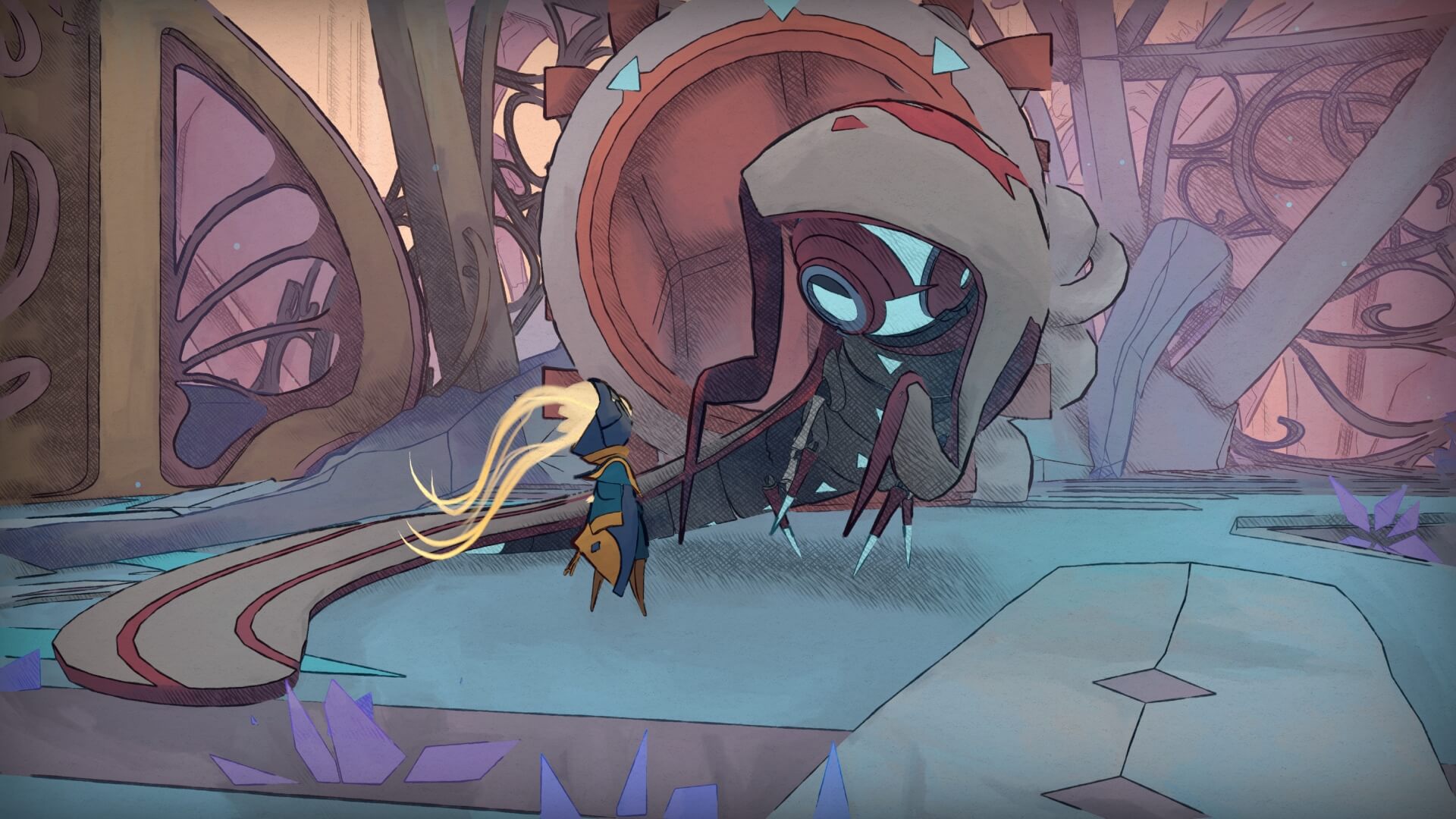
In MIO: Memories In Orbit, only the machines are left. These aren’t Terminator-esque monstrosities, but robots built to help humanity on an interstellar journey to a new home. The humans, whom the robots call Travellers, are long gone. The system that governs The Vessel—a network of AI clusters known as Pearls, with their own specific functions and personalities—are flickering out. And MIO, an android designed to support and defend the Pearls, has to figure out why they’re powering down, and do whatever they can to preserve The Vessel. It might seem like a lot to ask of a small robot, but MIO and their four cybernetic tentacles are up for the task.
Escaping the Earth is in vogue. Last week The A.V. Club reviewed another game set on a cosmic ark, Code: Violet, which is about as different from MIO as a game could be. Last month we looked at Interstellar Arc, an interactive VR exhibit in Las Vegas about a future mission to an Earth-like planet lightyears away. Looking at this world we’ve created, it’s not hard to see why this idea is popular right now. Ecological disaster, endless violence, a widespread lack of empathy, the global rise of fascism and authoritarianism… who wouldn’t want to fuck off to space these days?
MIO is unique for this trend in that it barely factors humanity into its equation. We’re just gone—cosmic toast before the title screen even hits. We’re not even drifting through space in a diabetic coma, like in the bad second half of WALL-E. Our fingerprints remain visible throughout, scattered remnants of whatever human culture launched this ship, but the memories in the title aren’t even entirely about us. MIO is deeply in debt to Metroid in a myriad of ways, but here the defunct civilization barely visible on the game’s fringes is our own.
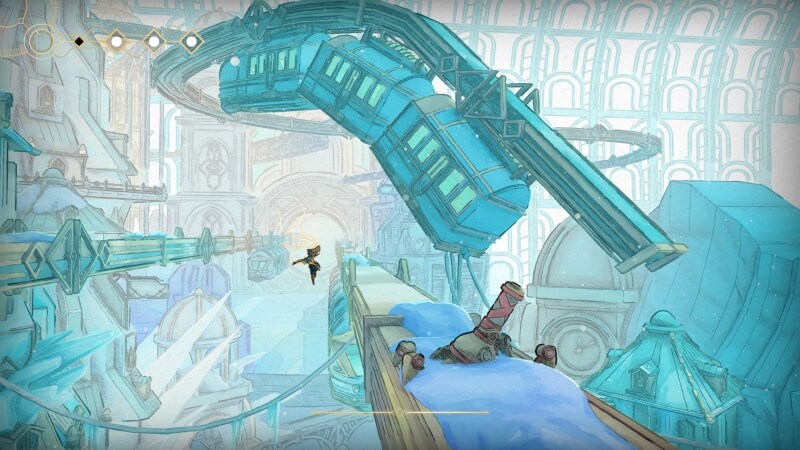
MIO doesn’t foreground that widescale loss. It’s not even clear at first if humans ever played a role here at all. Details about how The Vessel reached this state slowly unspool throughout the game, but are revealed environmentally, or through short bits of text on public plaques. It’s not even clear how long we’ve been dead or how the ship came to be abandoned, but it’s clearly been ages; vegetation runs wild through certain sectors, others are frozen over with thick layers of ice, machinery is all busted or haywire, and almost half The Vessel is flooded with a deadly liquid. Sounds like the kind of obstacles you’d find in a video game, doesn’t it?
MIO is a fairly traditional side-scrolling search action game in a few key ways. Its assortment of physical obstacles and aggressive enemies have direct parallels back to the lava and deadly critters of the original Metroid. MIO acquires crucial new skills after major milestones, unlocking areas they’ve known about but couldn’t access. MIO doesn’t shoot, but the reach of their tentacles lets them attack from a slight distance, like the short range of Samus’ arm cannon before she upgrades it.
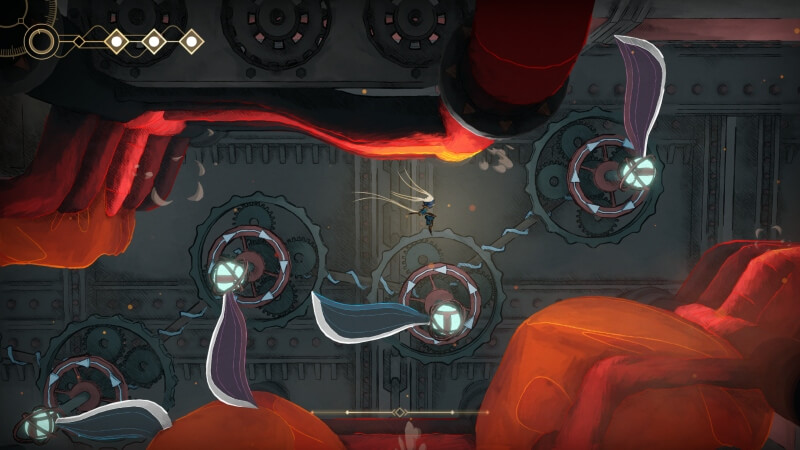
MIO’s action establishes its own distinctive rhythm through its fluid, expansive range of motion. Most of the abilities you’ll unlock are movement-based. Initially limited to a double jump, MIO will eventually be able to float, fling themselves by grappling onto certain nodes, scurry across walls and roofs like a spider, and more. All these abilities tap into the same small reserve of energy which is only restored in two ways: by standing still on solid ground for a beat, or by striking an enemy or one of a handful of other sources of energy. A good chunk of the game is trying to move through treacherous territory by keeping MIO airborne, bouncing off enemies or energy-restoring flowers without touching the deadly turf that surrounds them. You basically have to become a master juggler, using MIO’s skills to keep them in the air until they finally reach a safe spot. You’ll need crack reflexes, a good memory, and an almost endless reservoir of patience to make it through the game’s trickiest platforming sequences, of which there are many. It can be deeply frustrating to hurl yourself at the same long, intricate passage again and again, dying with the slightest misjudged jump and restarting over from the very first step; when you do make it through one of those sections, though, it feels like a genuine, pump-your-fist-in-the-air triumph. That reliance on airborne maneuvers and clockwork precision can be found in many of the game’s boss battles, too.
Despite its obvious love of Metroid, MIO is a game of its time, fully aware of Hollow Knight’s massive impact. It runs at a fast pace, MIO can only take a few hits before dying, there’s a currency that’s lost whenever they do die, and there are a number of optional, equippable modifiers that can be found or bought that boost MIO’s defense or offense. Team Cherry’s most obvious inspiration is difficulty, though: MIO’s boss battles are brutal. Most of them are rapid-fire chaos, with a large variety of attacks that are cycled through randomly and require instant recognition to avoid, and invariably a second phase where everything gets faster and more complex. If you enjoy this genre for its sense of exploration and discovery, and aren’t particularly adept at split-second action, these battles (of which there are many) will serve as frequent brick walls to your progress.
Fortunately MIO offers a few options that help moderate that challenge. In the settings you can pick a “pacifist” mode where none of the regular enemies attack you first—although that won’t help with the boss battles, which, outside of some long and complicated platforming sections, are the only extremely tough moments in the game. There’s also an option that will grant MIO a one-hit shield if they stand still on the ground for five seconds. That’s also not particularly useful in a boss battle, as you’ll constantly be on the move in all of them. The most genuinely useful one of these accessibility options is also guaranteed to be the most controversial. You can choose to “erode” the bosses over time, marginally weakening them every time they kill you. With that option on, boss battles become a form of endurance test: throw yourself at them over and over, and inevitably they’ll get so weak that you’ll finally beat them. It’s an option that certain types of player will dismiss out of hand, but without it many who would appreciate MIO’s world and general aesthetic would no doubt drop out of it at the very first boss.
That would be a shame, because that world and aesthetic are fantastic. Evoking the intricate details, subdued colors, and surreal flourishes of comic artist Moebius, MIO looks like a Euro sci-fi comic come to life. It even uses various sequential art techniques for dramatic effect like comic artists would, crowding out certain spaces with extreme detail to create a sense of claustrophobia or entrapment, or blanching other areas and leaving backgrounds unsketched to emphasize the foreground action. And although its story deals in some familiar sci-fi concepts, it’s approached from a different angle than you’d expect from American creators; the developers at French studio Douze Dixièmes clearly hold cultural influences and inspirations not shared by American studios, visible not just in the game’s art but in its understated focus on the emotional impacts of this mechanized system losing its sole reason for existing.
Search action, as it’s known in Japan, is a crowded field. For a game to break through it has to be not just good, but unique. It has to marry smart, proficient design with a legitimately interesting and distinctive story and aesthetic. It’s a high bar and MIO: Memories In Orbit sails right over it. There are no humans in its sci-fi, but sci-fi is rarely this human—the hands of its designers rarely this evident in a game.
MIO: Memories In Orbit was developed by Douze Dixièmes and published by Focus Entertainment. Our review is based on the PlayStation 5 version. It’s also available for PC, Switch 2, Switch, and Xbox Series X|S.


 Keep scrolling for more great stories.