Gleb’s professional position is pivotal to the story of Minotaur even if, at first, it seems like he’s just another cog in the machine. When the time comes for favors, the deal is a two-way between the mayor and the man who’s ensuring that goods continue flowing into the town not far from the Ukrainian border. This protection of class comes with other benefits, but also the possibility of abuse—something Gleb also takes advantage of. As long as he keeps doing this job, the local government will pave the way for him to continue trucking along, no matter what accusations rise up against him. Like any thorough despot, Gleb also makes sure to get rid of anyone who could blackmail him in return. Even the mild-mannered businessman can be moved to drastic action in this newly heightened, kill-or-be-killed, wartime regime.
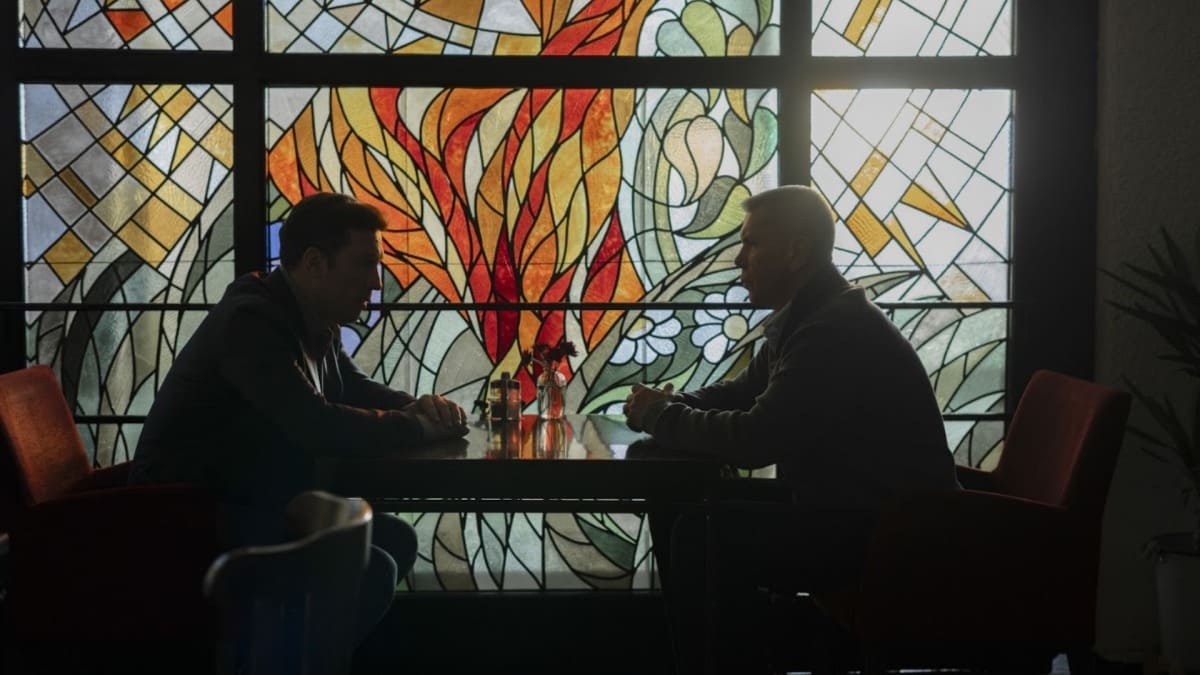
Zvyagintsev is also an expert at establishing the tension between Gleb and Galina, who, from the very first moments of the film, look uncomfortable with each other. As Gleb is walking his mother out to a car after dinner, he returns to find Galina on the phone. When she sees him back inside the house, her smile vanishes before she quickly ends the call; she thought she was alone. Their troubled relationship is directly inspired by Chabrol’s film, yet it feels organic in Zvyagintsev’s attempt to critique an oligarch’s abuse of power. For most of Minotaur, there’s a dark and broody quality to the scenes between husband and wife, turning their home into a sleek bunker trapping two unhappy people under the same roof. Through cinematographer Mikhail Krichman’s lens, Galina is a film noir femme fatale, seemingly provoking her husband to do something, anything, to let her know that he still cares for her at all. Zvyagintsev and Krichman give the film a chilly air, darkened by shadows and lit by a crisp gray light to illustrate the time of crisis. These are punctuated by a few interestingly colorful moments, like when Gleb asks for his wife to be followed under the kaleidoscopic glare of stained glass windows, an almost holy setting for a most unholy request. The filmmakers also play up the cavernous layout of their family home, using spatial distance to enhance the couple’s crumbling relationship. When the couple makes an uneasy alliance and they fall into each other’s arms, it’s shone in a tragic light, a complete surrender to each other. They have destroyed each other in this process.
As Gleb, Dmitriy Mazurov plays the role almost like a doomed Stephen Rea. He just can’t seem to escape the cloud he’s under ever since the mayor gave his character the grim assignment to send his men to war and his suspicions about his wife were confirmed. Ironically, Mazurov is also tasked with some of the film’s darkly comic moments, like when Gleb is awkwardly trying to clean the bloody floor of Anton’s apartment or bumbling around trying to hide his secret misdeed from a cop that seems to be following him. Mazurov doesn’t play it for laughs, but keeps his performance somber, almost internally cursing under his breath so only the audience can hear. As Galina, Iris Lebedeva moves through Minotaur like a sphinx, keeping her own secrets locked behind an inscrutable expression and wearing her melancholic air like a perfume. Her eyes, however, betray her, and when her secret world falls apart, so does her character, and Lebedeva levels the role with palpable heartbreak.
With Minotaur, Zvyagintsev uses the old Chabrol tale to condemn Russia’s abuses against its neighbor. He finds parallels in how comfortable oligarchs have been weaponized to feed the front, showing the harrowing result of Gleb’s decisions around who to send to war in a tearful scene of families sending off their sons, fathers, and husbands on buses, shipping out to make a sacrifice they did not choose. As children cry and mothers wail, a priest in the distance signs the cross as the buses roll away. Their patriotic reward is to become disposable heroes while the upper class continue living out their lives, playing petty games with few consequences.
Director: Andrey Zvyagintsev
Writer: Andrey Zvyagintsev, Simon Lyashenko
Starring: Dmitriy Mazurov, Iris Lebedeva, Boris Kudrin, Yuriy Zavalnyouk
Release Date: November 20, 2026


 Keep scrolling for more great stories.