Even here, though, my mother’s and my tastes diverged. My mom has always adored the stories of Christie’s own favorite, Miss Jane Marple, who combined an understanding of soft power and social currents with the sharpest deductive mind in tiny British village St. Mary Mead. I was drawn more to the masterful Belgian, Hercule Poirot. (Why I, a 12-year-old grades obsessive who collected more glowing report cards than friends in middle school, would feel compelled by a character once described by his own author as a “detestable, bombastic, tiresome, ego-centric little creep,” is left as a mystery for the ages.)
The thrill of Christie, though, is that you never have to enjoy her alone. The queen of the parlor scene understood that a good detective story is as much a game as it is a literary endeavor, filling her books with obvious moments where you can stick a finger in a page, close the book, and tell (to pick an example at random) your mom at the dinner table (where you’ve been ignoring all prior attempts at civil conversation with your nose stuck in a library book) what you think Poirot is about to reveal. Sure, I was almost always wrong with these youthful deductions—Christie mostly plays fair, on average, but that doesn’t mean she’s going to be out-thought on the regular by the 11th-ranked GPA at Otter Creek Middle School. But there was still a joy to be felt in connecting with my mom about our shared love of the solve—especially because it helped bridge a gap that had always existed between us.
I’ve always loved games, obsessively. The activity, the existence of goals, the simple ability to put my focus somewhere both specific and profoundly unimportant, have always been soothing for a brain that itches when presented with what it insists on labeling as “unstructured socializing.” (The only time I ever flirted with inheriting my father’s taste for the bottle, it feels worth noting, was when I discovered the existence of drinking games in college. At last, a way to get some rules, structure, and punishment into all this free-form debauchery!) My mom, meanwhile, has never seen the appeal, in part because any game is also an opportunity to fail; opting in to a completely unnecessary invitation to let people down was as anathema to her as small talk has always been to me. But the game of mystery-solving was something we could both connect with; you might not wind up getting it right, after all, but Marple or Poirot would always be there to pick up the slack.
TV helped, too. A&E’s addiction to Law And Order reruns was a godsend in the Hughes household, where the stresses of long working hours, my barely functioning teenage personality, and my dad’s flitting in and out of our lives as the dictates of rehab stints and DUI arrests demanded could all be subsumed into far-less-fractious arguments about a suspect’s guilt or the relative merits of ADAs Ben Stone and Jack McCoy. (No such debates need happen on the cop side of the show’s criminal justice divide, of course; Jerry Orbach’s Lennie Briscoe reigned supreme.) Looking back now, I can see how murder, for two people each working through their own versions of a nature-and-nurture-linked anxiety disorder, could become something precious: A series of consequence-free problems with clear, rational, and logical decisions to arrive at. The arc of the moral universe in Terre Haute, IN, may not have felt like it bent much toward justice in 1997, but in the world of convoluted killings, things made a lot more sense.
My mom’s in her 70s now, and still living in Indiana—a worrisome 2,000-plus miles from my current Portland, OR, home. When we visit a few times a year, she and I drive my wife crazy by going hog-wild on death, bingeing whatever low-rent detective series Netflix or Hulu have scraped up from Harlan Coben’s recycling bin or some Christie-light tales of the rich and famous. (Mom hates the way Nicole Kidman has infiltrated these spaces, by the way; we spent fully half of Netflix’s The Perfect Couple talking about how irritating she finds the Aussie star’s modern-day face.) Conversation is minimal, but heavy on “Okay, so it’s got to be her,” or “Why would he say that, if he wasn’t secretly setting things up?” Our hit rate on finding culprits has gotten a little higher, which either speaks to more than a century of combined sleuthing experience, or maybe just that modern murder plots have gotten dumber. These are long days of “nothing,” “wasted” on watching the base mechanics of killing from the couch for hours on end; they are some of the most precious memories of my life.
Even when we’re not on vacation, murder has helped bring us together. About three years ago—at a time when I had started to think more seriously about how to put care and attention into those small handful of relationships that really matter to me—I started setting up weekly standing dates with mom to play mystery video games together online. Most Sundays now, right after lunch I fire up the PlayStation and use its built-in screen-sharing technology to stream detective games directly to her iPad, tackling the controls as we talk through the cases of Sherlock Holmes and, yes, Hercule Poirot. (There are no Miss Marple games out there, to the best of my knowledge, possibly because the vast majority of video game designers skew more toward my particular personality disorders than mom’s.)
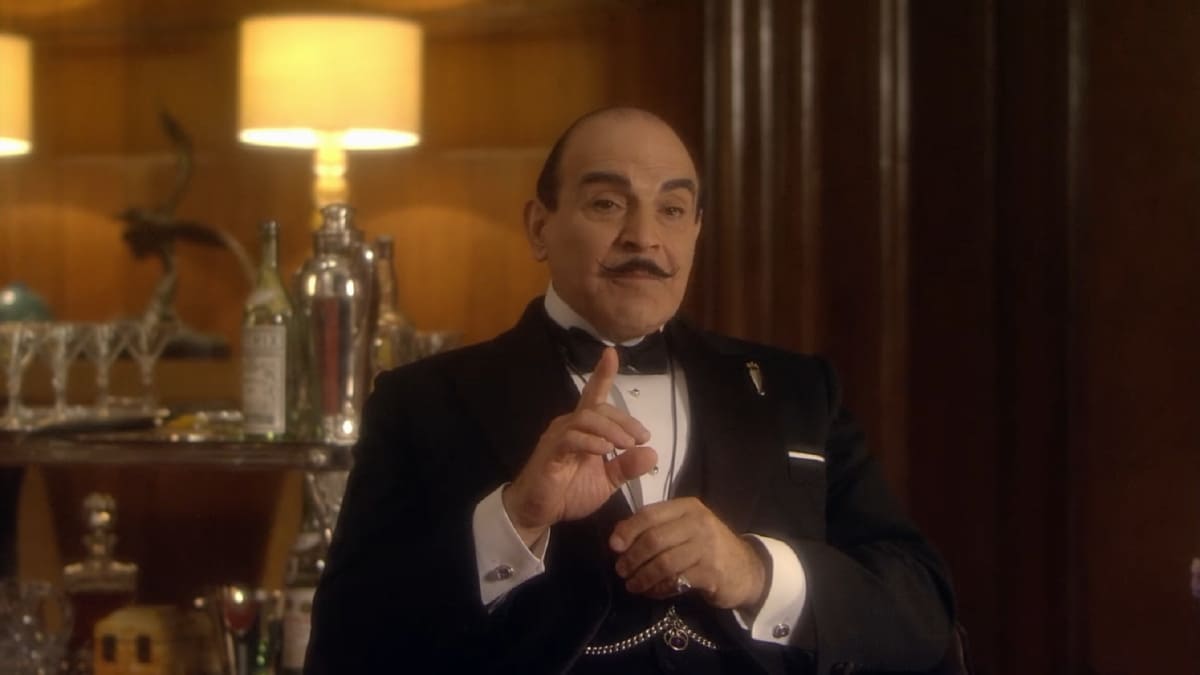
I handle all the walking around and annoying bits—because, god, but even really good modern detective games love throwing a stupid stock puzzle at you every 15 minutes—and we collaborate on the actual mystery-solving, arguing about what particular pieces of evidence could portend. Even with games based on novels we both know backwards and forwards—like Microids’ recent, heavily expanded adaptations of Christie’s Murder On The Orient Express and Death On The Nile—there’s still fun to be had, whether it’s complaining about how the voice performers simply can’t live up to The One True Poirot—Poirot TV series actor David Suchet—or wondering how designers are going to mix up familiar stories and pad them out.
The mystery isn’t really the important part, after all, even as we laugh about the silliness of some of these more absurd schemes. (The sheer amount of convolution and red herrings that go into something like the recent, and mostly excellent, The Mermaid Mask, which we played through together shortly after its release, is a feature of the genre, not a bug.) It’s just as much about the communal feeling of working on a problem together—or hearing my mom, who defied her small-town roots to become the most experienced world traveler I know in her 40s and 50s, talking about how video game depictions of the Nile or Florence compare to her real-world journeys. When it comes to the problems at hand, we’re wrong as often as we’re right, each prone to leading the other down dead-ends and blind alleys of faulty logic, as family members inevitably do. It doesn’t really matter, though; the murder will still be waiting for us when we get back to it. And for my mom and me, murder has always felt like home.


 Keep scrolling for more great stories.