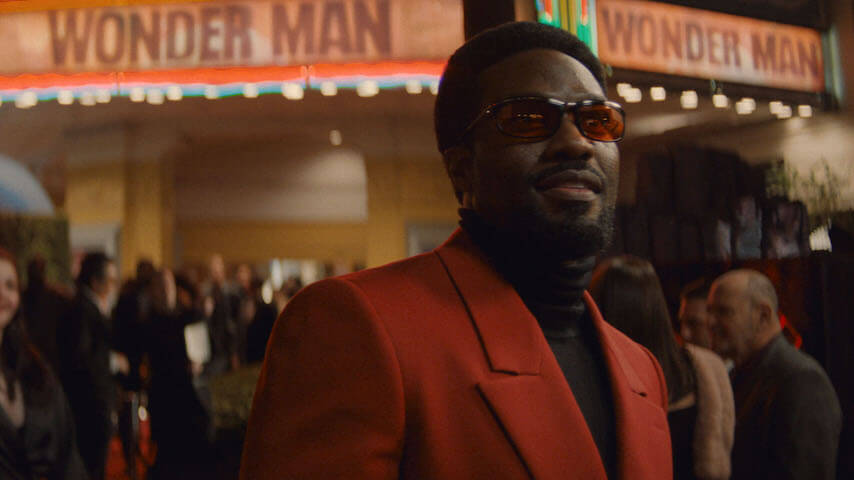
Halfway through Wonder Man‘s premiere, director Van Kovak (Zlatko Burić) poses the question, “What can we find when we look at Wonder Man today? What can he teach us about ourselves?” It’s an admittedly grandiose way to explain why he’s breathing new life into a familiar superhero story by remaking a 1980s movie. Van Kovak claims his take will be “human and spectacular” (how original!), but in all sincerity, co-creators Daniel Destin Cretton (Shang-Chi And The Legend Of The Ten Rings) and Andrew Guest (Community) seem to have taken a similar approach with their Disney+ series. What is it about their version of Simon Williams (Yahya Abdul-Mateen II) that makes him valuable to the franchise at a time when it’s grasping at straws to regain its pre-Endgame glory?
The answer lies in the fact that he largely isn’t vital to the ongoing Multiverse Saga, and the show doesn’t do anything to set up the upcoming Avengers: Doomsday either. Simon mainly provides an invigorating—some might even call it human—viewpoint into an imposing universe of heroes, villains, mutants, and whatnot. And that’s despite his own super strength, among other powers, which he doesn’t bring up because they’re a hindrance to his career. The show focuses on his personal dilemmas, complicated family dynamics, and professional journey instead of tipping over into broader franchise management or what role Simon might play in the future. Being free of these tie-ins allows Cretton and Guest to develop Simon as a person first and a superhero second (if at all). Unlike previous shows like The Falcon And The Winter Soldier, Loki, Hawkeye, and Ms. Marvel—which felt like essential viewing to contextualize Captain Marvel, Thunderbolts*, and Brave New World—Wonder Man comes off as more self-contained. And yet, it fills in some amusing gaps along the way.
For starters, Wonder Man reveals that superheroes in the MCU can’t turn to Hollywood for work, not that Bucky Barnes or Wanda Maximoff were looking for extra gigs. However, the Doorman Clause is a huge challenge for Simon, who is forced to conceal his real self to pursue his acting ambitions. But what is this surprising clause? Episode four, which is presented entirely in black and white, unpacks how Los Angeles nightclub bouncer DeMarr Davis (Byron Bowers) gained the ability to phase through objects, ended up befriending Josh Gad, and later accidentally trapped him in another dimension while filming a scene for his movie. Gad’s disappearance led to a rule that superpowered beings can’t be professional actors, which sucks for our guy Simon. The smaller stakes in “Doorman” are a departure from the other Disney+ MCU shows and get at Wonder Man‘s (comparatively) freestanding appeal.
But the show also has meta pop-culture nods, like a poster of Butch Cassidy And The Sundance Kid in Simon’s room (the film’s star, Robert Redford, played Alexander Pierce in The Winter Soldier). Simon’s ex-girlfriend mentions she got a part in Severance. (Tramell Tillman from the show is set to appear in the next Spider-Man film.) And Simon gets a guest role on American Horror Story. (Lest we forget, Black Panther‘s Angela Bassett and WandaVision‘s Evan Peters have been on Ryan Murphy’s long-running horror drama.) All of this to say: Wonder Man is having fun by letting audiences in on the joke.
Throughout the show’s eight half-hour episodes, Simon doesn’t care to nurture his ionic abilities so that he may one day go on world-saving adventures, a goal that Hawkeye‘s Kate Bishop and Ms. Marvel‘s Kamala Khan both had. His only concern is to nab his dream role in Kovak’s film. He doesn’t even suit up as Wonder Man until the finale, and even then, he’s fitting into a costume for the movie. This isn’t an origin story like Ironheart, nor is it a post-Blip tale like WandaVision or Falcon And The Winter Soldier. Best of all, there’s no CGI-fueled, messy action sequence to end the show. And unlike She-Hulk‘s Jennifer Walters (who happens to be Hulk’s cousin) or Echo‘s Maya Lopez (who seeks revenge on Daredevil‘s Kingpin), Simon has no missions or friendships in the MCU.
Well, he makes one connection by becoming fast friends with Trevor Slattery (Ben Kingsley), who debuted in 2013’s Iron Man 3 as the Mandarin, only to later admit he was hired to play the part of the terrorist. Trevor appeared in 2021’s Shang-Chi to assist the titular hero. Now, he’s back in L.A., hoping to secure the role of sidekick Barnaby in Van Kovak’s project. Wonder Man turns an amusing tertiary character into Simon’s unexpected BFF when the two join forces to audition together. But Trevor has a separate agenda: He’s been roped in by Department Of Damage Control’s Agent Cleary (Arian Moayed) to spy on Simon, so they can grab him before he uses his powers for destruction. Wonder Man‘s emotional conflict stems from whether Simon will find out his trusted mentor/pal is betraying him, how he might react, and if Trevor will switch sides to help him.
Abdul-Mateen II and Kingsley share such warm camaraderie that it doesn’t take long to care about this duo’s fate. Wonder Man puts a new spin on a familiar world, as A Knight Of The Seven Kingdoms does for Westeros. That HBO series’ emotional core lies in Dunk and Egg’s brotherly bond and not political chess games (despite the Targaryen involvement). Marvel has tried to switch to such focused plots under its Spotlight banner, but more so than Echo and Ironheart, Wonder Man acts as a neat reminder of how early MCU offerings like Captain America: The First Avenger charted a similar path with Steve Rogers (Chris Evans) and Bucky (Sebastian Stan). It’s why their Winter Soldier reunion remains one of the film’s strongest moments. But in the past few years, Phases Four and Five have mostly been devoted to setting up the next big battle and bringing back fallen favorites. In comparison, Wonder Man‘s relatively ordinary journey is refreshing because it dares not to worry too much about the rest of the franchise.
Saloni Gajjar is The A.V. Club‘s TV critic.


 Keep scrolling for more great stories.