Designer Dani Garcia has made a big splash since his first game was published in 2023, making a name for himself with some heavy, two-hour games like Barcelona, Windmill Valley, and Daitoshi. Neko Syndicate is his lightest game to date, but packs a chunk of that big-box energy into a smaller and simpler design, making for a quick-playing experience that still offers some of the satisfaction of engine-building and tableau-building.
In Neko Syndicate, players play as sushi-smuggling cats, playing cards to their personal tableaux to eventually build a ten-card “city” in a pyramid shape, with 1-2-3-4 cards in rows from top to bottom. Each card has two neighborhoods on it, two actions in its lower corners, and sushi orders on the top. Over the course of 15 rounds, players will use those actions by moving their meeple down through their city from top to bottom, invoking one action per card, to move sushi cubes from their warehouse to that neighborhood, deliver them across cards one neighborhood at a time or via the subway system, and collect new cards to build out their cities. Actions become more powerful if they’re lower down in your tableau; most actions are multiplied by the row they’re on, so an action on a card in the fourth row can be used four times, such as four moves of sushi cubes across the city, or four transfers from the warehouse to the city.
Every player starts the game with a Boss card that forms the first row of their city, with a unique sushi order on top and the same two actions on the bottom: draw three new city cards and discard two, or add a city card to your tableau. On each turn, you will start your cat meeple here, taking one of those two actions, and then move down to the left or right to another card (once you’ve played one there), taking one of its two actions, and so on, until you reach the bottom row of your city. One of the many keys to playing Neko Syndicate well is selecting and placing your cards so that you have enough variety in your choices of actions, and so that you set up paths for your meeple that make sense and allow you to maximize what you can do on each turn. For example, you don’t want a delivery action somewhere in your city where you’re likely to reach that card with no undelivered cubes out there, because that action has no value in that situation.
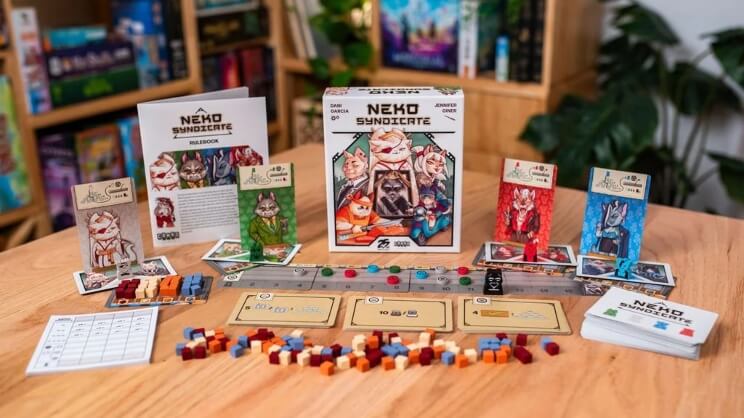
Each player begins with 32 sushi cubes in their warehouse, eight each in the four colors (those are specific types of fish, but as long as none of them is escolar I don’t care), and will have to move them from the warehouse to neighborhoods using card actions. Some cards show a specific color of cube, and you take a number of cubes matching that card’s row in your tableau, placing them in the bottom neighborhood of that card. Other cards have a swap action, allowing you to take cubes from your tableau and return them to your warehouse for cubes of any other color(s). It’s hard to get all four of the former type of action since you’ll only have nine cards in your city after the Boss one, so having that swap action in your tableau somewhere you’ll be able to invoke it is also critical.
The scoring gets a little wonky, although the game’s scorepad does break it down clearly enough that you aren’t forced to carry a lot of math in your head. There are three public objective cards in each game, and the sooner you complete one of them the more points it’s worth. You also score your tableau row by row, with the top row now worth the most and the bottom row the least. You gain one point for each cube placed on a delivery slot in this row, and gain points for completed cards if you have any that show that particular bonus. Then you lose two points for any cubes in that row that weren’t delivered anywhere, two points for any cards with no delivered cubes, and two points for any empty place in the city where you didn’t place a card. Add/subtract those five figures and multiply them by the row’s weight—4x for the top row, down to 1x (no multiplier) for the bottom row. So that’s seven different numbers you’ll have on your sheet: one for each row in your city, and one for each public objective.
The one downside to Neko Syndicate is that it is a multiplayer solitaire game. There’s no real interaction among players, no competition for resources or cards, just who can score the most points with their tableaux and reach the three public objectives the fastest. Nothing your opponents do matters to you, and there’s nothing you can do to stop or slow them down. That makes it a good solo game in its way; the game comes with solo rules where you build a tableau out of the cards you discard and come up with a score for a fake opponent, but I don’t think that’s necessary. Just try to score as many points as you can without taking that extra step.
Neko Syndicate would get an A from me if it had some sort of player interaction, because everything else is right in my wheelhouse: It’s puzzly and challenging, it activates different parts of my gaming brain, and it’s concise. You can play a multiplayer game in under a half hour, and you can play it solo in probably 10 minutes once you get the rhythm. It’s even in a fairly small box, smaller than my two favorites in the “heavy game in a small box” department, The Red Cathedral and The White Castle. (Those are also from Spanish designers. I think I need to go visit.) Aside from the mathiness of the final scoring, it’s pretty accessible, too, and offers good replay value. Granted, I already liked sushi, and cats, so maybe this was too easy, but I think Neko Syndicate is a gem.


 Keep scrolling for more great stories.