It would be ridiculously unfair to stack Phil Cairney’s HBO docuseries The Pet Cemetery Murders: A Ghost Story against the work of the Oscar-winning documentary filmmaker Errol Morris. The Pet Cemetery Murders isn’t trying to be bold or innovative. If you’ve watched A Killer Story or Murder In Glitterball City or any one of the dozens of true-crime docs streaming now on HBO Max, you’ll know what to expect from Cairney’s series. We’ve got a sordid old murder in an unglamorous corner of America—the 1985 killing of a rural Louisiana pet cemetery owner, in this case—explained via archival news footage and talking heads, and peppered with enough twists to keep an audience hooked through three episodes.
Still… the combination of pet cemeteries and murder can’t help but call to mind two of Morris’ masterpieces. The 1978 doc Gates Of Heaven is a quirky and soulful look into the state of the American Dream, as seen from the perspective of various Californians who work in the pet cemetery business. Ten years later, Morris’ The Thin Blue Line told a true-crime story that questioned how the justice system constructs narratives, with Morris using interviews and re-creations to show the audience how a possibly innocent man was railroaded. The movies are enthralling and visually inventive, and have continued to influence other documentary filmmakers for decades.
The Pet Cemetery Murders isn’t that daring, in either its style or scope. But Cairney does have a fascinating story to tell. And he has a sharp angle on it. Sometimes that’s enough.
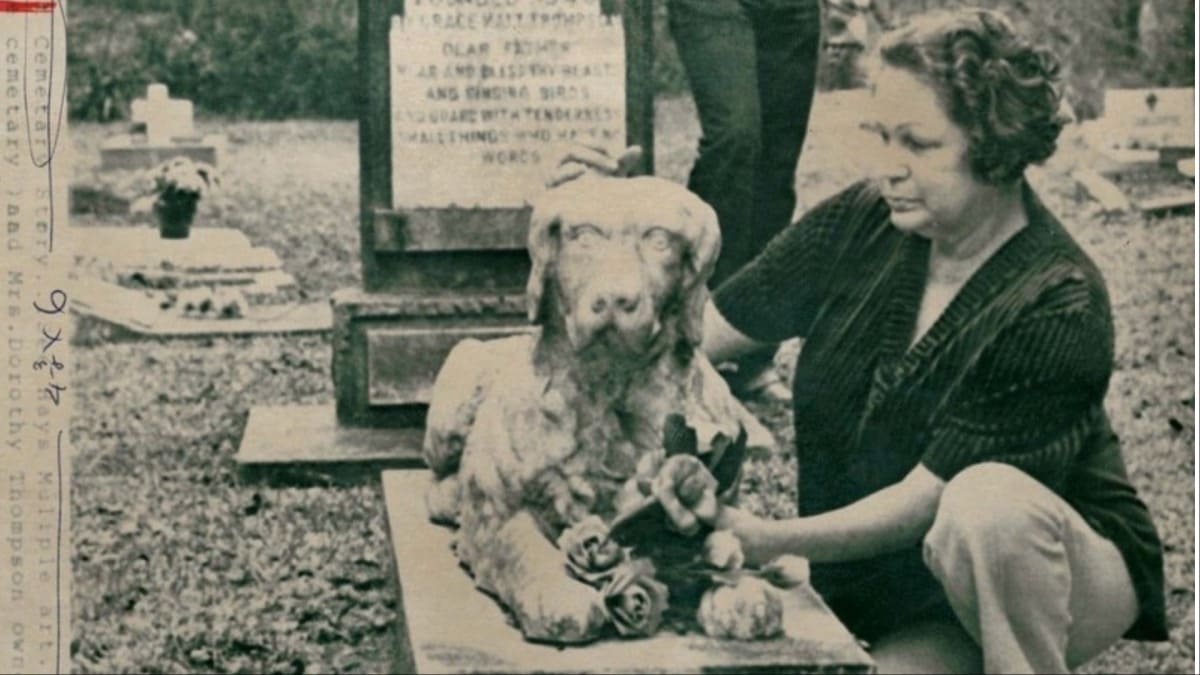
The series digs up the strange case of Dorothy Lou Thompson, who owned and operated a pet cemetery in Toca, LA, a region of St. Bernard Parish not far from New Orleans. It’s an area described in the series as “the end of the country,” where the main waterways empty into the ocean via bayous and marshes. There are no sandy beaches. There are no resort towns or rich tourists. There’s just water and muck—and centuries of malfeasance.
In 1985, Thompson’s corpse was found in the Mississippi River, bound in chains. At the time, the investigation turned up very few strong leads. Thompson had led a hard life, suffering through multiple bad romantic relationships and struggles with addiction. She didn’t have many friends, and while her property had some value, she was hardly leaving a fortune behind for any homicidal heirs she might have.
Yet rumors persisted around St. Bernard. The locals had long-suspected that Thompson may have been squirreling money away inside her cemetery’s tiny graves. Could her caretaker have killed her and dug up that loot? Were her nosy neighbors to blame? How about the executrix of her will? And was there any connection to Thompson’s murder and the highly suspicious deaths of two of her husbands?
One of the reasons why so many true-crime documentaries focus on long-forgotten or not-that-well-known murders is so the story can maintain some surprise. So while it wouldn’t take too much Googling to find out who was ultimately arrested and charged with killing Thompson, it’s probably best to leave that detail unspoiled here, so that the tale can unfold as intended. Suffice to say that Cairney’s interviewees directly accuse the chief suspect in episode two of The Pet Cemetery Murders, and that a lot of episode three is concerned with whether or not this person will get away with it.
Anyway, solving a murder is only part of what Cairney’s documentary is about. He and his team also consider why it took over 25 years to convict someone for killing Thompson. Astute viewers may also wonder why the title of this series appends A Ghost Story—and why Murders is plural.
The Ghost Story element is one of the doc’s main selling points. Another big rumor about Thompson’s pet cemetery is that it’s haunted—or, at the least, that Toca’s bayous are full of restless spirits. At the end of this series’ first episode, Cairney drops an unusual tidbit from 2009, when a man came to the St. Bernard police to say he’d been visited by Thompson’s ghost. As it turns out, this “witness” isn’t the only person who told the cops that Thompson was visiting people from beyond the grave, demanding justice.
As for why it took until the 21st century for this cold case to warm up, there are multiple mundane reasons, ranging from a lack of resources to a lack of urgency. (As one lawyer puts it, this case had “terrible witnesses and an unsympathetic victim,” referring to the rumors that Thompson may have murdered her husbands.) Plus, just when some new investigators started employing DNA evidence techniques to try and narrow down the suspects, Hurricane Katrina hit and washed away much of what they’d been working with.
Cairney emphasizes the Louisana-ness of this story throughout—sometimes unintentionally, just by interviewing people with thick accents, and sometimes very intentionally, by giving nearly every shot some high-humidity haze. The Pet Cemetery Murders also includes several interludes to address the tragic history of Toca. According to this documentary, the region was named for a cruel slave-holding judge who helped facilitate the reconstruction-era “St. Bernard Massacre” of 35 freed Black people. Indigenous residents tell their own stories of how their ancestors were slaughtered and/or enslaved by plantation owners. One Indigenous interviewee mocks the idea that his people took vengeance by cursing this land, saying that any curse came from the mass murderers, not their victims.
And it’s here where it’s a shame that Cairney doesn’t have the creativity Morris showed with Gates Of Heaven and The Thin Blue Line. There’s a bigger picture that The Pet Cemetery Murders is trying to paint, which gets a little lost in the dogged devotion to the usual true-crime documentary tropes. (If there’s an interview in this film, you’d better believe that the subject will be staring slightly askance from the camera, while sitting in some location with a lot of local color, like a diner.) Cairney’s prior filmography is filled with highbrow documentaries about fine artists and musicians. He brings some of that scholarly staidness to this project.
Nevertheless, his point does come through. Similar to The Thin Blue Line (and to a lot of true-crime docs inspired by The Thin Blue Line), this series is partly about how murder cases are messy, and how they often become even harder to solve as the evidence piles up. This is because the two people who know the most about the crime—the perpetrator and the victim—aren’t talking. But it’s also because everyone’s personal story gets pretty weird the more you dig into it. Certainly the more the investigators learned about Dorothy Lou Thompson, the more mysterious her life became.
But The Pet Cemetery Murders is also very much about what people do know, and what they’ve done nothing about. There are (probably) no literal ghosts in St. Bernard. But there are plenty of dark shadows, cast by crimes dating back centuries. And there have always been whispers too: about who’s dangerous, and about what they’ve not-so-secretly done.


 Keep scrolling for more great stories.