
Artificial doesn’t pull punches in its scathingly comic look at OpenAI’s origins
Andrew Garfield plays Sam Altman as a manipulative Bond villain in Luca Guadagnino’s Silicon Valley dramedy.
Photo: Neon
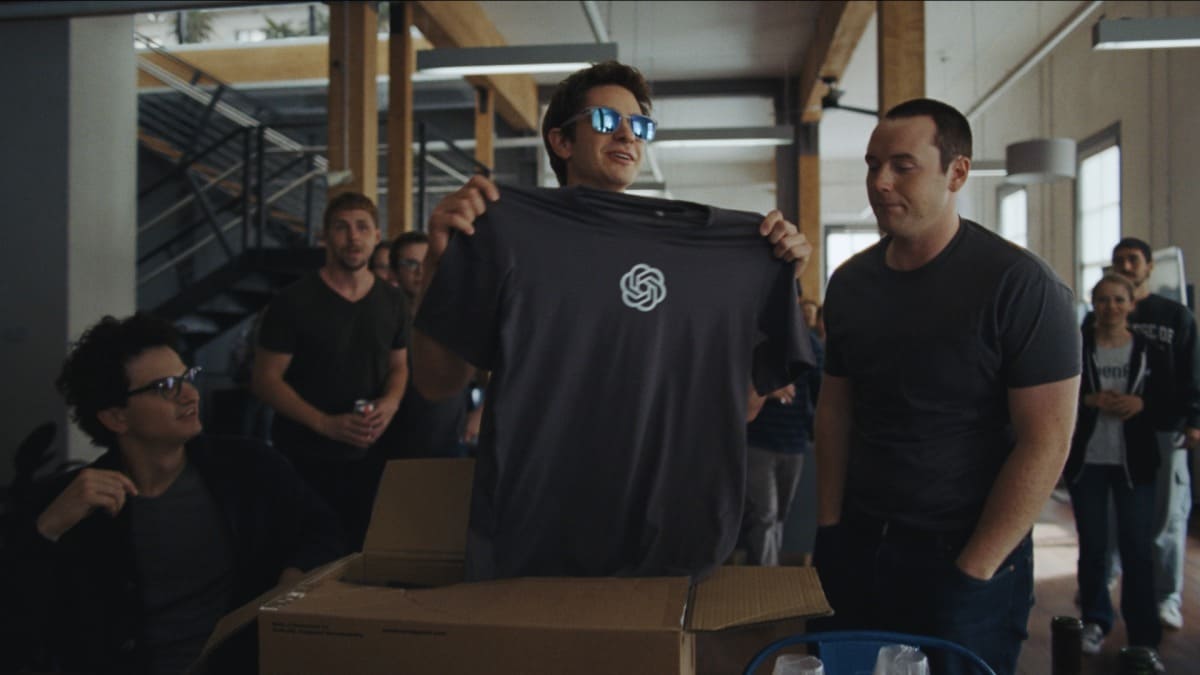
Sam Altman may be a relatively new figure to most of the public, but in tech circles, his story starts much earlier than when he opened Pandora’s Box and launched OpenAI to the world. In an industry that prizes speed and ingenuity, Altman seemed like he would fit in with the tech scions he partnered or competed with in the past. As audiences have come to learn through biopics like The Social Network or Steve Jobs, these stories are often much more complicated than the one man who becomes the face of a company. Luca Guadagnino’s film Artificial seeks to correct the record about one of tech’s newly minted stars and examine how the cult of personality that follows figures like Altman leads to both innovation and unintended consequences.
The heart of Artificial belongs to a solemn-faced Ilya Sutskever (Yura Borisov), a young genius in a field filled with very smart people and very fast talkers. His imagination is focused on computers that can think for themselves, and under the watchful gaze of his professor and later boss at Google, Geoffrey Hinton (Mark Rylance), his ambition is mostly kept in check out of concern that the power that Ilya dreams about needs to be deemed safe first. Feeling underappreciated at Google, he’s courted by enthusiastic hiker and hypeman Sam Altman (Andrew Garfield) and a skeptical Elon Musk (Ike Barinholtz) to work on a new startup that would become OpenAI. Altman soon pushes the company, originally built on a set of ethical ideals, to grow at the expense of its intentions, leaving Ilya in the uncomfortable position of standing up to his loudest supporter and risking the company’s future.
Despite the title of Artificial, the science behind the tech plays second fiddle to the human drama. Simon Rich’s script follows Ilya’s awkward journey into this space, first as an outsider whose theories and work seems a hundred years off, then as a guy who’s so painfully earnest, he can’t lie, even when his company’s future hangs in the balance. Guadagnino builds on these tensions with his actors’ performances, closing in on Garfield’s hand as Sam embraces Borisov’s misfit Ilya, welcoming him into the fold. Although Damon Albarn’s moody Nick Cave-lite score sounds more like a funeral dirge, it highlights the sense of foreboding running throughout the film, as if all the characters were sitting on top of a bomb that could explode at any moment.
Visually, Artificial is sleek and sometimes experimental, playing with subjects moving at different speeds or editing with sharp cuts to add even more electricity to the rapidly escalating chain of events, not unlike the quick edits in Guadagnino’s Challengers or his adaptation of Queer. There’s a running visual motif of the California sun streaming brightly into frame, forcing some of the characters, mostly Sam, to squint or shield their eyes. It’s as if Guadagnino and cinematographer Malik Hassan Sayeed are trying to throw a light on the backroom deals and emotional coaxing it took to manipulate people in the tech world.
 Keep scrolling for more great stories.