Here’s something to consider: All we ever really know about television characters is what their creators choose to show and tell us. So maybe it’s not fair of us to make snooty judgments about the choices they make—even though it’s only natural to do so.
In Pluribus, for example, we know a little bit about Carol Sturka’s tough childhood; but we also know that, as a successful author, she’s led a life of relative privilege. Conversely, we know almost nothing about Manousos Oviedo, except for where he’s from (Paraguay), what he did for a living (storage-unit manager), and his general attitude toward the alien takeover of humanity (extremely hostile). It’s fair to say that we are being led to assume that Carol has had an easier ride in life—and in her post-apocalypse—than Manousos has.
But is that assessment fair? I genuinely don’t know. I only know what I’ve been shown and told, which is just enough to find the contrast between their experiences incredibly funny—at least as they’re presented in this week’s perfectly titled episode, “The Gap.” It’s funny, that is, until—inevitably—a gloom descends.
Before I get into the finer details of this very fine episode, let’s take a moment to appreciate the level of craft that went into “The Gap.” Director Adam Bernstein and screenwriter Jenn Carroll are the credited creative team here, and they—along with the rest of the Pluribus crew—have adeptly handled a difficult challenge.
With the exception of two short monologues—both in Spanish—there’s not a lot of talking in this episode. Carol mutters to herself occasionally, sings to herself a lot, and places a few calls to the Joined. Manousos repeats phrases in English that he’s heard on language-lesson tapes. Otherwise, their stories are told almost entirely in images. All of the hallmarks of the Pluribus visual style—the exaggerated framing that makes the whole world feel out of whack, and the fleeting flashes of unsettling everyday horror—are put in service of delivering narrative.
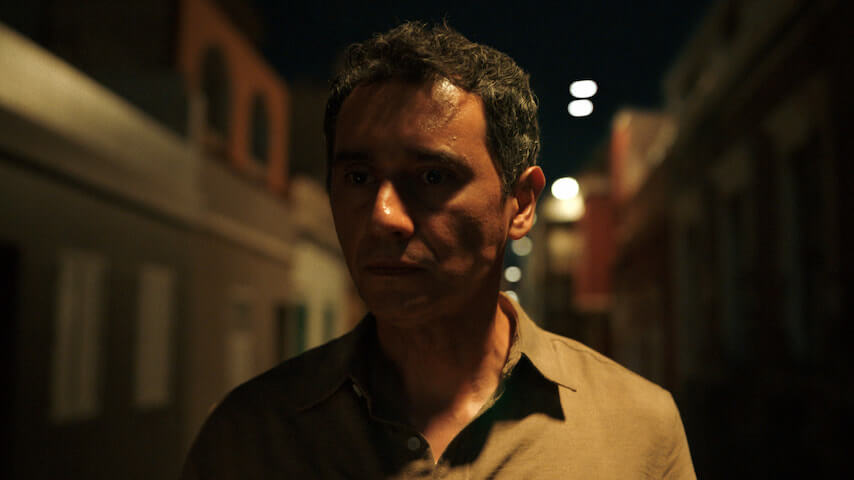
It’s two narratives, really. The more dramatic of the two—as well as the more visually stunning and exotic—is the one with Manousos. As I hinted at last week, Manousos’s apparent plan to travel to Albuquerque without the help of the Joined was bound to run into a snag once he hit the Darién Gap (the gap!). That stretch of land is infamously impassable. Sure enough…he can’t pass it.
In what amounts to an extended montage, we see him driving up through picturesque South America, siphoning gas along the way (and always leaving money behind to pay for it) and trying to ignore the occasional smiling hive-mind pods. He talks only to one guy, who is trying to warn him away from crossing the Darién, offering instead to transport him—and his car—to New Mexico quickly and safely. Manousos coolly tells the aliens they can’t give him what they don’t own. He considers them all to be thieves.
When Manousos hits the Gap, he burns his car, sets out on foot with his machete, and hacks his way through the wilderness. But, unsurprisingly, he eventually loses his footing on a loose rock, before falling backward into a spiky, bacteria-laden chunga palm. The Joined have to send in a rescue helicopter.
It doesn’t take long to summarize what happens to Manousos in this episode. That’s why it’s so impressive, the time and effort that went into shooting these scenes. We get a real sense of how long and how arduous this journey is for someone who stridently refuses the collective’s help. He has to collect rainwater in empty cans, because he won’t drink their water. He sleeps in churches. He catches fish in streams. He’s remarkably self-sufficient. Watching Manousos do his thing for the 20 or so minutes he’s onscreen this week is like watching a gripping survival drama compressed into a mini-epic.
Because Vince Gilligan has never been big on cutting restlessly back and forth between storylines and characters, the Manousos sequence is seen in full, flanked by two Carol sequences. In the first, beginning on Day 12, Carol drives back from Vegas and starts taking a new approach to bossing around the Joined—not desperately or indignantly, but instead kind of snottily. She goes on golf outings, visits a hot-springs resort, tours the Georgia O’Keeffe Museum, and demands gourmet meals. She never sees the collective, who still steer well clear of her. But they’re definitely helping to facilitate her self-indulgent spree.
The starkest example of the gap—the gap!—between Carol’s and Manousos’ experiences comes early in the episode, when she stops at a gas station and realizes that all of the snacks and drinks have been removed. She calls for a Gatorade (“the red kind… ice cold… real sugar”) and scratches off some lottery tickets while waiting for the telltale buzz of the delivery drone. She then calls back to complain that the Gatorade’s “tepid.”
One person gets impaled on spikes. The other endures a disappointing sports drink. Nobody knows the troubles they’ve seen.
After the Manousos sequence, we return to Carol on Day 48. Initially, she seems to be living the same life of solitary slackerhood. Before, we saw her drinking beer and setting off fireworks. She’s still doing all of that, and still working on her golf swing, too, rocketing balls from downtown rooftops into office building windows. (The wanton destruction, I have to admit, looks very cool.)
But in the gap—the gap!—in Carol’s life immediately post-Vegas and 36 days later, something has changed. She’s stopped singing, instead relying on a boom box and mix CDs for her soundtrack. And she doesn’t seem to be taking any pleasure in the decadence any more. In a scene legitimately as alarming as Manousos’s chunga wound, Carol notices that one of her firework tubes has toppled in such a way that it’s pointed directly at her. Rather than setting it upright, she faces it and waits.
The firework misses her, shooting past her head and torching a nearby house. But the incident seems to jar something within Carol. The next day she picks up a bucket of paint and writes “come back” in big white letters on her cul-de-sac’s pavement.
This sets up the moving conclusion to a wild episode, as Zosia drives up to Carol’s house and Carol collapses into her arms, sobbing. What struck me about this ending is how it turns the usually fun Pluribus game of “think along with Carol” on its head. It’s hard to know what’s going through her mind as she heads off to the hardware store. And because we don’t see her painted message until the very end, it’s hard to predict what she’s going to do when Zosia arrives. She approaches slowly, hesitantly…almost ominously. And then: tears.
I keep thinking about the O’Keeffe painting, Bella Donna, that Carol takes from the museum to replace the poster she has on her wall of that same piece. While she waits for Zosia, we see her staring at Bella Donna impassively. It’s easy to imagine her returning to that painting, day after day, using it as a kind of tether as the weight of loneliness begins to tug at her sanity.
Again: I don’t know. I don’t know Carol, really. I only know what I’ve been shown and told. Just enough to empathize, intensely.
Stray observations
- • After Manousos backs into the chunga palm, he cauterizes his wounds with a hot machete, while biting down on his belt. Has anything good ever happened to a movie or TV character who was biting down on a belt?
- • I’m not sure if we can read any particular deeper meaning into the English phrases Manousos repeats. (“To whom do the coats belong?” “The girl saves the mouse from the trap.”) But it is telling that his mantra while trudging through the Gap is, “My name is Manousos Oviedo. I am not one of them. I wish to save the world.” The man has a mission.
- • Another gap: Manousos drives a Midget, while Carol replaces her busted cop car with a Rolls-Royce. The Rolls has a personalized license plate that reads ACEBABY and a “Just Married” announcement soaped into the rear window…still present weeks later.
- • Carol sings many songs in this episode, including “Georgia” while at the O’Keeffe museum, “Hot In Herre” while swimming naked at the hot springs, and the Caddyshack classic “I’m All Right” while golfing. (Like anyone who has ever sung “I’m All Right” to themselves, Carol tries her best to do all the voices in the song.) The funniest bit of Carol karaoke though comes pre-credits, when she sings “It’s The End Of The World As We Know It (And I Feel Fine).” The scene cuts off before she can finish the phrase “and I feel f….”
Noel Murray is a contributor to The A.V. Club.


 Keep scrolling for more great stories.