
Remembering my nana through Coco
How Pixar’s latter-day masterpiece and its indelible music forged an even deeper family connection.
Image courtesy of Disney/Pixar
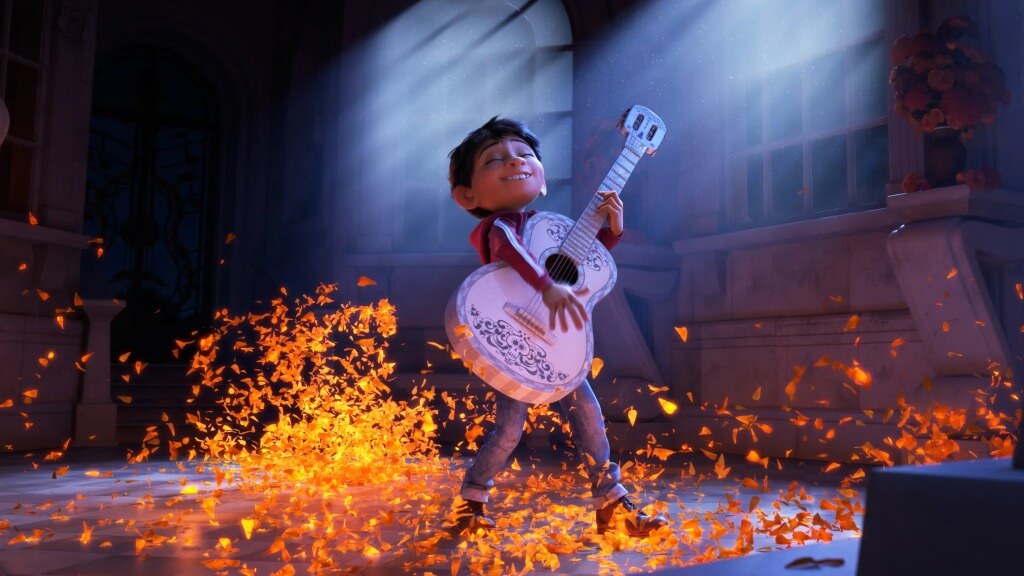
Her name was Genoveva Fonseca Ganaden, but I knew her as Nana. Born in Panama before later relocating to the United States, Nana was the matriarch of my maternal family line. Gatherings were invariably at Nana and Papa’s house, where reggaetón, salsa, and dembow, the music of her native country, would blast out of the speakers, and she and her sister would vanish only to reappear a minute later, dancing, with claves and maracas in tow. Music was an integral part of her life, and she encouraged my own musical journey. After I expressed interest in teaching myself the guitar by playing their worn-down 12-string, she and Papa surprised me with a brand-new electric. She attended my many performances and recitals for drums and piano; she had me play songs at their house with the electric guitar and laughably tiny Squire mini-amp they purchased for me; when I began writing my own original material and pressing CDs in high school, she’d pop my very first EP into their speaker system so I’d hear my own music echoing throughout the house any time I was over.
In 2017, Nana suffered an accident that incurred severe brain damage. She was in amazing health for her age, but a single fall took all of that away. An emergency vehicle transported her to an ICU, where she was in a coma for weeks, before then being shuffled through various nursing homes for the remaining five years of her life. This marked the first time I had to reckon with the possibility of a major familial death. Even though Nana would live until 2022, she would never be the lively, dancing, energetic force we once knew her as. She was forever changed, and that was a lot to process as someone who, fortunately, had yet to wrestle with grief so directly. Both of my parental bloodlines benefit from longevity. My paternal grandfather died before I was born, but my paternal grandmother just turned 91. The only drawback of this genetic durability was that I’d felt ill-prepared for such a moment, as if there’s really any way to prepare for something like this at all.
Mere months after Nana’s accident, Pixar released Coco. For those unfamiliar with this latter-day Pixar masterpiece, the film follows Miguel, whose strong ambitions as a young guitarist lead him on a journey through the Land of the Dead to find his idol and putative great-great-grandfather, Ernesto de la Cruz. His most popular song, and Miguel’s favorite, is “Remember Me,” which de la Cruz dedicates to his legions of adoring fans. But the movie draws its name from Miguel’s great-grandmother, colloquially known as Coco, the eldest living member of the family and the glue that unites them. Despite her ailing memory, Miguel tells her everything and nourishes a close bond with her, dressing her up in a luchador mask and showing off his single dimple for her. Their love transcended mortal barriers. Within the first 15 minutes of my initial viewing, I’d already begun drawing parallels between Coco and Nana, who retained the sweetness she displayed before her brain damage. Whereas many people with cognitive injuries undergo drastic shifts in personality, Nana’s disposition—prone to laughter, physical affection, and artistic expression—remained perfectly intact. What ultimately defined her proved unbreakable and everlasting.
During Miguel’s adventure, he meets Héctor, a Land of the Dead denizen and former bandmate of de la Cruz, who’s unable to cross the threshold to the living world because no one has displayed his photograph on their ofrenda, an altar that honors deceased loved ones for the traditional Mexican holiday Día de los Muertos. So, the duo strike a bargain: Héctor will take Miguel to meet his alleged great-great-grandfather and musical hero, and then Miguel will place his new friend’s photo on his family’s ofrenda. It’s a deal. Hijinks ensue, and we eventually arrive at de la Cruz’s house, where he’s throwing a self-aggrandizing party celebrating his legacy and prolific output. Spoilers for a nearly 10-year-old movie with an admittedly predictable twist: Shortly thereafter, the audience learns that Héctor, not de la Cruz, is actually Miguel’s great-great-grandfather. He’s also the one who wrote “Remember Me,” which he penned not for a fawning fandom but for his daughter, a toddler Coco, before he went away on tour. We then learn that, when Héctor had misgivings about the tour and wanted to back out, de la Cruz murdered him and stole all his songs for himself, profiting off a collaborator who now lay dead by his hand.
 Keep scrolling for more great stories.